
Building Smart Facilities with AI Video Analytics
The first employee arrives before sunrise. The building unlocks designated entrances, lighting adjusts automatically, cleaning teams complete overnight tasks, and delivery vehicles begin arriving at loading bays. By the time the workforce fills the facility, hundreds of operational events have already taken place. In many organizations, these activities occur independently, making it difficult to maintain a complete view of what is happening across the property.
Smart facilities are changing this model by connecting building operations with intelligent video analysis. Rather than treating cameras as isolated security devices, organizations are using AI Video Analytics to understand how facilities function throughout the day. The result is better operational awareness, faster decision-making, and more efficient use of people, spaces, and resources
Looking Beyond Traditional Building Security
Modern facilities generate thousands of visual events every hour. People move through entrances, meeting rooms reach capacity, vehicles enter loading zones, maintenance teams access equipment rooms, and deliveries arrive at different times.
Instead of reviewing footage after an issue occurs, AI continuously interprets these activities and identifies events that require attention.
Examples include:
- Occupancy monitoring
- Visitor movement analysis
- Queue detection
- Unauthorized access alerts
- Loading dock activity
- Emergency exit monitoring
- Workplace Safety observations
- Event Monitoring across multiple zones
This creates a facility that responds to operational conditions rather than simply recording them.
A Smarter Building Throughout the Day
Different parts of a facility require different types of intelligence.
Time of Day | AI Video Analytics in Action |
Early Morning | Verifies scheduled access and delivery arrivals |
Business Hours | Monitors occupancy, visitor movement, and shared spaces |
Peak Activity | Detects congestion and queue formation |
Maintenance Periods | Verifies authorized access to equipment rooms |
After Hours | Identifies unexpected movement and restricted-area access |
Instead of isolated alerts, facility teams receive a continuous picture of building performance.
How AI Supports Everyday Facility Operations
AI Video Analytics contributes to much more than physical security. It provides operational insights that help building managers optimize daily activities.
Common applications include:
Space Utilization
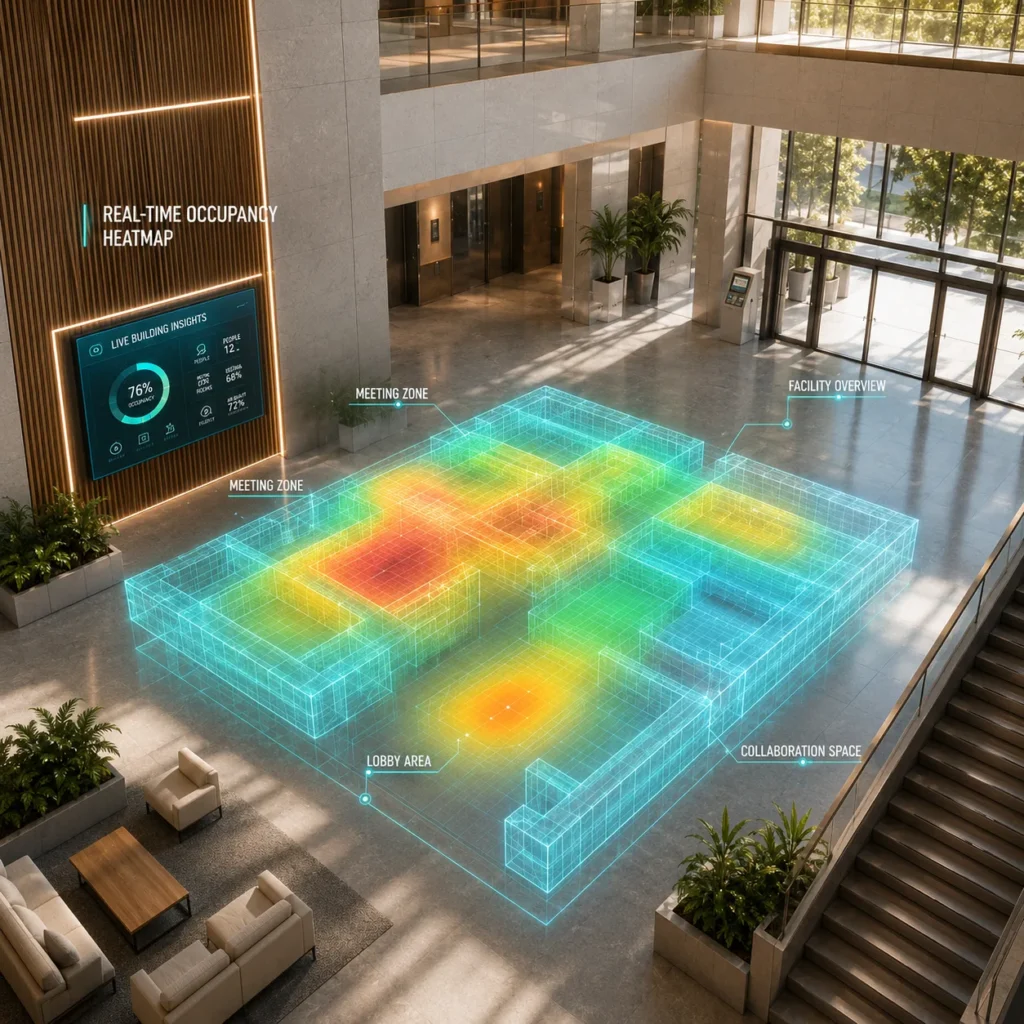
Computer Vision measures how offices, meeting rooms, common areas, and workspaces are used throughout the day, helping organizations improve space planning.
Occupancy Monitoring
Facility teams receive real-time visibility into crowd density, visitor flow, and building occupancy without relying on manual counting.
Access Verification
AI supports Compliance Monitoring by identifying unusual movement patterns, monitoring restricted areas, and validating authorized access.
Operational Coordination
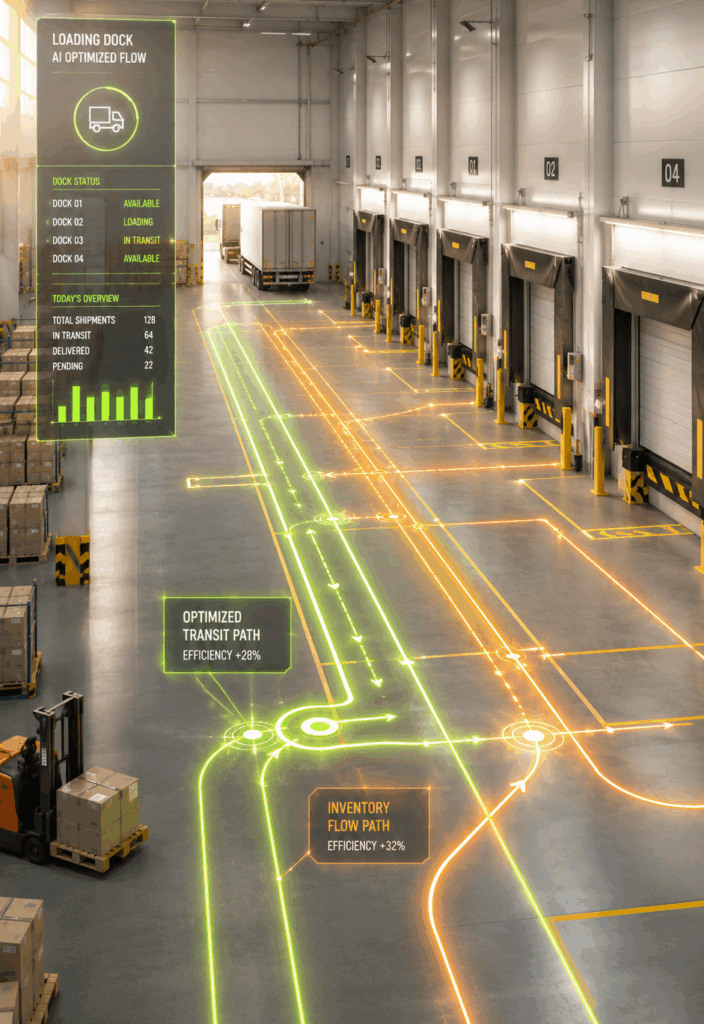
Loading bays, reception areas, parking facilities, and service entrances can all be monitored continuously, improving coordination between departments.
Workplace Safety
AI assists in identifying blocked exits, hazardous conditions, PPE compliance in operational areas, and other safety-related events that require immediate attention.
Connecting Multiple Facilities
Many enterprises operate dozens or even hundreds of locations. Managing each site independently often leads to inconsistent reporting and delayed responses.
With Enterprise AI, facility managers can oversee multiple properties through centralized AI Dashboards.
This enables teams to:
- Compare occupancy trends between sites.
- Identify recurring operational issues.
- Monitor facility performance in real time.
- Standardize operational procedures.
- Prioritize resources based on live conditions.
Centralized visibility helps organizations maintain consistency while supporting local decision-making.
Operational Benefits Beyond Security
Organizations investing in Intelligent Operations frequently experience improvements across several business functions.
Operational Goal | AI-Driven Outcome |
Better facility awareness | Continuous Operational Intelligence |
Faster response | Real-Time Analytics and automated alerts |
Reduced manual monitoring | AI Automation of routine observations |
Improved compliance | Continuous Compliance Monitoring |
Better space planning | Occupancy and utilization insights |
Smarter resource allocation | Data-driven operational decisions |
The greatest value comes from using video data as a source of business intelligence rather than simply evidence.
Planning a Smart Facility Strategy
Successful projects typically begin with operational priorities rather than technology selection.
A practical roadmap includes:
- Identifying operational pain points.
- Selecting high-impact facility workflows.
- Integrating AI Video Analytics with existing camera infrastructure.
- Deploying Edge AI for latency-sensitive areas.
- Monitoring results through centralized dashboards.
- Expanding deployments based on measurable outcomes.
This phased approach allows organizations to scale intelligently while minimizing operational disruption.
Designing Facilities That Learn and Adapt
Smart facilities are defined not by the number of cameras they contain, but by how effectively they use the information those cameras provide. AI Video Analytics enables organizations to transform everyday building activity into actionable insights that improve efficiency, safety, and operational performance. By combining Computer Vision, Edge AI, Operational Intelligence, and Real-Time Analytics, enterprises can create facilities that continuously adapt to changing conditions, helping teams make faster decisions and manage complex environments with greater confidence.
FAQ
What makes a facility "smart"?
A smart facility uses connected technologies such as AI Video Analytics, sensors, and intelligent software to improve operational visibility, automation, and decision-making.
Can AI Video Analytics work with existing security cameras?
Yes. Many AI platforms integrate with existing IP camera infrastructure, allowing organizations to enhance current systems without replacing all hardware.
Which facilities benefit the most from AI Video Analytics?
Corporate campuses, manufacturing plants, warehouses, hospitals, educational institutions, transportation hubs, retail centers, and commercial buildings commonly use AI-powered facility monitoring.
How does AI improve facility management?
AI automates routine monitoring, provides real-time operational insights, identifies anomalies, and helps managers optimize resources across multiple locations.
Does AI Video Analytics only improve security?
No. It also supports occupancy management, operational efficiency, compliance, visitor flow analysis, workplace safety, and long-term facility planning.