
Real-Time Event Detection Using Edge AI
A safety violation on a production line, an unauthorized person entering a restricted warehouse zone, or a vehicle moving in the wrong direction can become costly if detected too late. Many organizations still rely on centralized monitoring or manual review of surveillance footage, creating delays between an event occurring and corrective action being taken. In environments where every second matters, these delays can impact safety, productivity, and compliance.
Edge AI enables organizations to detect events directly where data is generated—at the camera or edge device—without waiting for information to travel to a central server. By combining AI Video Analytics, Computer Vision, and Real-Time Analytics, businesses can identify operational events instantly, reduce response times, and improve decision-making across distributed facilities.
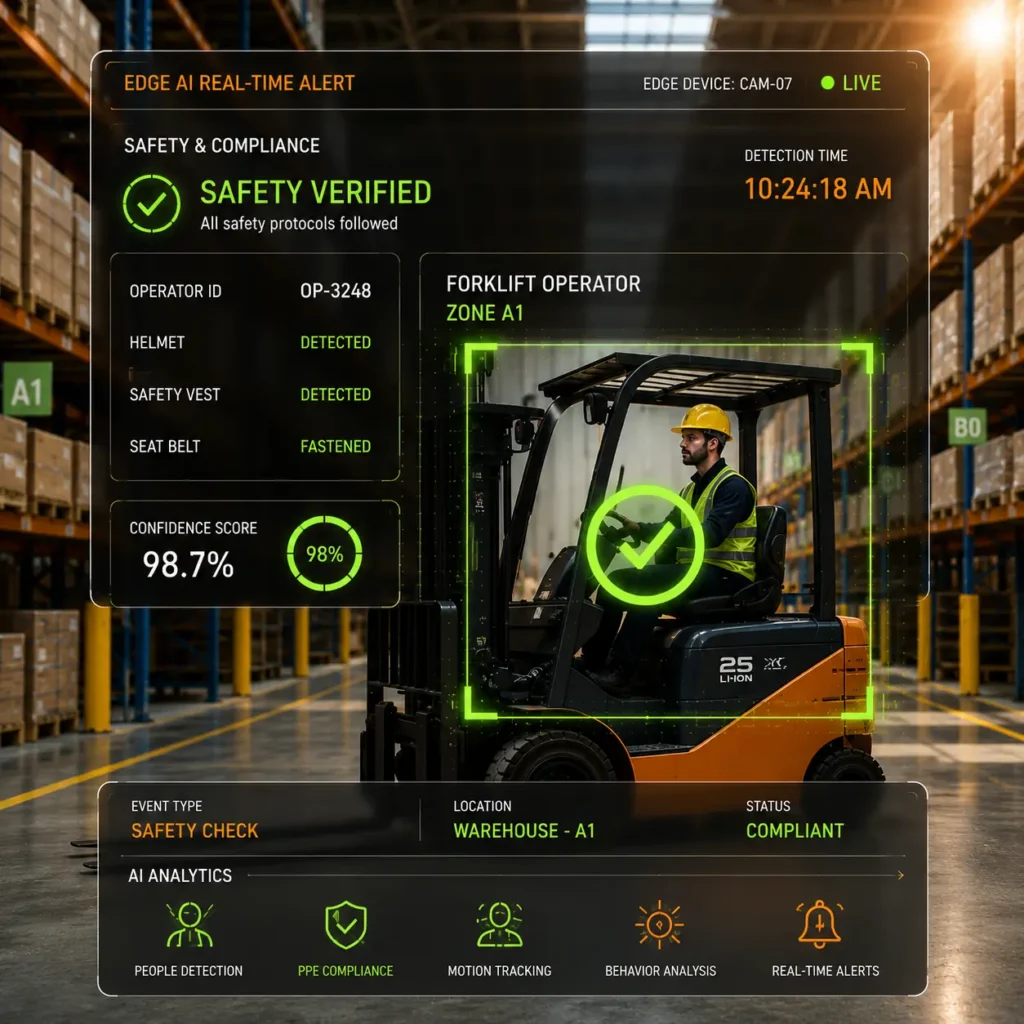
What Is Real-Time Event Detection Using Edge AI?
Real-Time Event Detection using Edge AI refers to processing live video streams on devices located close to the data source rather than sending every video frame to the cloud or a centralized data center.
Instead of simply recording footage, Edge AI continuously analyzes live video to identify predefined events such as:
- Unauthorized access
- PPE compliance violations
- Restricted area intrusion
- Equipment abnormalities
- Fire and smoke indicators
- Vehicle movement violations
- SOP Monitoring deviations
- Workplace Safety incidents
Once an event is detected, alerts are generated immediately, enabling faster operational responses.
How Edge AI Detects Events
Edge AI combines intelligent cameras, embedded AI models, and Edge Analytics to process visual information locally.
Stage | Function |
Video Capture | Cameras collect live visual data. |
Local AI Processing | Edge AI analyzes images directly on the device. |
Event Recognition | Computer Vision identifies predefined events or anomalies. |
Instant Alert | Notifications are generated in real time. |
Operational Dashboard | AI Dashboards display live alerts, trends, and analytics. |
Because processing occurs locally, organizations reduce latency while maintaining continuous monitoring even when network connectivity is limited.
Why Edge AI Improves Event Detection
Edge AI has substantial operational advantages over cloud-only processing.
Cloud-Based Processing | Edge AI Processing |
Video sent to central server | Processing occurs near the camera |
Higher network usage | Lower bandwidth consumption |
Potential latency | Near real-time response |
Greater dependence on connectivity | Continues operating during network interruptions |
Centralized analysis | Distributed intelligent monitoring |
Facilities that need to react quickly to operational events may find this architecture especially useful.
Industry Applications
Manufacturing
Manufacturers use Industrial AI to detect machine stoppages, missing PPE, unsafe worker behavior, production bottlenecks, and equipment anomalies. Immediate alerts help reduce downtime while supporting Smart Manufacturing initiatives.
Warehousing and Logistics
Edge AI monitors forklift movement, loading dock activity, inventory handling, and restricted storage zones. Real-Time Analytics improve safety while providing better visibility into warehouse operations.
Retail
Retail organizations use AI Surveillance to identify queue congestion, after-hours access, shelf availability issues, and unusual customer behavior. Local processing enables rapid event detection without overwhelming network infrastructure.
Energy and Utilities
Power plants, substations, and utility facilities monitor restricted zones, equipment conditions, perimeter activity, and safety compliance using Edge AI to support continuous operations.
Transportation
Airports, logistics hubs, and transportation facilities use Computer Vision to monitor traffic flow, platform safety, unauthorized access, and vehicle movement while minimizing response times.
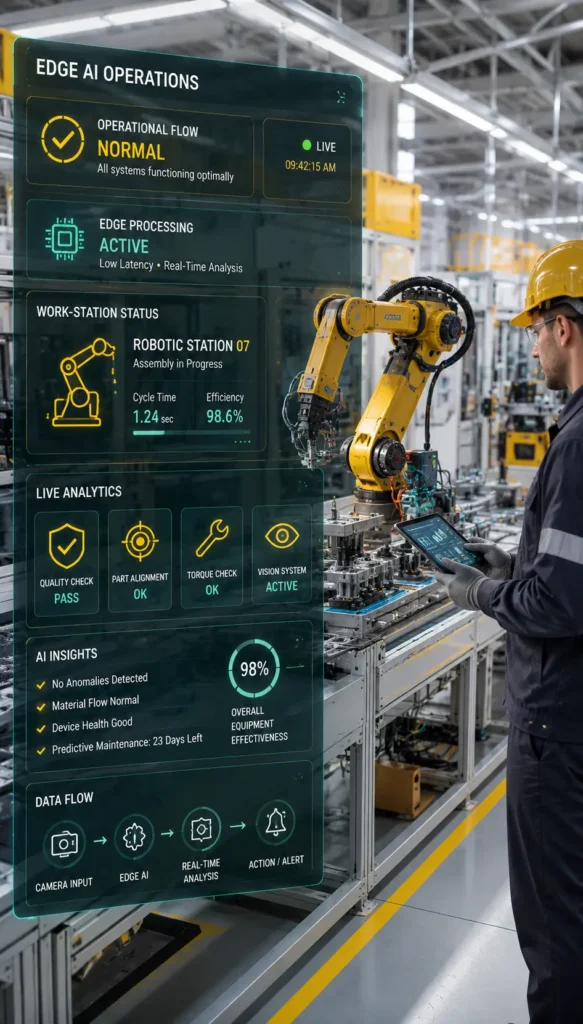
Business Benefits
Organizations implementing Edge AI for event detection can achieve measurable operational improvements.
Key benefits include:
- Faster incident response
- Reduced network bandwidth requirements
- Improved Compliance Monitoring
- Better Workplace Safety
- Lower manual monitoring effort
- Enhanced Operational Intelligence
- Greater system reliability
- Faster decision-making across multiple locations
These advantages help organizations improve both operational performance and resource utilization.
Best Practices for Deployment
To maximize the effectiveness of Edge AI, organizations should:
- Prioritize high-risk operational areas.
- Define clear event detection rules.
- Regularly update AI models for improved accuracy.
- Combine Edge Analytics with centralized reporting.
- Integrate alerts into existing operational workflows.
- Monitor AI performance using AI Dashboards.
- Continuously review false positives and optimize detection parameters.
A well-planned deployment ensures Edge AI delivers reliable, actionable insights while supporting existing business processes.
Enabling Faster Operational Decisions
As enterprises manage larger facilities and increasingly complex operations, immediate visibility becomes essential. Real-Time Event Detection using Edge AI transforms traditional monitoring into intelligent operational awareness by analyzing events where they occur. Combined with AI Video Analytics, Intelligent Operations, and Enterprise AI, Edge AI helps organizations reduce response times, improve safety, strengthen compliance, and make faster, data-driven decisions. By processing visual information locally, businesses gain scalable, resilient monitoring that supports modern operational excellence.
FAQ
What is Edge AI in video analytics?
Edge AI processes video directly on cameras or nearby devices, enabling real-time analysis without sending all footage to centralized servers.
Why does Edge AI process data more quickly than cloud-only processing?
Because analysis occurs locally, Edge AI minimizes network latency and generates alerts almost immediately after an event is detected.
Which sectors gain the most from Edge AI?
Manufacturing, warehousing, retail, healthcare, transportation, energy, construction, education, and smart city applications commonly use Edge AI for operational monitoring.
Does Edge AI replace cloud platforms?
No. Many organizations use a hybrid approach where Edge AI performs real-time detection while centralized platforms provide long-term analytics, reporting, and management.
What types of events can Edge AI detect?
Edge AI can identify safety violations, unauthorized access, equipment anomalies, restricted zone intrusions, vehicle movement, operational deviations, and compliance-related events in real time.