
Real-Time Intelligence Creates Faster Business Decisions
Business decisions are only as effective as the information behind them. In many organizations, managers still depend on periodic reports, manual inspections, and historical data to understand what is happening across operations. While these methods provide useful context, they often arrive after the opportunity to prevent an issue or improve a process has already passed.
Real-time intelligence changes this approach by continuously collecting, analyzing, and presenting operational insights as events occur. Powered by AI, Computer Vision, and Edge Analytics, organizations gain immediate visibility into their operations, enabling leaders to make informed decisions based on current conditions rather than outdated information.
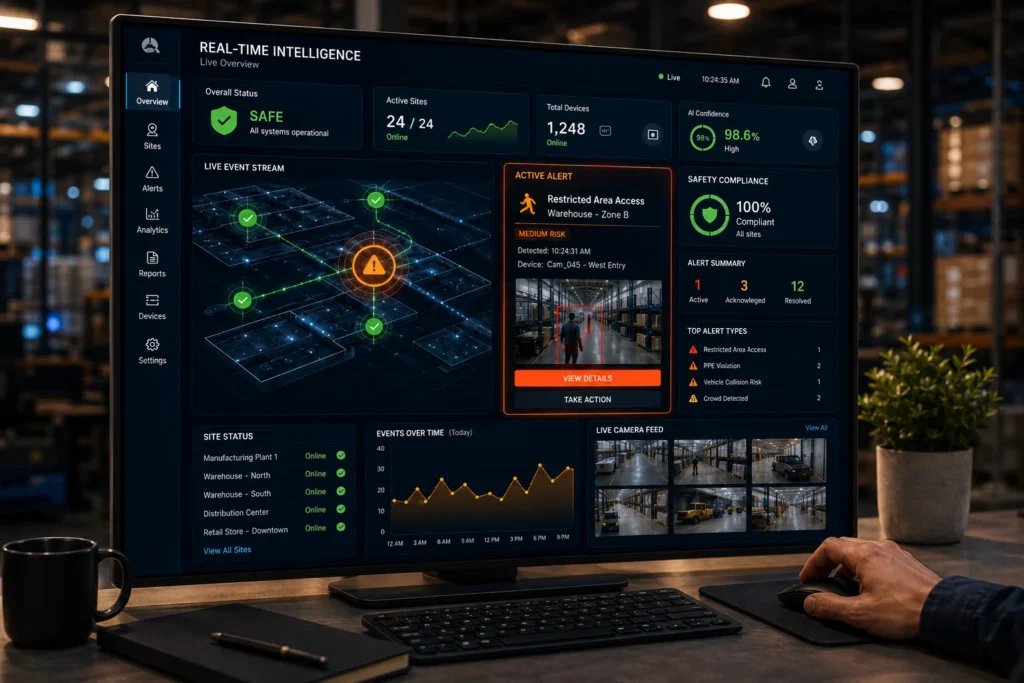
Decisions Improve When Information Arrives on Time
Operational environments change constantly. Equipment status, workforce movement, production throughput, inventory flow, and compliance conditions can vary from one minute to the next. Waiting for scheduled reports or manual updates creates delays that affect productivity and responsiveness.
With Real-Time Analytics, operational events are detected instantly, allowing supervisors and managers to respond before small issues become larger business challenges.
Examples include:
- Identifying production bottlenecks
- Detecting workplace safety risks
- Monitoring SOP compliance
- Tracking equipment utilization
- Managing warehouse traffic
- Observing customer activity in retail environments
- Verifying hygiene procedures in food processing facilities
Instead of reacting after an incident, businesses can take corrective action while operations continue.
Turning Operational Data Into Immediate Action
Modern enterprises generate information from multiple sources, including cameras, machines, sensors, and connected systems. Real-time intelligence brings these inputs together and transforms them into actionable insights.
A typical workflow includes:
Stage | AI Function | Business Outcome |
Capture | Collect live operational data | Continuous visibility |
Analyze | AI evaluates events in real time | Faster identification of issues |
Prioritize | Critical events are classified | Reduced information overload |
Notify | Alerts reach responsible teams instantly | Faster response |
Resolve | Teams take corrective action | Reduced operational disruption |
Learn | Historical trends support continuous improvement | Better long-term planning |
Rather than overwhelming teams with raw information, AI highlights what requires attention first.
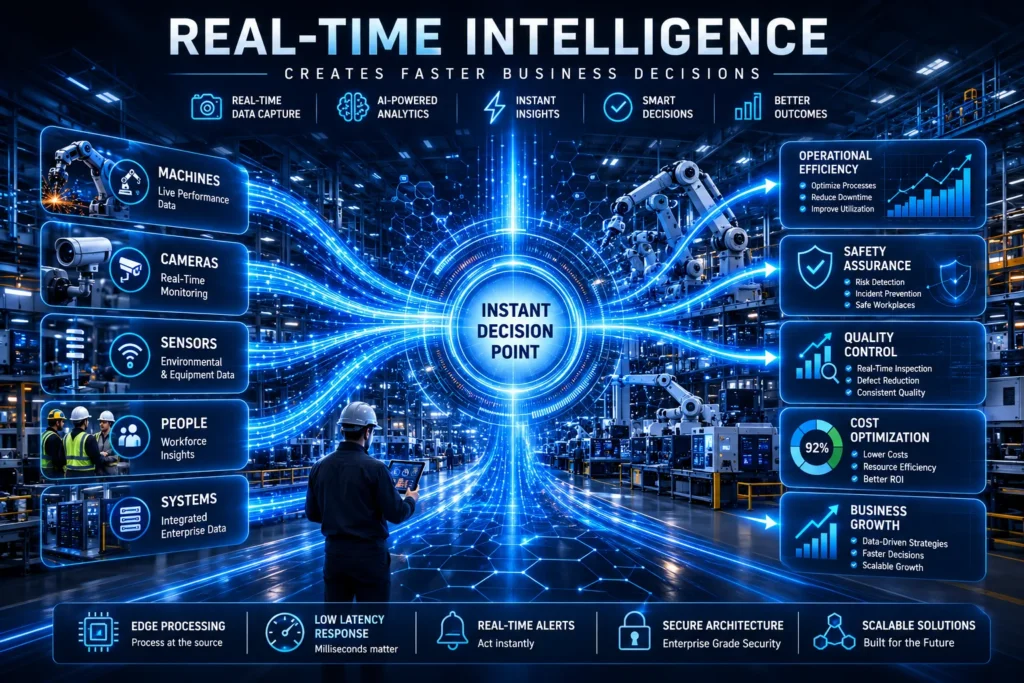
Reducing Delays in Everyday Operations
One of the greatest advantages of real-time intelligence is reducing the time between detection and response.
Instead of waiting for someone to notice an issue manually, AI can automatically identify operational events such as:
- PPE non-compliance
- Equipment anomalies
- Unauthorized access
- Workflow interruptions
- Safety zone violations
- Congestion in operational areas
- Process deviations
- Housekeeping concerns
By shortening response times, organizations improve both operational efficiency and Workplace Safety.
Where Real-Time Intelligence Delivers the Greatest Value
Every department benefits when decisions are based on live operational information rather than assumptions.
Business Area | Real-Time Intelligence Example |
Manufacturing | Monitor production flow and machine performance |
Warehousing | Track forklift movement and loading activities |
Retail | Measure customer traffic and queue conditions |
Healthcare | Verify compliance with operational protocols |
Food Processing | Monitor hygiene and sanitation procedures |
Corporate Facilities | Manage occupancy and restricted area access |
This continuous visibility helps organizations maintain consistent operational standards across multiple locations.
Supporting Better Decisions at Every Level
Real-time intelligence is valuable across the organization, from frontline supervisors to executive leadership.
Operational teams receive immediate alerts to resolve issues quickly.
Compliance managers gain continuous visibility into policy adherence.
Facility managers monitor multiple sites through centralized AI Dashboards.
Executives access Operational Intelligence that highlights enterprise-wide trends, helping prioritize investments and improve strategic planning.
Everyone works from the same trusted source of information, creating faster and more consistent decision-making.
Measuring Business Impact
Organizations implementing Enterprise AI and AI Automation often measure success through operational improvements such as:
- Faster incident response
- Improved compliance monitoring
- Reduced manual inspections
- Increased productivity
- Better workplace safety performance
- Lower operational downtime
- Improved resource utilization
- Greater visibility across multiple facilities
These measurable outcomes demonstrate how real-time intelligence contributes directly to stronger business performance.
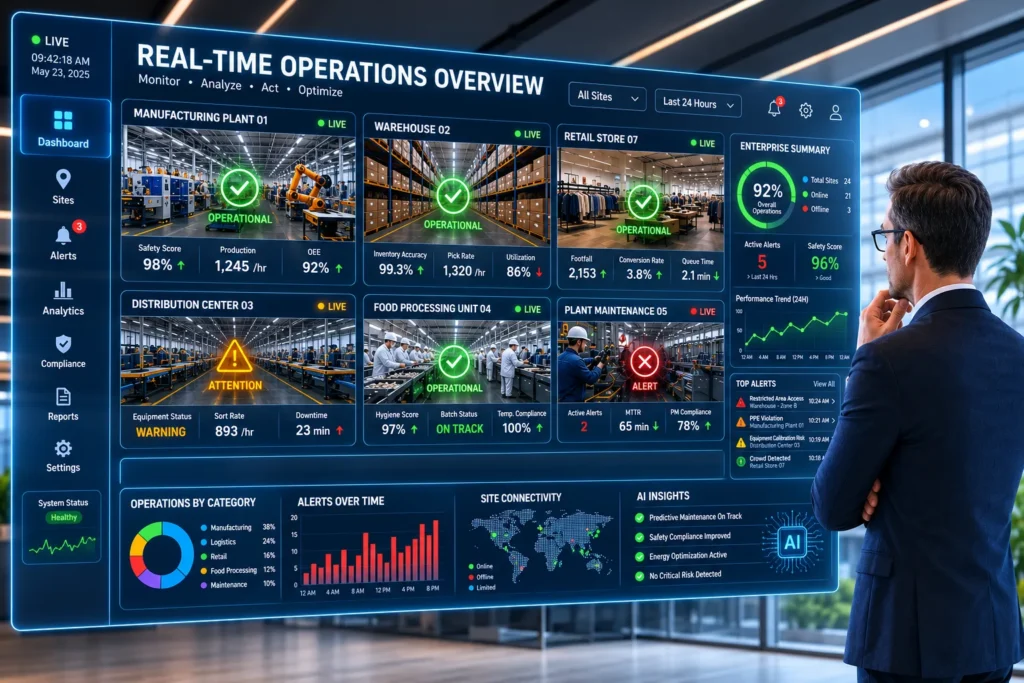
From Information to Immediate Decisions
Successful organizations are defined not only by the data they collect but by how quickly they act on it. Real-time intelligence transforms operational information into immediate business value by providing continuous visibility, faster responses, and more confident decision-making. As enterprises continue their Digital Transformation journey, combining AI, Operational Intelligence, Intelligent Operations, and Edge Analytics will enable businesses to become more agile, resilient, and prepared for the challenges of modern operations.
Frequently Asked Questions
What is real-time intelligence?
Real-time intelligence is the continuous collection and analysis of operational data, enabling organizations to make informed decisions as events occur.
How does AI support real-time decision-making?
AI analyzes live data, identifies important operational events, prioritizes risks, and delivers alerts that help teams respond immediately.
Which technologies enable real-time intelligence?
Common technologies include AI Video Analytics, Computer Vision, Edge AI, Edge Analytics, Real-Time Analytics, and AI Dashboards.
Can real-time intelligence work with existing camera systems?
Many AI platforms integrate with compatible IP camera infrastructure, allowing organizations to enhance existing monitoring systems without major replacements.
Which industries benefit from real-time intelligence?
Manufacturing, warehousing, logistics, retail, healthcare, food processing, construction, transportation, education, banking, hospitality, and energy sectors all benefit from faster operational insights.