
Modern Surveillance Must Deliver Business Intelligence
Organizations have invested in surveillance systems for years to improve security, investigate incidents, and protect assets. While these systems continue to serve those purposes, today’s business environment demands much more than recorded video. Enterprises need surveillance that delivers meaningful insights into daily operations, workplace safety, compliance, and process efficiency. Instead of reviewing footage after an incident occurs, businesses increasingly expect intelligent systems to identify issues in real time and support faster, data-driven decisions.
Moving Beyond Traditional Video Monitoring
Conventional surveillance systems primarily capture and store video for later reviewThis method frequently necessitates manual monitoring or drawn-out investigations, making it challenging to react swiftly when operational problems emerge.
Modern AI Video Analytics powered by Computer Vision transforms surveillance into a source of actionable information. Rather than simply recording events, intelligent systems continuously analyze video streams to detect unusual activities, monitor operational workflows, and generate alerts when predefined conditions are met.
This shift enables organizations to improve both security and business performance without increasing manual oversight.
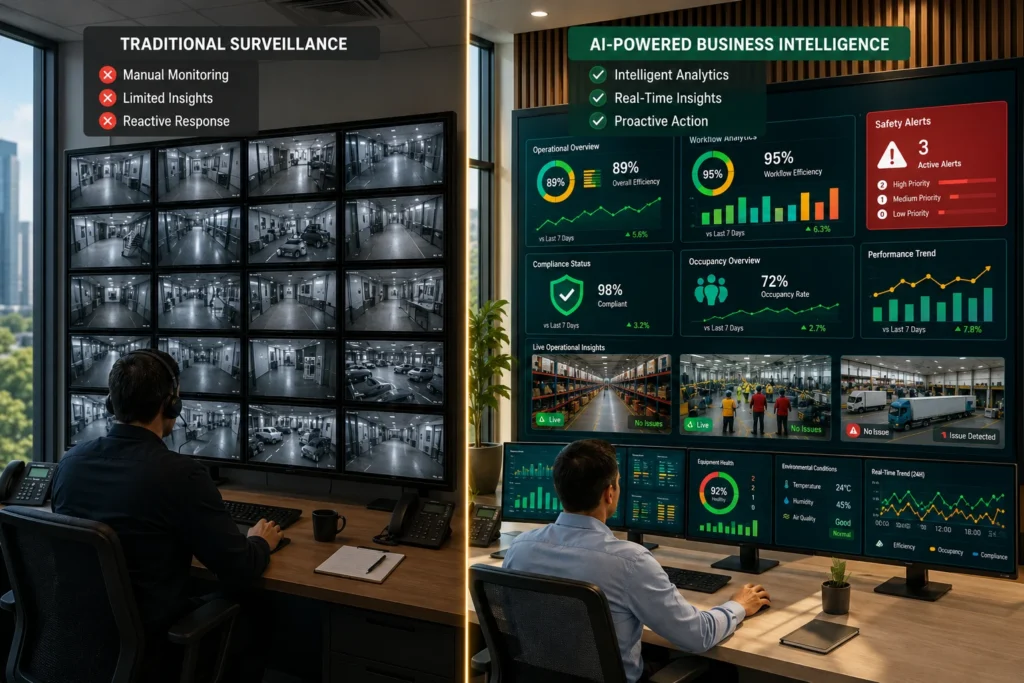
Traditional Surveillance | Intelligent Business Surveillance |
Records video for review | Analyzes video in real time |
Reactive investigations | Proactive alerts |
Manual monitoring | AI-assisted monitoring |
Limited operational insights | Business intelligence and analytics |
Incident-focused | Continuous operational improvement |
How Business Intelligence Changes Surveillance
Business intelligence extends the value of surveillance by converting visual information into measurable operational data. Instead of asking what happened after an incident, organizations can understand what is happening now and identify opportunities to improve performance.
Modern surveillance platforms support:
- Real-time operational monitoring
- Automated compliance verification
- Workplace safety observation
- Process optimization
- Resource utilization analysis
- Multi-site operational visibility
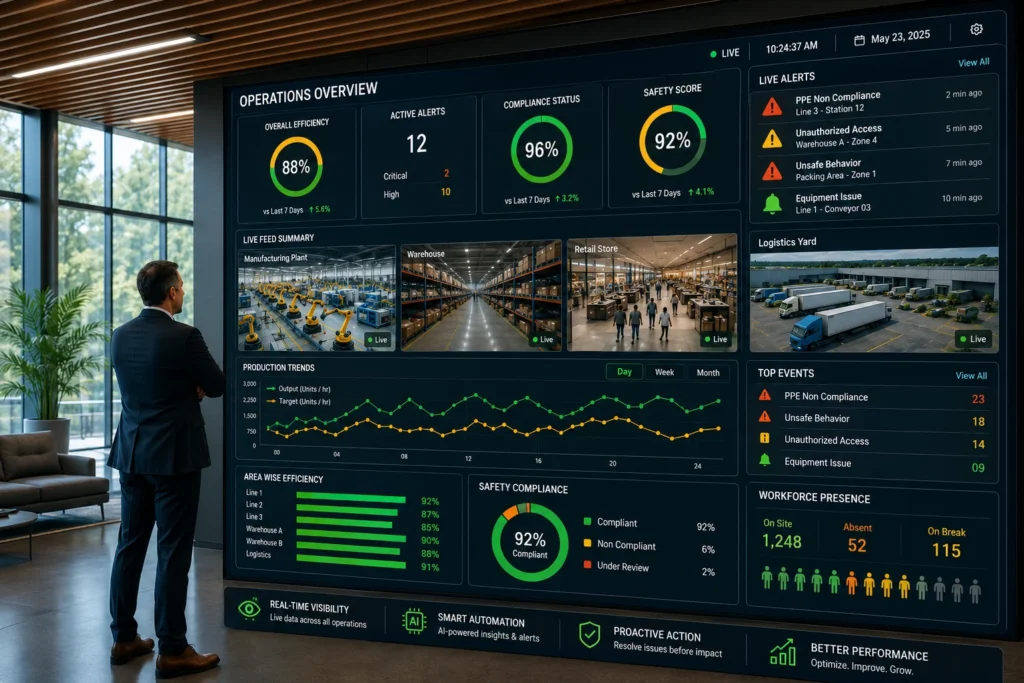
- Executive reporting through AI Dashboards
These capabilities allow management teams to make informed decisions using continuously updated operational data.
Practical Applications Across Business Operations
Intelligent surveillance provides value far beyond physical security.
Improving Compliance Monitoring
Companies using standard operating procedures frequently struggle to ensure uniform compliance across several locations. AI can continuously monitor critical activities, helping identify deviations before they become larger operational issues.
This supports:
- SOP Monitoring
- Compliance Monitoring
- Documentation of operational events
- Faster internal audits
Enhancing Workplace Safety
Maintaining a safe working environment requires constant observation, especially in manufacturing plants, warehouses, construction sites, and industrial facilities.
Modern systems can identify situations such as:
- Missing personal protective equipment
- Unauthorized access to restricted areas
- Unsafe equipment operation
- Hazardous working conditions
Real-time alerts allow supervisors to respond before minor issues become serious incidents.
Strengthening Operational Intelligence
Video analytics also helps organizations understand how work is performed throughout the day.
Examples include:
- Monitoring production flow
- Identifying operational bottlenecks
- Measuring equipment utilization
- Tracking queue lengths
- Monitoring loading and unloading activities
- Supporting continuous process improvement
These insights contribute directly to better operational planning.
Comparing Reactive Monitoring With Intelligent Operations
Reactive Surveillance | Intelligent Operations |
Reviews incidents after they occur | Detects issues as they develop |
Mostly depends on human observation | Uses AI Automation to monitor continually |
Limited operational visibility | Enterprise-wide Operational Intelligence |
Delayed decision-making | Faster response through Real-Time Analytics |
Primarily supports investigations | Supports ongoing operational improvement |
Organizations that adopt intelligent monitoring can reduce response times while improving visibility across multiple business functions.
Business Outcomes That Matter
The value of modern surveillance should be measured by business results rather than the number of cameras installed.
Key outcomes include:
- Faster incident detection
- Reduced manual monitoring effort
- Improved operational consistency
- Better Workplace Safety performance
- Enhanced compliance visibility
- Increased productivity
- Faster management reporting
- More effective multi-site oversight
- Better decision-making through Enterprise AI
These quantifiable gains enable businesses to get the most out of their surveillance expenditures.
Building a Smarter Operational Ecosystem
Modern surveillance becomes even more valuable when integrated with broader operational systems. Video events can automatically trigger workflows, notify responsible teams, support investigations, and provide historical data for performance analysis.
Combining Edge AI, Edge Analytics, Industrial AI, AI Surveillance, and Intelligent Operations enables organizations to monitor facilities more efficiently while reducing reliance on manual intervention. As part of a broader Digital Transformation strategy, intelligent surveillance supports consistent decision-making across locations and departments.
Lorem ipsum dolor sit amet, consectetur adipiscing elit. Ut elit tellus, luctus nec ullamcorper mattis, pulvinar dapibus leo.
Turning Surveillance Into Operational Value
Modern surveillance is no longer limited to recording events for future investigation. When combined with AI-driven analytics, it becomes a valuable source of business intelligence that supports safer workplaces, stronger compliance, and more efficient operations. Organizations that leverage intelligent surveillance gain continuous visibility into daily activities, enabling faster responses, better resource utilization, and informed decision-making that contributes to long-term business performance.
Frequently Asked Questions
What makes modern surveillance different from traditional surveillance?
Modern surveillance uses AI to analyze live video, detect events automatically, and provide operational insights instead of only recording footage.
How does AI Video Analytics improve business operations?
It identifies operational issues in real time, supports compliance, enhances workplace safety, and provides actionable data for management decisions.
Can intelligent surveillance support multiple business locations?
Yes. Centralized monitoring allows organizations to oversee multiple facilities through unified dashboards and standardized operational reporting.
Which industries benefit most from intelligent surveillance?
Manufacturing, retail, logistics, healthcare, construction, energy, warehousing, and transportation are among the industries that gain significant operational benefits.
Why is business intelligence becoming an essential part of surveillance?
Organizations increasingly require surveillance systems that not only improve security but also generate operational insights that help reduce costs, improve efficiency, strengthen compliance, and support better business decisions.