
Industrial IoT and Edge AI Ecosystem: Sensors to Business Intelligence
Every industrial facility generates thousands of operational signals every second. Temperature sensors, vibration monitors, energy meters, PLCs, CCTV cameras, and production equipment continuously produce data, yet much of it remains isolated within individual systems. As a result, maintenance teams, production managers, and business leaders often work with fragmented information instead of a unified operational picture.
An Industrial IoT and Edge AI ecosystem connects these disconnected data sources into a structured decision-support environment. Rather than collecting data for reporting alone, it processes operational information close to where it is generated, correlates events across multiple systems, and delivers meaningful business insights that support production, maintenance, quality, and safety management.
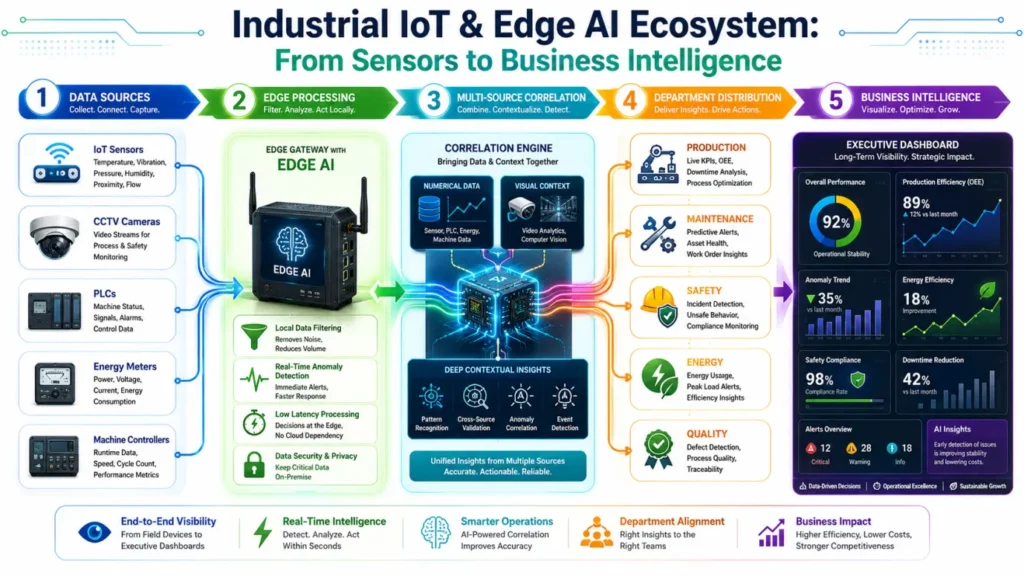
The Building Blocks of an Industrial IoT Ecosystem
A connected industrial environment combines multiple operational technologies that work together throughout the production process.
These commonly include:
- IoT sensors
- Industrial cameras
- PLCs and control systems
- SCADA platforms
- Energy monitoring devices
- Environmental sensors
- Machine controllers
- Industrial gateways
Each component contributes operational data that reflects the current condition of equipment, processes, or workplace activities.
Capturing Information at the Source
The first stage begins where industrial events occur. Sensors continuously measure physical conditions while cameras observe workplace activities that cannot be captured through numerical values alone.
Typical observations include:
- Machine vibration
- Motor temperature
- Air quality
- Power consumption
- Conveyor speed
- Equipment operating status
- Worker movement
- Material flow
Collecting information directly from operational assets creates a reliable foundation for later analysis.
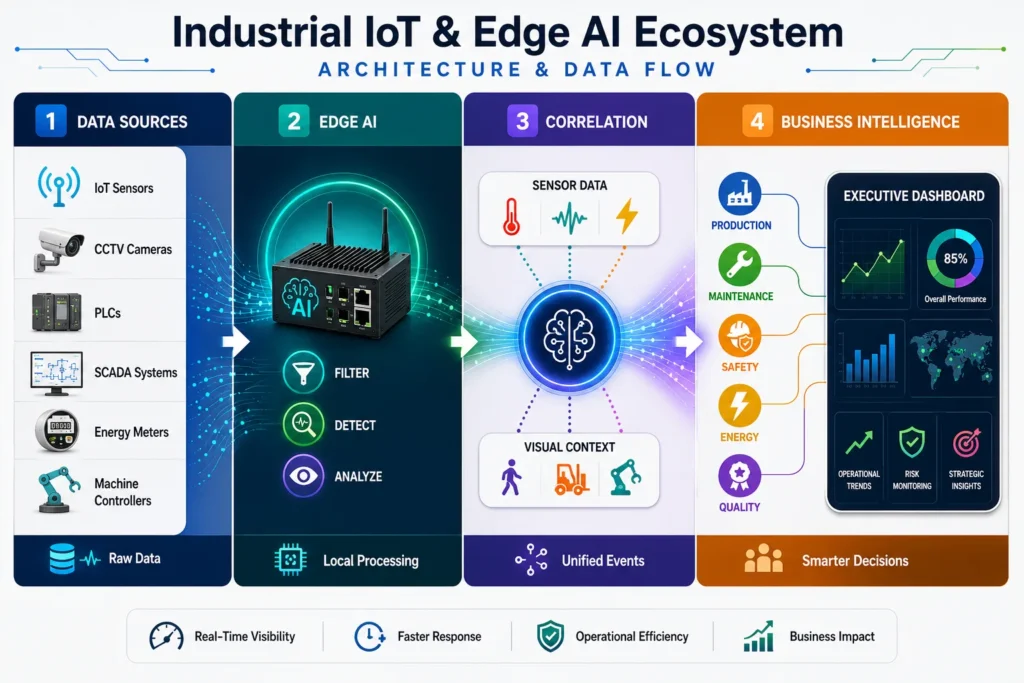
Why Edge AI Plays a Critical Role
Not every industrial decision should depend on cloud processing. Many operational events require immediate evaluation within the facility itself.
Edge AI processes information locally by:
- Filtering unnecessary data
- Detecting abnormal conditions
- Running Computer Vision models
- Reducing network traffic
- Supporting faster operational decisions
- Maintaining production even during network interruptions
Processing data closer to operational assets also reduces the amount of raw information transmitted across enterprise networks.
Bringing Multiple Data Sources Together
Individual sensor readings rarely provide sufficient operational context. Greater value is created when information from different systems is interpreted collectively.
Information Source | Operational Context Added |
IoT Sensors | Equipment condition and environmental measurements |
CCTV Cameras | Workplace activities and visual verification |
PLC Systems | Machine operating status and production signals |
SCADA Platforms | Process control information |
Energy Meters | Utility consumption patterns |
Production Systems | Manufacturing output and equipment utilization |
This combination allows operational events to be understood within the broader production environment instead of as isolated metrics.
Transforming Events into Operational Insights
Once information has been collected and correlated, analytical models identify situations requiring management attention.
Examples include:
- Equipment operating outside defined parameters
- Production delays caused by process bottlenecks
- Unexpected machine downtime
- Unsafe workplace activities
- Utility consumption exceeding normal levels
- Material movement irregularities
- Repeated quality inspection failures
These observations help managers understand operational conditions without manually reviewing multiple independent systems.
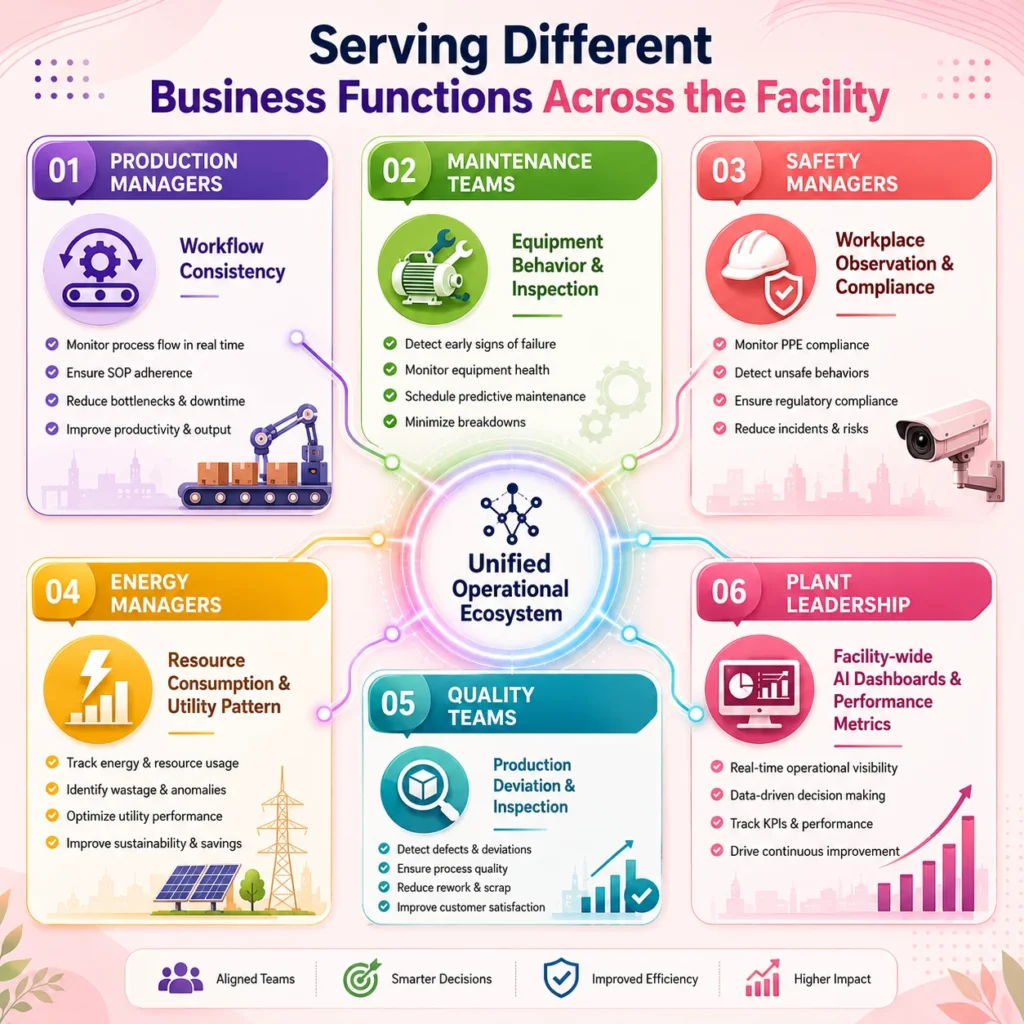
Supporting Different Business Functions
The same operational data serves different purposes across departments.
- Production managers monitor workflow consistency.
- Maintenance teams identify equipment behaviour requiring inspection.
- Safety managers review workplace observations.
- Energy managers evaluate resource consumption.
- Quality teams investigate production deviations.
- Plant leadership reviews overall operational performance through AI Dashboards.
Providing department-specific information allows each team to focus on decisions relevant to its responsibilities.
From Operational Data to Business Intelligence
Business Intelligence is created when operational information becomes measurable, searchable, and suitable for long-term evaluation.
Organizations can review:
- Equipment performance trends
- Production stability
- Facility comparisons
- Maintenance history
- Safety observations
- Energy usage patterns
- Resource utilization
- Operational exceptions
Historical analysis also helps management evaluate whether process improvements are producing measurable operational results.
Business Value Across the Ecosystem
Operational Objective | Practical Outcome |
Equipment oversight | Better understanding of asset behaviour |
Process management | Improved coordination across operational systems |
Resource planning | More informed allocation of maintenance and production resources |
Workplace Safety | Visual and sensor-based operational verification |
Performance evaluation | Consistent reporting using shared operational data |
Management reporting | Clear visibility into facility-wide operational trends |
Creating a Connected Decision Environment
Industrial facilities become easier to manage when operational information flows across departments instead of remaining confined within individual systems. By combining Industrial IoT, Edge AI, Computer Vision, AI Video Analytics, AI Surveillance, Edge Analytics, and Operational Intelligence, organizations create a shared operational view that supports informed planning, coordinated decision-making, and continuous organizational learning without adding unnecessary complexity to daily operations.
FAQs
Why are cameras important in an Industrial IoT ecosystem?
For tasks like worker actions, material handling, and process verification that cannot be measured by sensors alone, cameras offer visual context.
Can Edge AI process information without sending every event to the cloud?
Yes. Edge AI can analyse data locally, allowing many operational decisions to be made within the facility while transmitting only relevant information.
How do IoT sensors and Computer Vision complement each other?
Sensors measure physical conditions such as temperature or vibration, while Computer Vision interprets visual activities, providing a more complete operational picture.
Which facilities stand to gain the most from an edge AI and industrial IoT ecosystem?
Manufacturing plants, warehouses, logistics centres, energy facilities, food processing units, pharmaceutical plants, and large industrial campuses commonly implement these ecosystems.
How does Business Intelligence differ from raw operational data?
Raw data consists of individual measurements or events, while Business Intelligence organizes and interprets that information to support operational reviews, planning, and management decisions.