
Industrial Communication Protocols Explained: OPC UA, MQTT, Modbus, PROFINET, BACnet, and EtherNet/IP
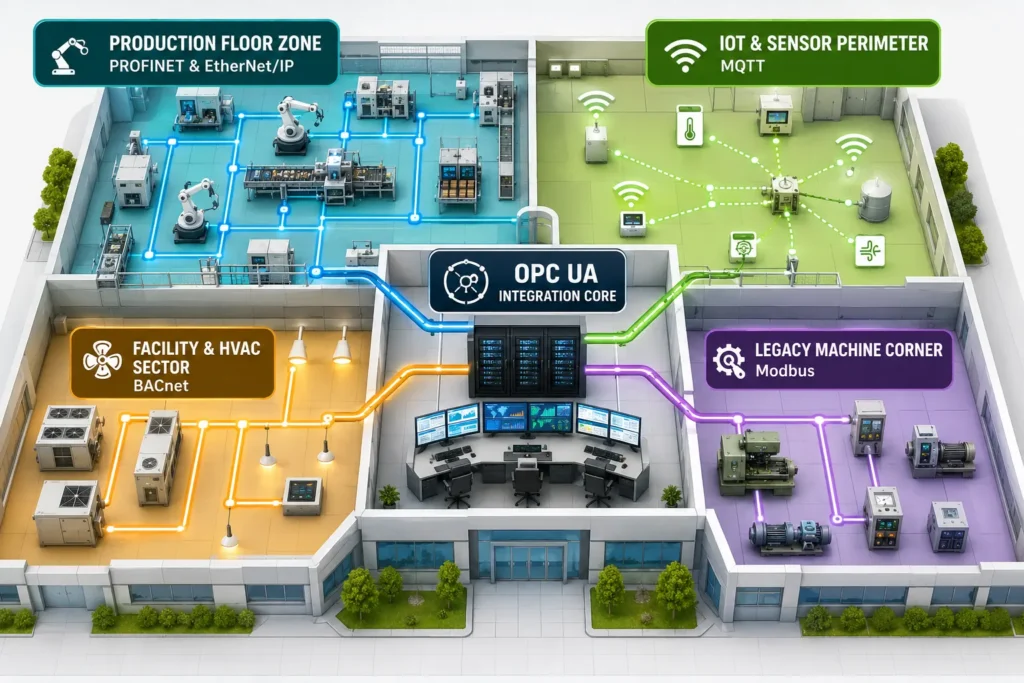
A production line may include equipment from multiple manufacturers installed over several years. One machine communicates through Modbus, another uses PROFINET, the building management system operates on BACnet, and newer IoT devices publish data using MQTT. Although each system performs its intended function, exchanging information across these technologies can become a significant operational challenge.
Industrial communication protocols provide the common language that allows machines, controllers, sensors, and software platforms to exchange information reliably. Understanding the role of each protocol helps organizations design connected industrial environments where operational data flows efficiently between production systems, monitoring platforms, and business applications.
Why Industrial Communication Protocols Matter
Modern industrial facilities depend on information moving seamlessly between equipment and management systems. Without standardized communication methods, integrating machines from different vendors becomes complex and time-consuming.
Reliable communication protocols support:
- Machine coordination
- Process monitoring
- Equipment diagnostics
- Production reporting
- Energy management
- Maintenance activities
- Building automation
- Operational decision-making
Selecting the appropriate protocol depends on the equipment involved and the operational objectives of the facility.
OPC UA: Standardizing Industrial Data Exchange
OPC UA (Open Platform Communications Unified Architecture) is widely used for sharing information between industrial equipment, supervisory software, and enterprise applications.
It is commonly used for:
- PLC communication
- SCADA integration
- MES connectivity
- Equipment diagnostics
- Cross-platform interoperability
- Historical data exchange
Its standardized data structure makes it suitable for facilities that need to integrate equipment from multiple manufacturers.
MQTT: Efficient Communication for IoT Devices
MQTT (Message Queuing Telemetry Transport) is designed for lightweight, publish-subscribe communication, making it well suited for Industrial IoT applications.
Typical use cases include:
- Sensor data transmission
- Edge AI communication
- Remote equipment monitoring
- Environmental monitoring
- Energy management
- Cloud data publishing
Its efficient messaging approach minimizes bandwidth while supporting communication across distributed industrial environments.
Modbus: Connecting Industrial Equipment
Modbus remains one of the most widely implemented industrial communication protocols due to its simplicity and broad compatibility.
Common applications include:
- Motor controllers
- Energy meters
- Industrial sensors
- Variable frequency drives
- Temperature controllers
- Legacy industrial equipment
Many facilities continue using Modbus because it supports straightforward communication with a wide range of industrial devices.
PROFINET: Supporting Industrial Automation
PROFINET is designed for high-speed industrial automation where reliable communication between controllers and production equipment is essential.
Operational Area | Typical PROFINET Application |
Production machinery | Machine control communication |
Robotic systems | Coordinated automation tasks |
Assembly lines | Equipment synchronization |
Packaging equipment | High-speed production control |
Material handling | Conveyor and automation coordination |
Manufacturing cells | Real-time industrial communication |
Its performance makes it suitable for manufacturing environments requiring precise coordination.
BACnet: Managing Building Infrastructure
Unlike production-focused protocols, BACnet is primarily used within building automation systems.
It commonly connects:
- HVAC systems
- Lighting controls
- Fire safety systems
- Access control
- Energy management equipment
- Environmental monitoring devices
Industrial campuses often use BACnet alongside production communication protocols to support facility operations.
EtherNet/IP: Integrating Industrial Networks
EtherNet/IP extends standard Ethernet technology to industrial automation environments, allowing equipment to exchange operational information across manufacturing networks.
Common implementations include:
- PLC communication
- Industrial robots
- Motor control systems
- Process equipment
- Conveyor automation
- Distributed I/O systems
Its compatibility with standard Ethernet infrastructure simplifies industrial network deployment while supporting automation requirements.
EtherNet/IP: Integrating Industrial Networks
EtherNet/IP extends standard Ethernet technology to industrial automation environments, allowing equipment to exchange operational information across manufacturing networks.
Common implementations include:
- PLC communication
- Industrial robots
- Motor control systems
- Process equipment
- Conveyor automation
- Distributed I/O systems
Its compatibility with standard Ethernet infrastructure simplifies industrial network deployment while supporting automation requirements.
Choosing the Right Protocol for Different Applications
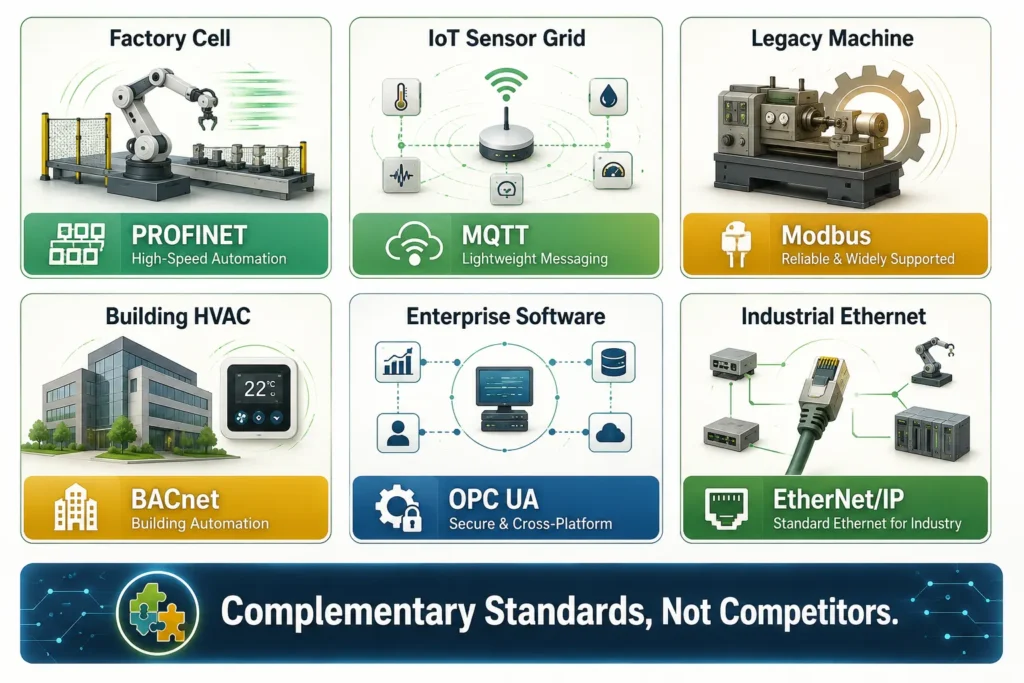
Different operational requirements call for different communication protocols rather than a single universal solution.
Operational Requirement | Common Protocol |
Cross-platform industrial integration | OPC UA |
Industrial IoT communication | MQTT |
Legacy equipment connectivity | Modbus |
Factory automation | PROFINET |
Building management | BACnet |
Industrial Ethernet automation | EtherNet/IP |
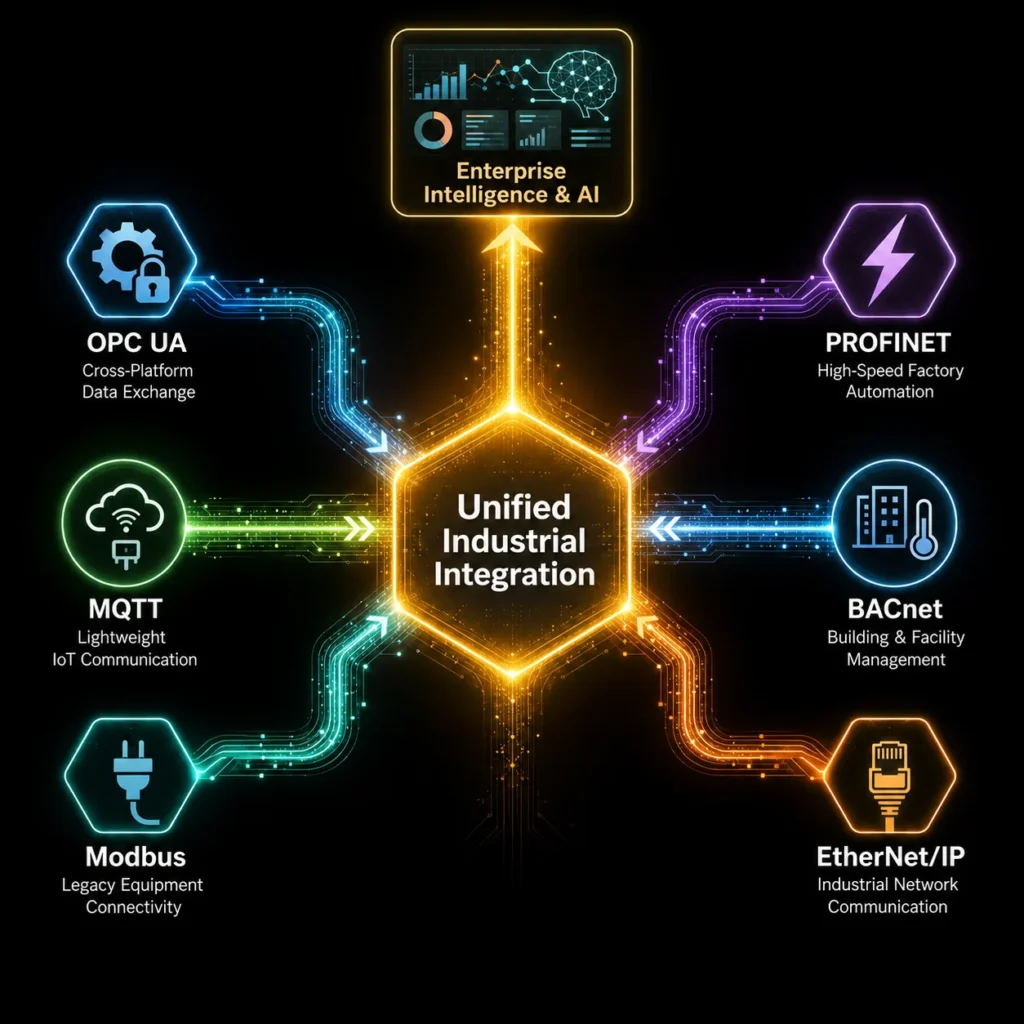
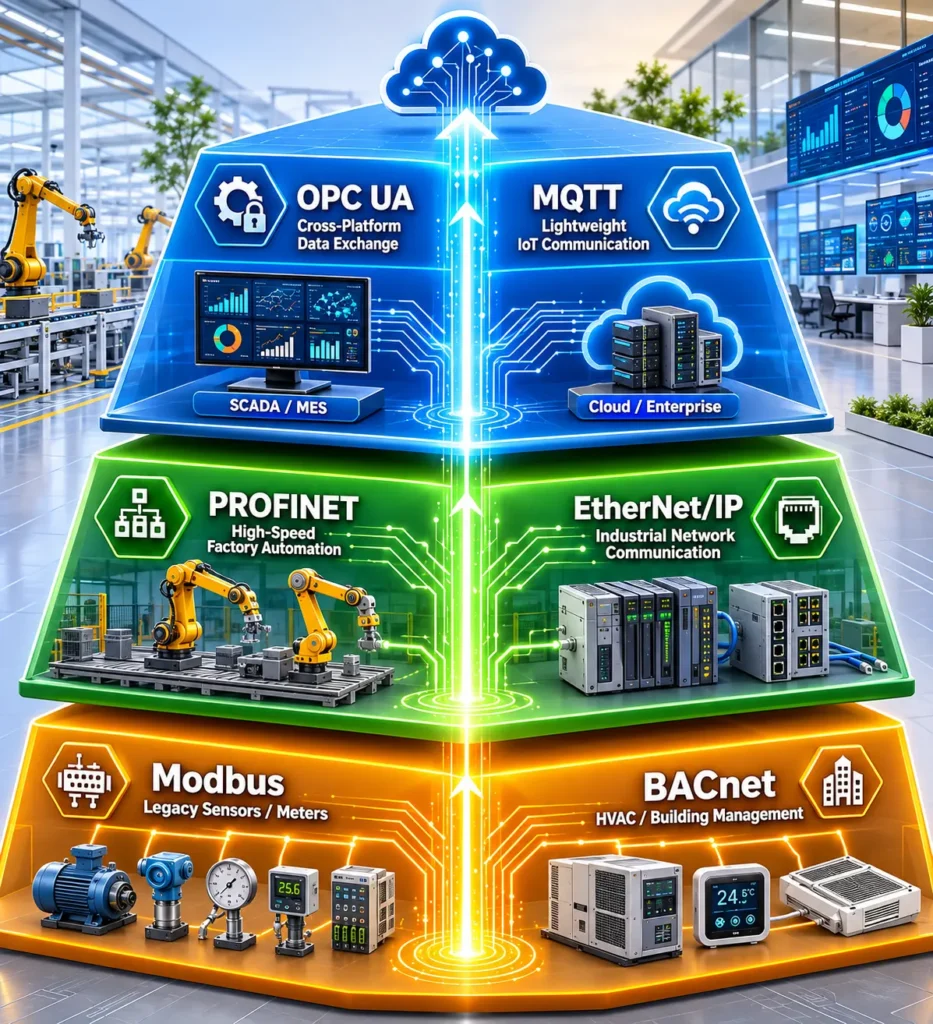
Many industrial facilities operate several of these protocols simultaneously as part of a unified communication architecture.
Where AI Fits Within Industrial Communication
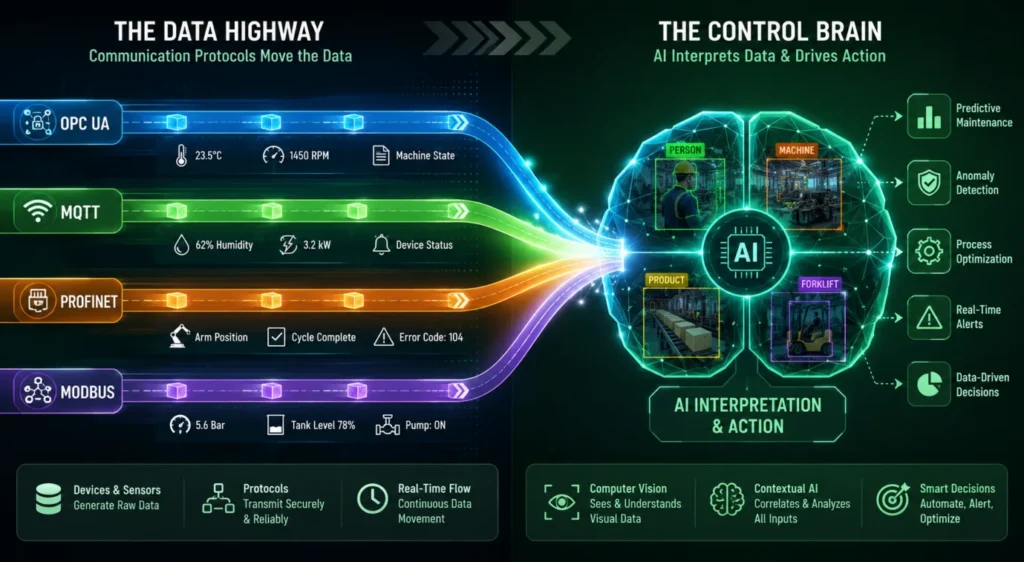
Industrial communication protocols transport operational information, while AI interprets that information to support management decisions.
By combining protocol data with AI Video Analytics and Computer Vision, organizations can:
- Correlate machine events with workplace activities
- Monitor production alongside equipment status
- Support predictive maintenance initiatives
- Verify operational procedures
- Improve incident investigations
- Generate AI Dashboards for management reviews
This integration allows operational information from multiple communication standards to contribute to a shared understanding of facility performance.
Building an Open Industrial Information Environment
Industrial communication protocols are not competing technologies; they are complementary tools that serve different operational purposes. Manufacturing equipment, IoT sensors, building infrastructure, and automation systems often rely on different protocols because each has been designed for specific industrial requirements. When these communication standards work together with Computer Vision, Edge AI, AI Video Analytics, Industrial AI, Operational Intelligence, and Smart Manufacturing platforms, organizations establish an information environment where data can move across systems without creating barriers between departments or technologies.
FAQ
Can multiple industrial communication protocols operate within the same facility?
Yes. Most industrial facilities use several protocols simultaneously because different equipment and systems often support different communication standards.
Why is OPC UA commonly used for system integration?
OPC UA provides a standardized method for exchanging structured information between equipment, SCADA platforms, MES applications, and enterprise software.
Is MQTT suitable for factory automation control?
MQTT is primarily used for efficient data transmission in Industrial IoT environments rather than deterministic machine control applications
What is the difference between BACnet and PROFINET?
BACnet is mainly designed for building automation systems, while PROFINET focuses on industrial production and factory automation