
The Future of AI Video Analytics Lies in Hybrid Edge-Cloud Architectures
Every day, enterprises capture thousands of hours of video across factories, warehouses, retail stores, hospitals, and corporate facilities. While this visual data contains valuable operational insights, the challenge is deciding where it should be processed. Some events require immediate action at the facility, while others contribute to long-term business analysis across multiple locations.
A new strategy for business monitoring is being driven by this shifting operational environment. Rather than relying entirely on local processing or centralized cloud platforms, organizations are adopting hybrid Edge-Cloud architectures that combine the strengths of both. This model is shaping the future of AI Video Analytics by delivering faster responses, scalable intelligence, and enterprise-wide visibility.
Why a Single Processing Model Is No Longer Enough
Early AI Video Analytics deployments often followed one of two approaches. Some organizations processed every video stream in the cloud to simplify management, while others relied entirely on local Edge AI devices for faster decision-making.
As operations became more distributed, both models revealed practical limitations.
Processing continuous video streams might result in higher storage costs, network latency, and bandwidth needs for cloud-only implementations. Edge-only deployments deliver rapid local decisions but may lack the centralized reporting and cross-site analysis required by enterprise leaders.
Hybrid Edge-Cloud architectures address these limitations by assigning each environment the tasks it performs best.
How a Hybrid Architecture Works
AI Video Analytics functions across two interconnected levels in a hybrid setup.
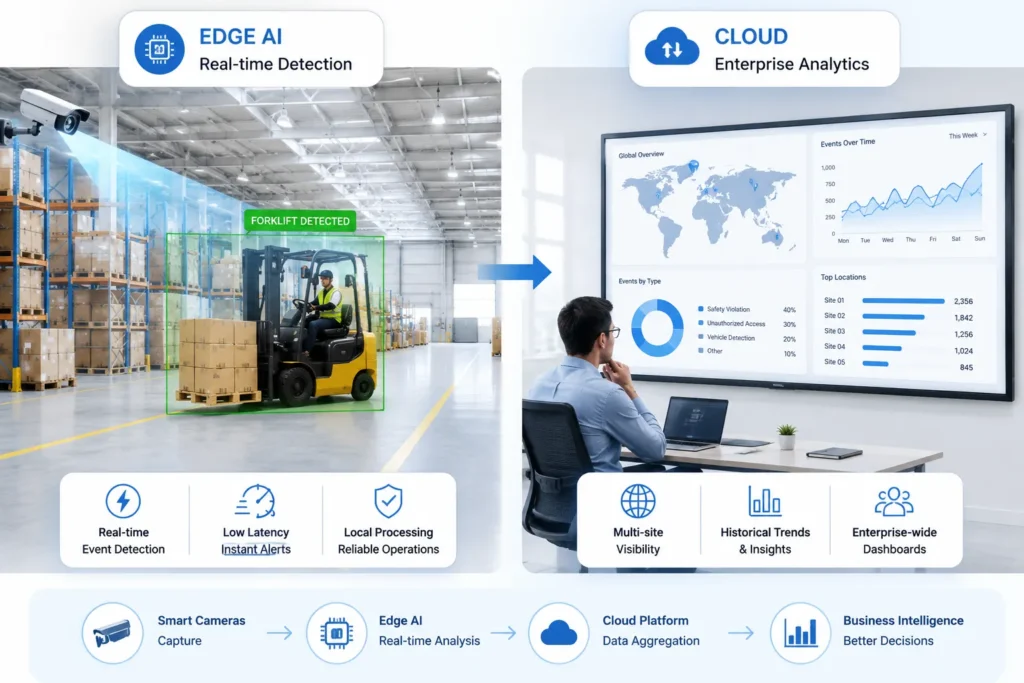
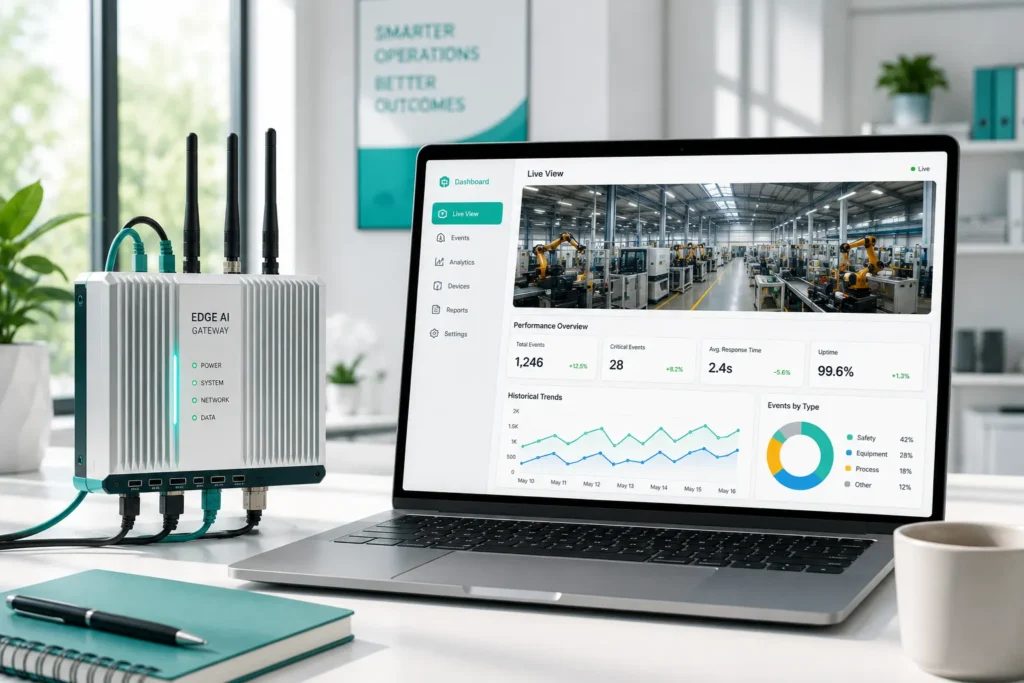
The edge layer processes live video close to the cameras, enabling immediate event detection and rapid operational responses. Computer Vision models identify activities such as equipment anomalies, restricted-area access, vehicle movement, or workflow deviations without depending on continuous cloud communication.
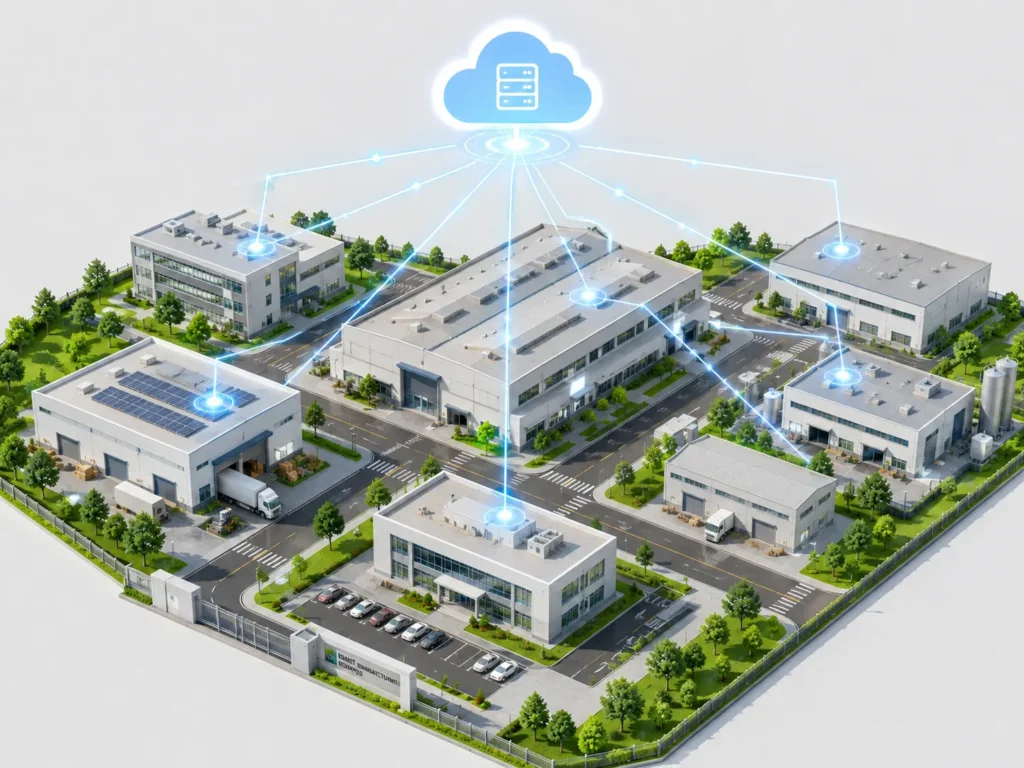
The cloud layer receives summarized events, operational metadata, and selected video evidence. It combines information from multiple facilities to support long-term reporting, AI Dashboards, trend analysis, and Enterprise AI initiatives.
This shared architecture enables organizations to balance speed, scalability, and operational visibility.
Business Advantages of Hybrid Edge-Cloud Architectures
Hybrid deployments improve operational performance in several ways.
Faster operational responses
Critical events are processed locally, allowing teams to respond without waiting for cloud-based analysis.
Lower network utilization
Instead of transmitting continuous video streams, only relevant events and insights are sent to centralized platforms.
Greater scalability
New facilities can be added without dramatically increasing bandwidth demands or cloud processing costs.
Improved operational resilience
Edge devices continue monitoring during temporary network interruptions, while cloud platforms maintain centralized visibility when connectivity is restored.
Better enterprise decision-making
Resource optimisation, performance benchmarking, and strategy planning are all supported by operational data gathered from various places
Industries Benefiting from Hybrid AI Video Analytics
Different industries apply hybrid architectures based on their operational priorities.
Manufacturing
Production facilities process equipment monitoring locally while using cloud platforms to compare productivity and quality metrics across multiple plants.
Warehousing and Logistics
While cloud analytics assesses distribution performance across regional warehouses, Edge AI controls dock activities, forklift movement, and inventory flow in real time.
Retail
Stores detect operational events locally while headquarters analyzes customer movement trends, staffing efficiency, and store performance across multiple locations.
Healthcare
Hospitals monitor patient movement and restricted areas through local AI processing while enterprise systems evaluate operational performance across healthcare networks.
Transportation and Smart Infrastructure
Airports, ports, and transportation hubs combine local event detection with centralized monitoring to coordinate operations across large geographical areas.
Key Considerations Before Adopting a Hybrid Architecture
Organizations planning a hybrid deployment should evaluate both operational and technical requirements.
Important considerations include:
- Camera coverage and image quality.
- Business objectives for AI Video Analytics.
- Network capacity and connectivity.
- Edge computing hardware requirements.
- Data privacy and governance policies.
- Integration with existing AI Dashboards and Enterprise AI platforms.
- Scalability for future expansion.
A phased deployment allows organizations to optimize architecture decisions while minimizing operational disruption.
Building the Next Generation of Intelligent Operations
Hybrid Edge-Cloud architectures represent the next stage of enterprise AI Video Analytics. Rather than choosing between local intelligence and centralized analytics, organizations can combine both to create a monitoring strategy that is responsive, scalable, and data-driven.
As Computer Vision, Edge AI, Real-Time Analytics, Operational Intelligence, and AI Automation continue to advance, hybrid architectures will become the standard foundation for intelligent enterprise operations. Organizations that adopt this approach will be better positioned to improve operational efficiency, reduce infrastructure costs, and gain meaningful insights across every facility.
FAQ
What is a hybrid Edge-Cloud architecture for AI Video Analytics?
It is an architecture that combines local Edge AI processing for real-time event detection with cloud platforms for centralized reporting, analytics, and enterprise management.
Why are organizations moving toward hybrid AI Video Analytics?
Hybrid deployments lower bandwidth consumption and cloud processing expenses while balancing quick operational responses with scalable enterprise-wide visibility.
Which tasks should be processed at the edge?
Time-sensitive activities such as live video analysis, event detection, operational alerts, and immediate workflow monitoring are typically handled at the edge.
What functions are better suited to the cloud?
Historical reporting, AI model management, cross-site performance analysis, Enterprise AI, and long-term Operational Intelligence are typically managed in the cloud
Which industries benefit most from hybrid architectures?
Manufacturing, warehousing, retail, healthcare, transportation, energy, utilities, and smart infrastructure commonly benefit from hybrid Edge-Cloud deployments.