
AI Hospital Operations Monitoring
Healthcare Operations Intelligence
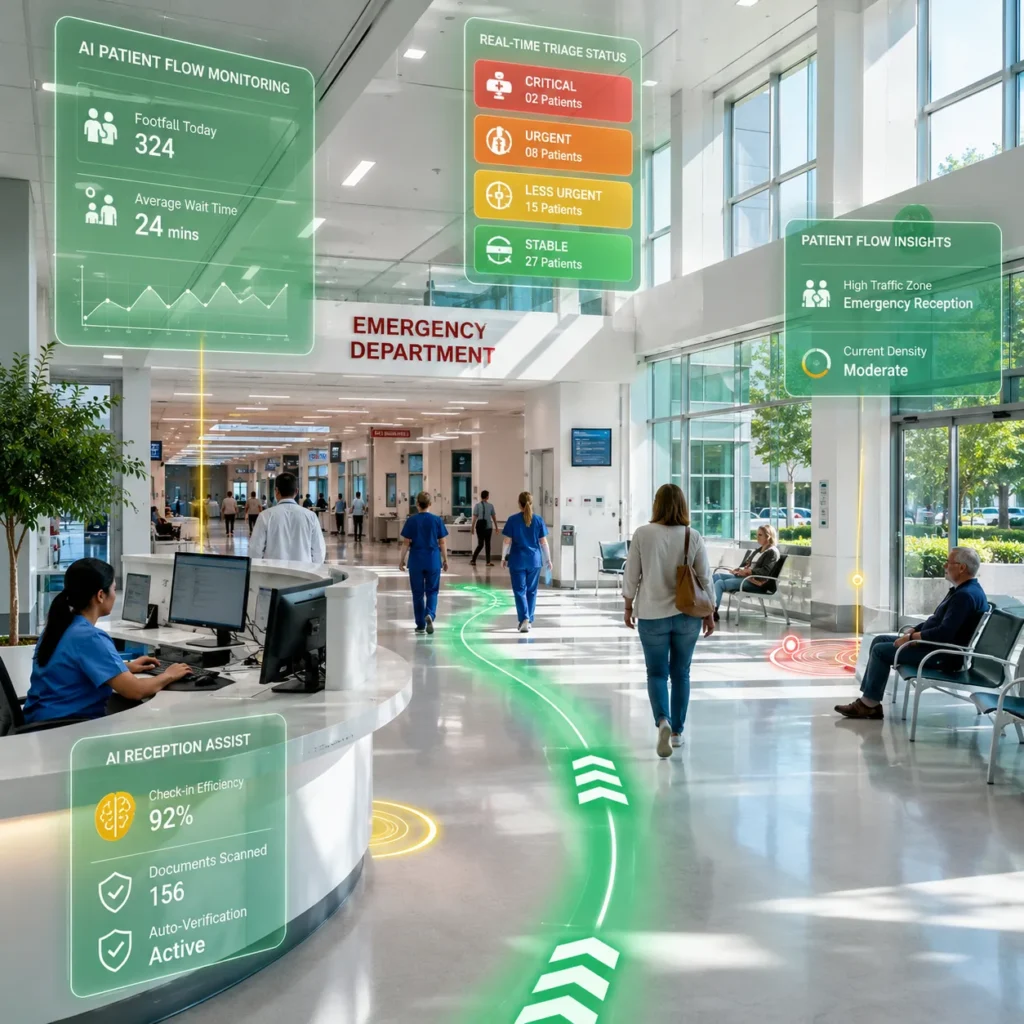
Hospitals are dynamic environments where clinical teams, patients, visitors, support staff, and critical facilities operate together to deliver continuous care. Every activity, from patient movement and emergency response to facility management and operational coordination, contributes to the overall quality and efficiency of healthcare services. Healthcare Operations Intelligence provides continuous visibility into these interconnected operational activities, enabling hospitals to identify operational challenges, improve coordination, optimise workflows, and support uninterrupted patient care. AI Monitoring strengthens this approach by enhancing operational awareness while helping healthcare organisations maintain safe, efficient, and patient-focused environments.
Executive Summary
A multi-specialty hospital sought to improve operational visibility across its healthcare facilities while ensuring smooth patient care and efficient coordination between clinical and support departments. Although existing systems effectively managed medical records and facility infrastructure, maintaining awareness of day-to-day operational activities, patient flow, restricted area access, and support services required a more comprehensive operational approach.
SPGS introduced a Healthcare Operations Intelligence framework using AI Monitoring to strengthen operational coordination across the hospital. The initiative improved visibility into hospital workflows, supported timely operational decisions, enhanced collaboration between departments, and helped maintain consistent healthcare delivery without disrupting clinical operations.
Customer Profile
Industry: Multi-Specialty Healthcare (Anonymous)
Project Scope
- Multi-specialty hospital campus
- Emergency department
- Intensive care and critical care units
- Operation theatre corridors
- Patient waiting and reception areas
- Pharmacy and diagnostic centres
- Restricted clinical zones
- Central hospital operations centre
- Continuous 24×7 operational oversight
Operational Environment
The hospital operated continuously with multiple departments functioning simultaneously, including emergency care, outpatient services, inpatient wards, diagnostic laboratories, pharmacies, and administrative offices. Clinical teams, support staff, patients, and visitors interacted throughout the day, making operational coordination essential for maintaining quality healthcare services. While specialised hospital systems managed clinical information and medical equipment, understanding how daily operational activities influenced patient care required broader visibility across hospital operations.
Business Challenges
- Coordinating multiple clinical and support departments.
- Managing patient and visitor movement efficiently.
- Improving visibility across hospital operations.
- Protecting restricted healthcare areas.
- Supporting emergency response coordination.
- Maintaining compliance with hospital operational procedures.
- Reducing operational bottlenecks.
- Strengthening hospital-wide coordination.
Project Objectives
- Improve hospital operational visibility.
- Enhance patient flow management.
- Strengthen coordination between departments.
- Support efficient facility operations.
- Improve operational governance.
- Maintain continuity of healthcare services.
- Establish a Healthcare Operations Intelligence framework.
Keeping Care Delivery Running Smoothly
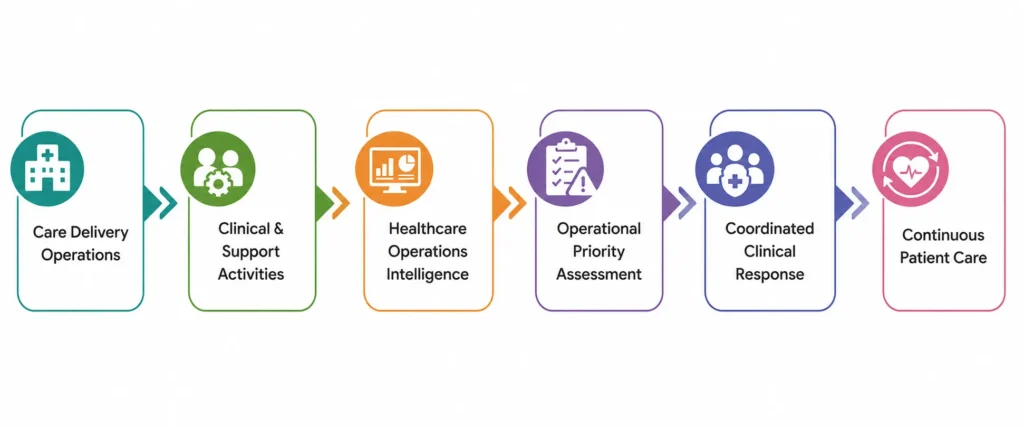
The transformation focused on improving operational coordination across the hospital rather than monitoring isolated events. Patient movement, staff activities, support services, emergency operations, equipment availability, housekeeping, and restricted area access were viewed as interconnected healthcare processes. This operational perspective enabled hospital teams to identify workflow inefficiencies, coordinate resources more effectively, reduce operational delays, and support continuous patient care across the facility.
Solution Architecture
Operational Flow
Operational Technology Ecosystem
Technology | Business Contribution |
AI Monitoring | Continuous visibility across hospital operations |
Computer Vision | Observation of operational activities |
AI Video Analytics | Identification of operational anomalies |
Edge AI | Immediate analysis within hospital facilities |
Hospital Information System (HIS) | Clinical and operational context |
Access Control System | Management of restricted healthcare areas |
Enterprise AI Dashboard | Central operational oversight |
REST APIs | Enterprise interoperability |
Operational Decision Intelligence
The solution supported hospital operations by answering key operational questions:
- Which hospital departments require immediate operational attention?
- Are patient movement patterns affecting healthcare delivery?
- Which operational activities require better coordination?
- Are restricted clinical areas being managed appropriately?
- Where should support teams prioritise their response?
- Which operational trends could influence hospital performance?
- How can resources be coordinated more effectively across departments?
Implementation Methodology
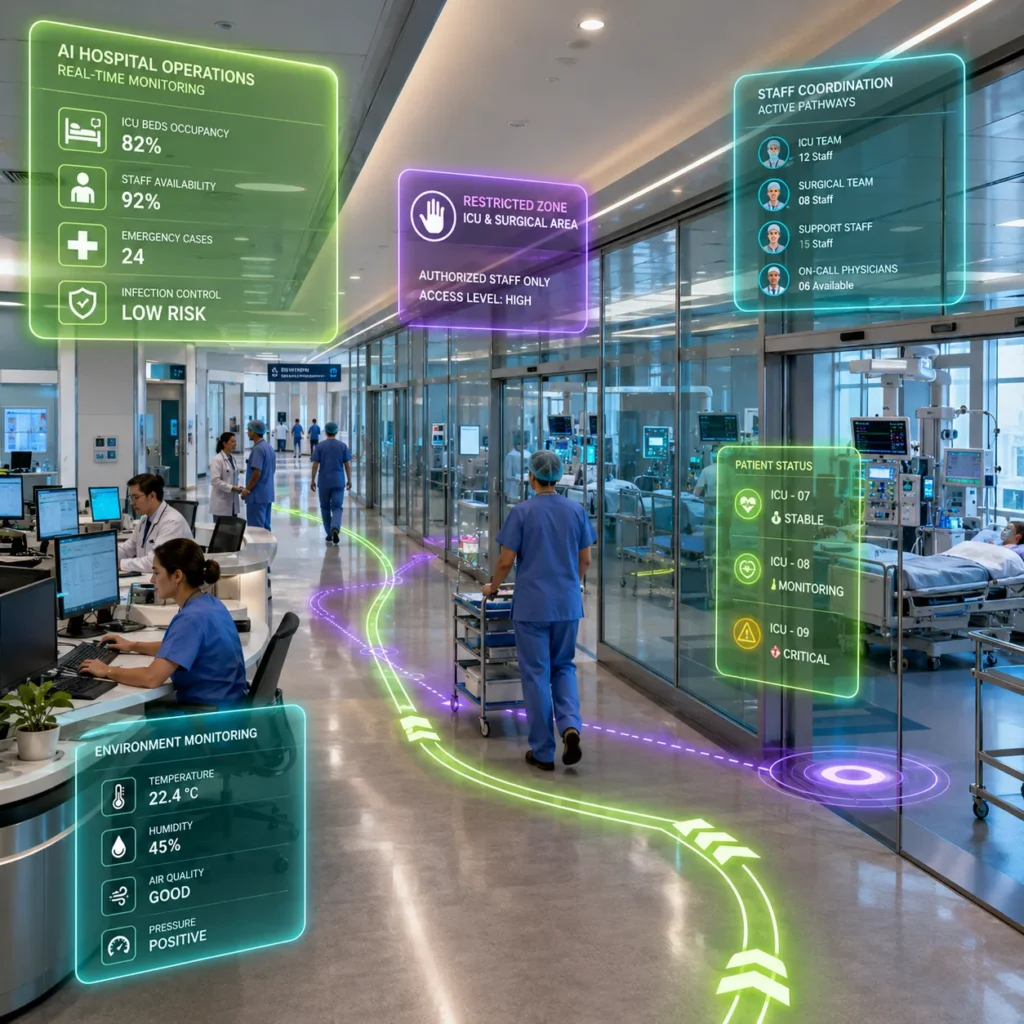
The programme began with a detailed assessment of hospital workflows, departmental interactions, patient movement patterns, facility operations, and existing operational procedures. Critical areas, including emergency departments, operation theatre corridors, intensive care access points, diagnostic centres, pharmacies, waiting areas, and restricted clinical zones, were prioritised for phased implementation. AI Monitoring capabilities were integrated alongside existing hospital systems, allowing clinical and operational teams to validate insights, refine operational workflows, and strengthen coordination without interrupting patient care.
Enterprise Integrations
System | Business Contribution |
Hospital Information System (HIS) | Operational and clinical information |
Electronic Medical Record (EMR) | Patient workflow context |
Access Control System | Restricted area management |
Enterprise AI Dashboard | Central operational visibility |
Facility Management System | Infrastructure operations |
REST APIs | Enterprise interoperability |
Business Outcomes
- Improved coordination across hospital departments.
- Enhanced visibility into daily healthcare operations.
- Better patient flow management.
- Reduced operational delays.
- Stronger governance of hospital procedures.
- Improved coordination between clinical and support teams.
- More efficient utilisation of hospital resources.
- Greater continuity in patient care delivery.
ROI & Business Value
The initiative strengthened hospital operations by improving coordination between clinical services, support functions, and facility management. Better visibility into operational workflows enabled hospital teams to minimise delays, optimise resource allocation, and improve collaboration across departments. By supporting more efficient operations without affecting clinical care, the hospital enhanced service quality, operational consistency, and long-term organisational performance.
Future Roadmap
The organisation plans to expand Healthcare Operations Intelligence through:
- Predictive Hospital Operations Analytics
- AI-Assisted Patient Flow Optimisation
- Vision-Language Models for Healthcare Operations
- Digital Twin Integration for Healthcare Facilities
- Intelligent Facility Operations Management
- Enterprise Healthcare Performance Dashboards
Related Technology Pages
- AI Monitoring
- Computer Vision
- AI Video Analytics
- Edge AI
- Hospital Information System Integration
- Enterprise AI Dashboards
- Intelligent Operations
Contact SPGS
Efficient healthcare extends beyond clinical treatment to the operational systems that keep every department working together. SPGS helps hospitals build greater operational awareness by connecting people, processes, and facilities through intelligent AI Monitoring, enabling healthcare teams to respond faster, coordinate better, and sustain reliable hospital operations every day.