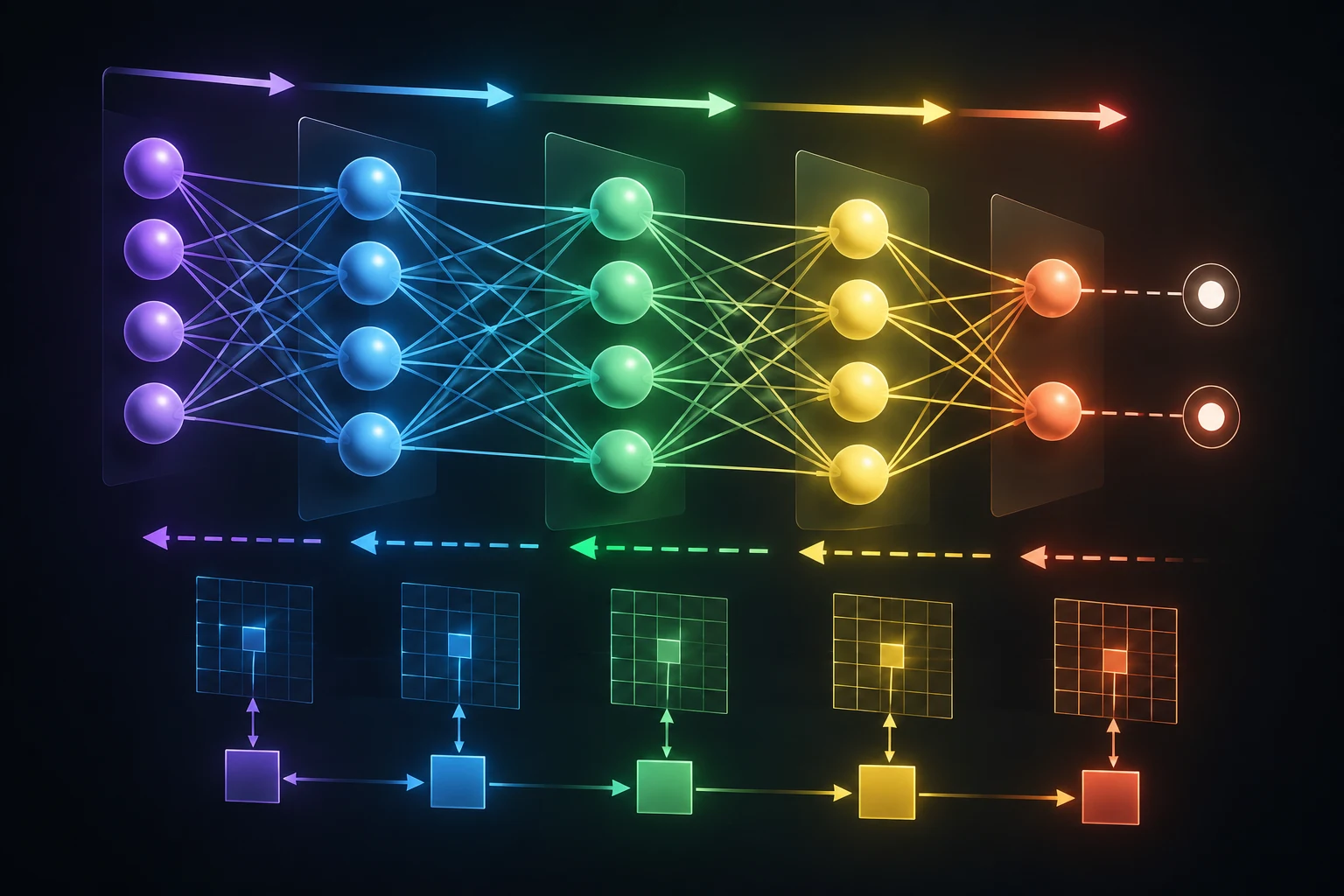
Backpropagation is a training algorithm used in neural networks to determine how much each model parameter contributed to the error in a prediction. After the network produces an output, backpropagation calculates the difference between that output and the expected result, then works backward through the network using the chain rule of calculus to calculate gradients for each weight and bias.
These gradients tell the optimization algorithm how to adjust the network’s parameters to reduce future errors. Backpropagation is fundamental to training deep learning models for tasks such as image recognition, speech processing, forecasting, and natural language processing. It is typically used together with optimization methods such as gradient descent and its variants.