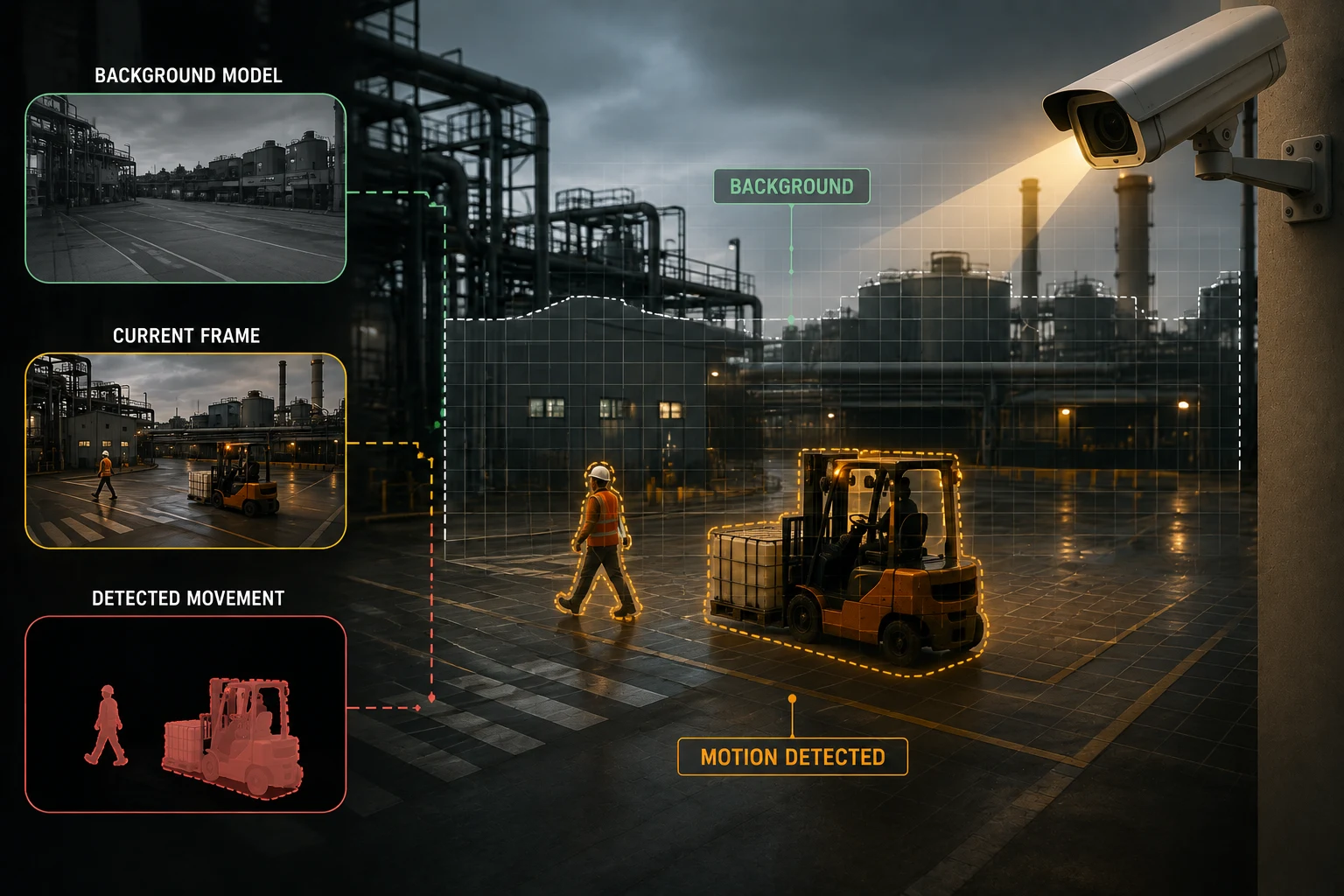
Background modeling is a computer vision technique used to represent the normal, relatively stable parts of a scene so that changes or moving objects can be detected. A system continuously compares incoming camera frames with its learned background model and identifies pixels or regions that differ significantly, making it possible to distinguish foreground activity from the surrounding environment.
In applications such as industrial surveillance, traffic monitoring, and security systems, background modeling can detect people, vehicles, or unexpected movement within a monitored area. The model may adapt to gradual changes such as lighting, shadows, or environmental conditions while preserving sensitivity to meaningful events. Techniques including Gaussian mixture models, adaptive background subtraction, and deep-learning-based segmentation are commonly used for this purpose.