
Edge Analytics: The Future of Real-Time Business Intelligence
Every second, enterprises generate massive volumes of operational data from cameras, sensors, machines, and connected devices. The challenge is no longer collecting data—it is acting on it before delays affect productivity, safety, or customer experience. Edge Analytics addresses this need by processing information where it is created, enabling businesses to make faster and more informed decisions.
How Edge Analytics Works
A typical Edge Analytics workflow consists of four stages:
Stage | Purpose |
Data Collection | Cameras, IoT sensors, and industrial devices capture operational data. |
Local AI Processing | Edge AI analyzes data in real time at the device or gateway. |
Event Detection | Computer Vision identifies predefined events, anomalies, or safety risks. |
Business Action | Alerts, dashboards, or automated workflows enable immediate response. |
This architecture allows organizations to process only meaningful information while reducing unnecessary network traffic.
Why Enterprises Are Adopting Edge Analytics
Traditional cloud-based analytics may introduce delays because every data point must travel across the network before analysis. Edge Analytics minimizes this delay by processing data close to its source.
Key business advantages include:
- Faster decision-making
- Lower network bandwidth usage
- Reduced cloud storage requirements
- Real-Time Analytics for immediate response
- Improved operational resilience
- Better data privacy and security
- Continuous monitoring, even during network interruptions
These capabilities help organizations improve both operational performance and business continuity.
Core Technologies That Power Edge Analytics
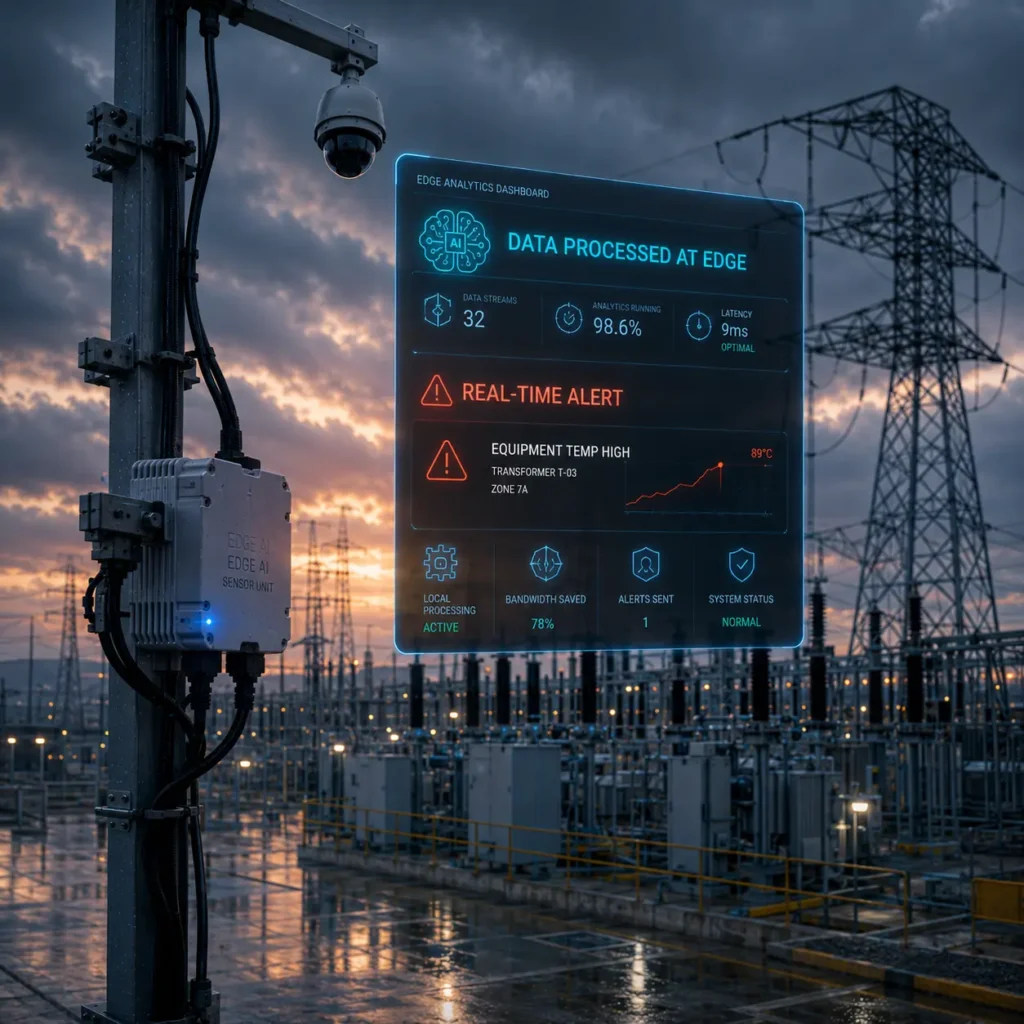
Edge AI
Edge AI enables intelligent devices to run machine learning models locally, supporting rapid decision-making without constant cloud connectivity.
Computer Vision
Computer Vision analyzes live video streams to detect people, vehicles, equipment, and operational events automatically.
AI Video Analytics
AI Video Analytics transforms video feeds into actionable insights by identifying safety violations, equipment issues, occupancy levels, and unusual activities.
AI Dashboards
AI Dashboards consolidate alerts, trends, and operational metrics into a centralized interface, giving managers real-time visibility across multiple locations.
Enterprise Applications Across Industries
Edge Analytics delivers value across a wide range of business environments.
Manufacturing
Industrial AI monitors production lines, verifies SOP Monitoring, detects equipment anomalies, and supports Workplace Safety by identifying unsafe conditions in real time.
Retail
Retail Analytics helps stores understand customer movement, monitor checkout queues, optimize staffing, and improve store operations through live insights.
Warehousing And Logistics
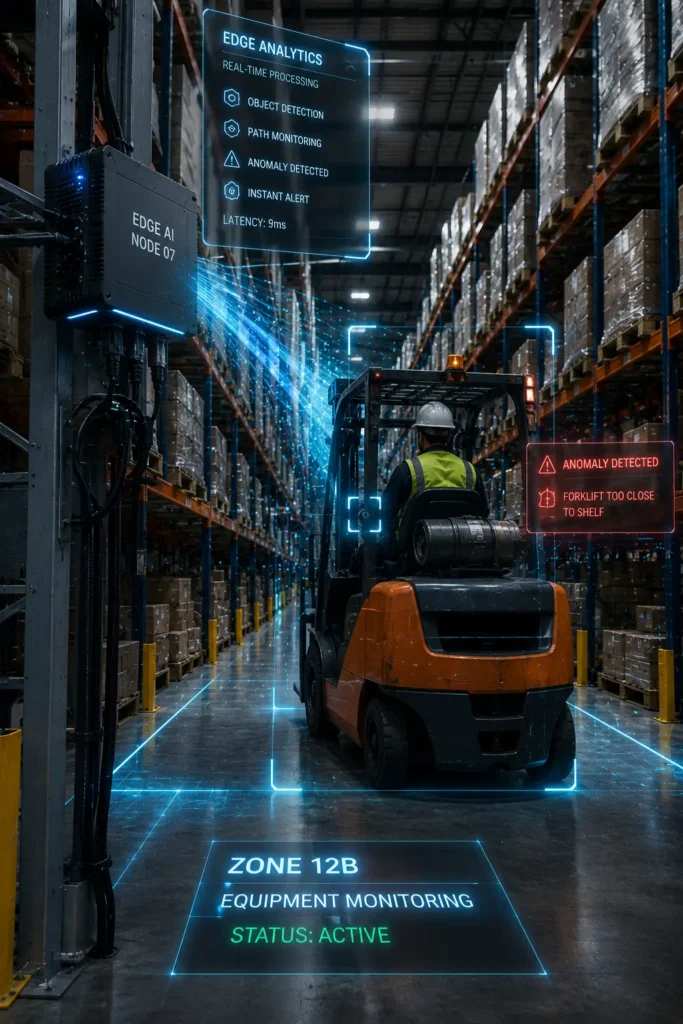
Edge Analytics monitors loading docks, forklift movement, restricted areas, and inventory operations while enabling rapid responses to operational disruptions.
Healthcare
Hospitals use Intelligent CCTV Monitoring to improve patient safety, monitor restricted zones, and maintain operational awareness across critical facilities.
Smart Buildings
Organizations analyze occupancy, visitor flow, energy usage, and access control to improve building management and resource utilization.
Edge Analytics vs Cloud Analytics
Feature | Edge Analytics | Cloud Analytics |
Processing Location | Near the data source | Centralized cloud |
Response Time | Near real time | Depends on network latency |
Bandwidth Usage | Lower | Higher |
Internet Dependency | Minimal | Continuous connection often required |
Scalability | Distributed | Centralized |
Best For | Operational Intelligence and instant actions | Historical reporting and large-scale analysis |
Many enterprises adopt a hybrid architecture that combines Edge Analytics for immediate event detection with cloud platforms for long-term reporting and strategic analysis.
Best Practices for Successful Edge Analytics Deployment
To maximize business value, organizations should:
- Identify operational processes that require immediate responses.
- Deploy AI models close to critical equipment and camera locations.
- Integrate Edge Analytics with existing enterprise systems.
- Define alert priorities to reduce unnecessary notifications.
- Update AI models frequently to increase detection precision.
- Monitor system performance using centralized AI Dashboards.
A phased implementation allows organizations to validate performance before expanding across multiple facilities.
Frequently Asked Questions
What is the difference between Edge Analytics and Edge AI?
Edge Analytics refers to processing and analyzing data locally, while Edge AI specifically uses artificial intelligence models at the edge to automate decision-making.
Why is Edge Analytics important for real-time business intelligence?
It reduces processing delays, allowing businesses to detect events and respond immediately instead of waiting for centralized analysis.
Can Edge Analytics reduce cloud costs?
Yes. Processing data locally minimizes bandwidth usage and decreases the amount of information stored and processed in the cloud.
Which industries benefit most from Edge Analytics?
Manufacturing, retail, logistics, healthcare, smart buildings, transportation, and energy sectors commonly use Edge Analytics to improve operational visibility.
Can Edge Analytics work alongside cloud analytics?
Yes. Many organizations combine Edge Analytics for immediate operational decisions with cloud analytics for reporting, trend analysis, and long-term business planning.