
Edge Analytics is the Backbone of Smart Enterprises
Enterprise operations are becoming increasingly distributed. Manufacturing plants, warehouses, retail stores, corporate offices, and logistics hubs generate continuous streams of operational data every minute. Relying solely on centralized systems to process this information can create delays, increase network traffic, and reduce the speed of operational decision-making.
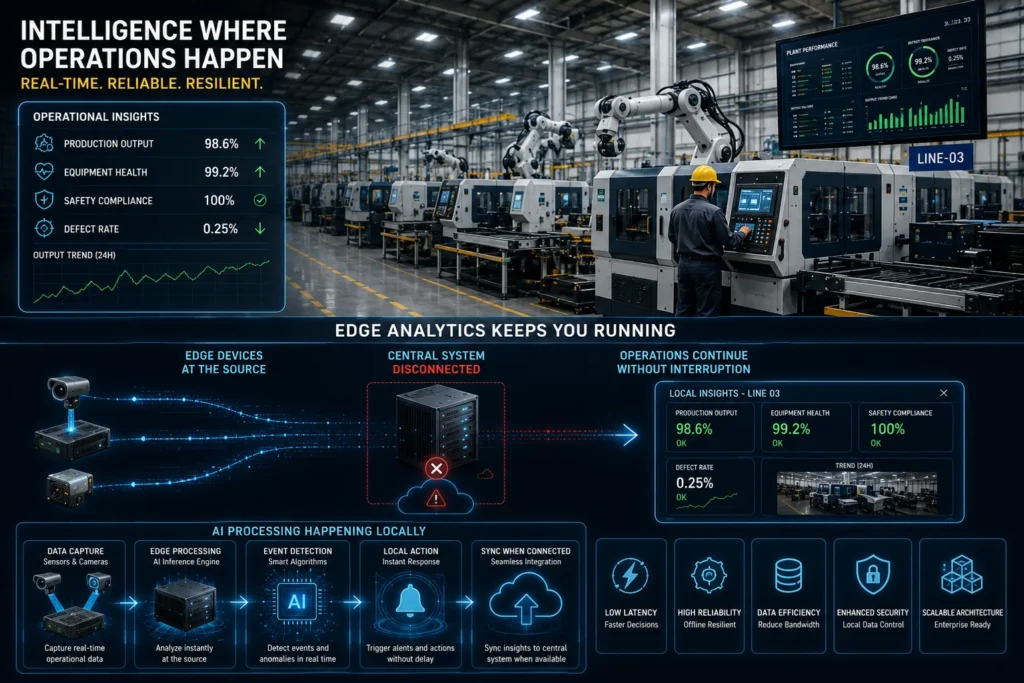
Edge Analytics changes this model by processing information where it is generated. Instead of transmitting every video stream or sensor reading to a central server, intelligent edge devices analyze data locally and deliver only meaningful events and insights. This approach enables organizations to respond faster while building a more resilient and scalable operational infrastructure.
Why Processing Data at the Source Creates Business Value
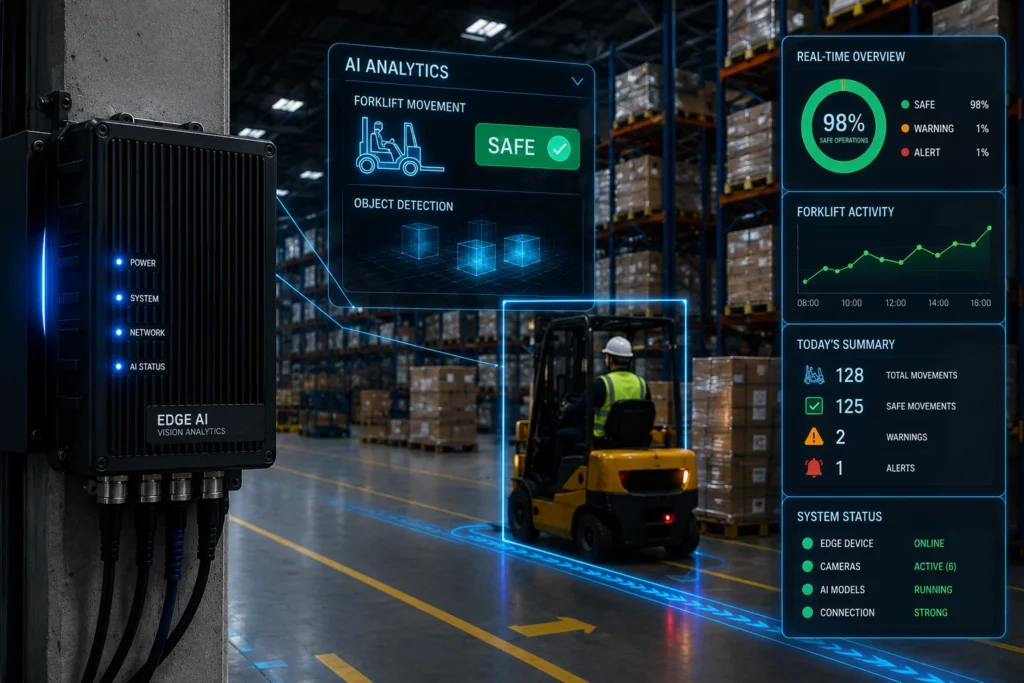
Not every operational event requires cloud processing. A worker entering a restricted area, a production line stopping unexpectedly, or a forklift approaching a pedestrian crossing requires an immediate response.
With Edge Analytics, these events are identified within the facility itself, allowing supervisors to take corrective action without waiting for centralized processing.
The result is:
- Faster operational response
- Reduced network dependency
- Lower data transmission requirements
- Improved business continuity
- Better utilization of existing infrastructure
Edge Analytics as an Enterprise Intelligence Layer
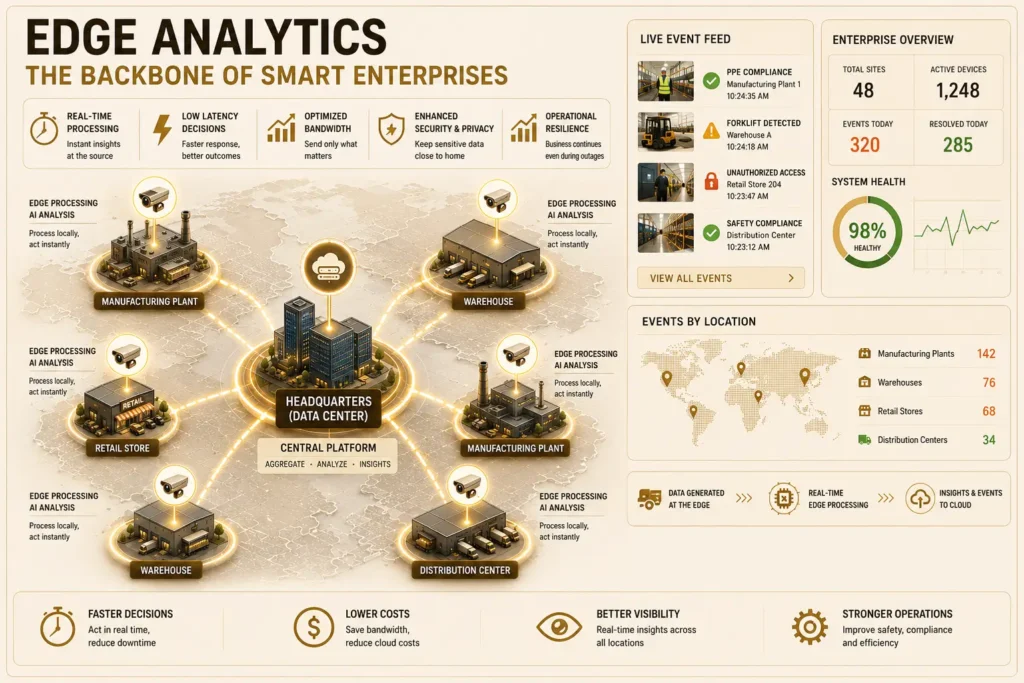
Think of Edge Analytics as a distributed intelligence network rather than a single technology component. Each edge device continuously evaluates operational activities and shares only relevant information with enterprise platforms.
This allows organizations to:
Business Function | Edge Analytics Contribution |
Workplace Safety | Detect unsafe behaviors and PPE violations |
Compliance Monitoring | Verify operational procedures continuously |
Production Operations | Identify workflow interruptions and bottlenecks |
Asset Protection | Monitor unauthorized movement and restricted areas |
Facility Management | Track occupancy and space utilization |
Operations Management | Deliver real-time dashboards and actionable alerts |
Instead of creating more data, Edge Analytics creates more useful information.
Supporting Smarter Decisions Without Increasing Complexity
Modern enterprises require technology that simplifies operations rather than adding additional management overhead.
Edge Analytics supports this objective by:
- Prioritizing important operational events
- Reducing manual video review
- Providing immediate operational alerts
- Filtering unnecessary information
- Supporting faster investigations
- Delivering contextual evidence for decision-making
Teams spend less time searching for information and more time resolving operational issues.
A Practical Architecture for Growing Organizations
As enterprises expand, they often need consistent monitoring across multiple facilities without overloading central infrastructure.
A balanced architecture typically follows this workflow:
- Cameras and sensors capture operational activities.
- Edge devices analyze events locally using AI.
- Significant events generate alerts instantly.
- Operational summaries are synchronized with enterprise dashboards.
- Historical trends support reporting and continuous improvement.
This approach combines local responsiveness with centralized visibility, enabling organizations to manage both individual sites and enterprise-wide performance effectively.
Edge Analytics Compared with Traditional Processing
Capability | Edge Analytics | Centralized Processing |
Event Analysis | Performed locally | Performed centrally |
Response Speed | Immediate or near real-time | Dependent on network latency |
Data Transmission | Sends prioritized insights | Transfers larger volumes of raw data |
Network Utilization | Optimized | Higher bandwidth demand |
Operational Resilience | Continues processing locally during connectivity interruptions | Greater reliance on continuous connectivity |
Enterprise Reporting | Integrates with centralized platforms | Native centralized reporting |
Many organizations combine both models, using Edge Analytics for operational decisions and centralized platforms for strategic reporting and long-term analytics.
Where Enterprises See the Greatest Impact
Organizations adopting Edge Analytics commonly experience improvements in several operational areas:
- Faster incident detection
- Improved Workplace Safety
- Stronger Compliance Monitoring
- Better Operational Intelligence
- Reduced manual monitoring effort
- Higher production consistency
- More efficient facility management
- Improved decision-making across multiple sites
These measurable outcomes help organizations strengthen daily operations while supporting long-term Digital Transformation initiatives.
Building an Enterprise That Thinks Closer to the Action
The future of enterprise operations depends on making informed decisions at the moment they matter most. Edge Analytics provides the foundation for this capability by placing intelligence directly within operational environments instead of relying exclusively on centralized infrastructure. As organizations continue adopting Enterprise AI, Computer Vision, AI Automation, and Real-Time Analytics, processing information at the edge will remain a critical enabler of faster, safer, and more efficient operations.
Frequently Asked Questions
What is Edge Analytics?
Edge Analytics processes operational data near the source where it is generated, enabling faster analysis and quicker operational responses.
Is Edge Analytics only used for video analytics?
No. While commonly used with AI Video Analytics and Computer Vision, Edge Analytics can also process information from sensors, industrial equipment, and connected operational devices.
Can Edge Analytics reduce cloud costs?
Yes. Since only relevant events and summarized insights are transmitted, organizations often reduce bandwidth usage and centralized processing requirements.
Is Edge Analytics suitable for multi-site enterprises?
Yes. It allows each location to process operational events locally while maintaining centralized visibility through enterprise dashboards.
Does Edge Analytics improve operational resilience?
Yes. Local processing enables monitoring and event detection to continue even if connectivity to centralized systems is temporarily disrupted.