
Why Edge AI is Becoming the Foundation of Real-Time Industrial Intelligence
A machine begins operating outside its normal vibration range. A forklift enters a restricted loading zone. A production line starts slowing due to a blocked conveyor. In each case, the value of artificial intelligence depends less on how it analyzes the event and more on where that analysis happens.
For years, cloud platforms have been the primary destination for industrial data. They continue to play a critical role in enterprise reporting and long-term analytics. However, as industries demand immediate operational decisions, organizations are increasingly moving intelligence closer to equipment, production lines, and warehouse operations. This shift is positioning Edge AI as the foundation of real-time industrial intelligence.
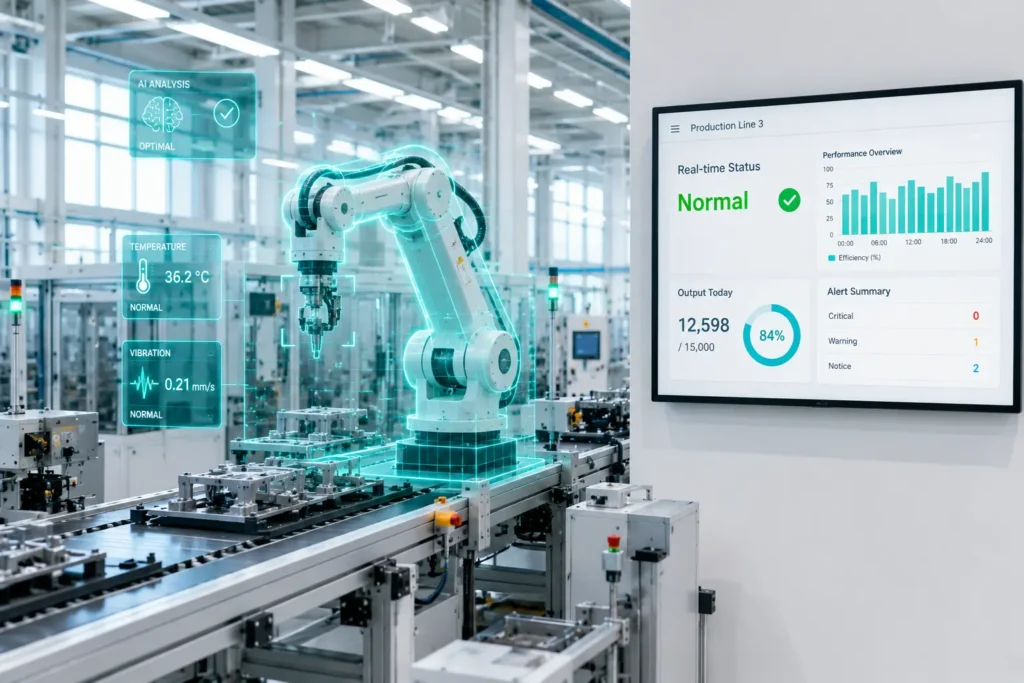
Cloud Intelligence vs. Edge Intelligence: Different Purposes, Different Strengths
Although edge AI and cloud AI are sometimes seen as rival technologies, they address different business problems.
Cloud platforms excel at storing large datasets, comparing performance across facilities, and identifying long-term operational trends. They provide the centralized visibility required for Enterprise AI and Operational Intelligence.
Conversely, edge AI emphasises making decisions quickly. AI models run directly on local devices, processing information from cameras, sensors, and industrial equipment without waiting for data to travel across a network.
Instead of replacing cloud computing, Edge AI fills the operational gap where every second matters.
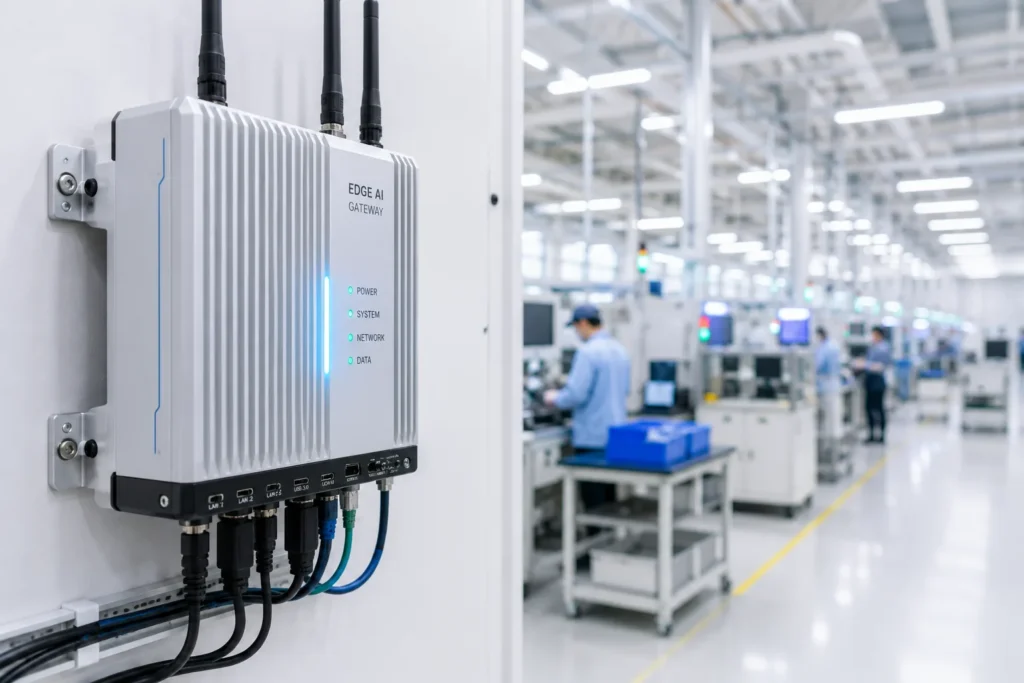
Where Cloud AI Reaches Its Limits
Industrial environments generate enormous volumes of operational data every minute. Sending every video frame, equipment reading, and operational event to the cloud can create practical challenges.
These include:
- Higher network bandwidth requirements
- Increased processing delays
- Greater dependence on reliable internet connectivity
- Slower responses to operational incidents
- Rising cloud storage costs
For applications requiring instant decisions, these limitations can reduce operational efficiency.
Why Edge AI Changes Industrial Decision-Making
Edge AI processes information at or near the source where it is generated. Rather than transmitting continuous data streams, only meaningful operational events are analyzed and shared when necessary.
This approach enables organizations to:
- Detect operational anomalies immediately
- Reduce response times for critical events
- Minimize unnecessary data transmission
- Continue monitoring during network interruptions
- Support continuous operational visibility across industrial environments
The result is faster, more reliable decision-making without sacrificing enterprise-wide visibility
Comparing Edge AI and Cloud AI
Capability | Edge AI | Cloud AI |
Real-time event detection | Excellent | Moderate |
Response latency | Very low | Depends on network connectivity |
Continuous local monitoring | Excellent | Limited |
Enterprise-wide reporting | Limited | Excellent |
Historical analytics | Limited | Excellent |
Multi-site performance analysis | Supports data collection | Comprehensive |
AI model training | Limited | Excellent |
Rather than selecting one approach, many organizations combine both to create a balanced industrial intelligence strategy.
Industries Driving Edge AI Adoption
The demand for Edge AI is increasing because industrial operations require rapid decisions in different environments.
Manufacturing
Computer Vision and AI Video Analytics identify production issues, equipment abnormalities, and workflow interruptions before they affect output.
Warehousing and Distribution
Edge Analytics supports dock operations, inventory movement, vehicle monitoring, and order fulfillment with minimal latency.
Energy and Utilities
Remote facilities continue operating with intelligent monitoring even when cloud connectivity is limited.
Pharmaceutical Manufacturing
SOP Monitoring helps identify deviations in production workflows while supporting quality and operational consistency.
Transportation Infrastructure
Ports, airports, and logistics terminals process operational events locally to improve traffic flow and equipment coordination.
Building an Effective Edge AI Strategy
Organizations adopting Edge AI should focus on business objectives before selecting technology.
Key planning considerations include:
- Assess camera placement and image quality.
- Identify operations where response time directly affects performance.
- Determine which workloads should remain at the edge and which belong in the cloud.
- Integrate Edge AI with AI Dashboards and Operational Intelligence platforms.
- Establish governance for data security and system maintenance.
- Measure operational improvements using business-focused KPIs.
A phased rollout allows organizations to validate performance improvements before expanding across multiple sites.
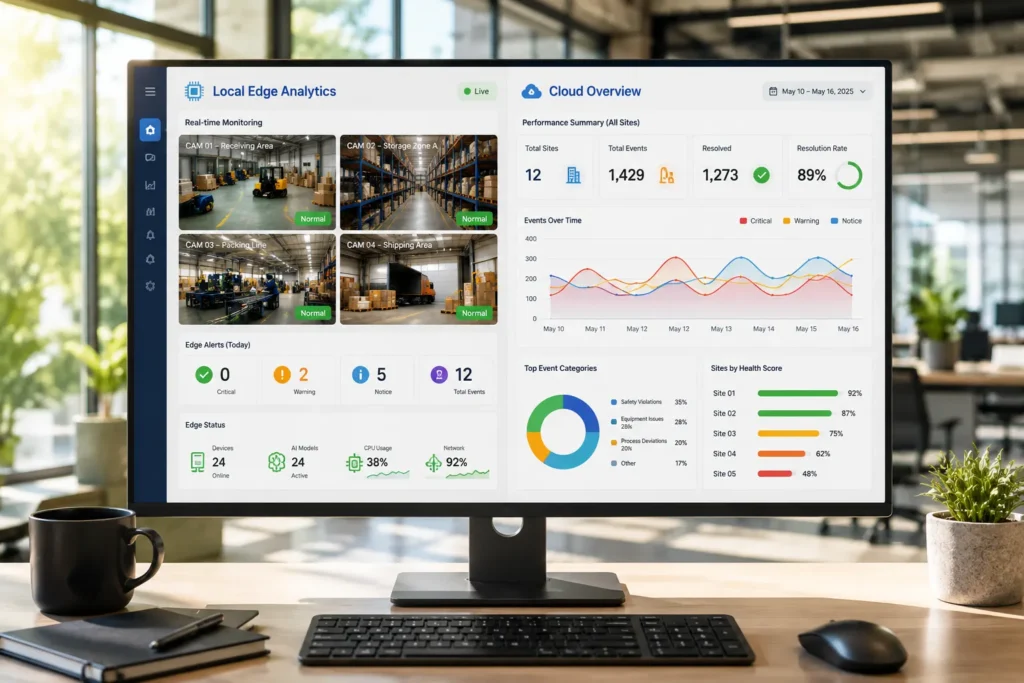
The Future of Industrial Intelligence
Industrial intelligence is evolving toward distributed decision-making. As AI models become more efficient, more analysis will occur directly where operations take place, while cloud platforms continue providing enterprise-wide coordination and long-term insights.
Edge AI will increasingly support AI Automation, Intelligent Operations, Real-Time Analytics, and Digital Transformation initiatives by enabling immediate responses without depending entirely on centralized infrastructure.
Organizations that successfully combine local intelligence with enterprise-wide analytics will be better positioned to improve operational efficiency, reduce downtime, and build resilient industrial operations.
FAQ
Why is Edge AI becoming more important in industrial environments?
Decisions that must be made quickly in industrial processes are becoming more and more dependent on cloud processing. Local analysis with low latency is made possible by edge AI.
Does Edge AI replace cloud computing?
No. Edge AI handles real-time operational decisions, while cloud platforms remain essential for centralized reporting, historical analysis, and AI model management.
Which industrial sectors benefit most from Edge AI?
Manufacturing, warehousing, logistics, pharmaceuticals, energy, utilities, mining, and transportation infrastructure commonly benefit from local AI processing.
How does Edge AI improve AI Video Analytics?
By processing video locally, Edge AI reduces bandwidth usage, accelerates event detection, and supports uninterrupted monitoring during network disruptions.
What should organizations evaluate before implementing Edge AI?
Key considerations include camera quality, network infrastructure, operational priorities, cybersecurity, scalability, and integration with existing enterprise systems.
Which technologies work alongside Edge AI?
Edge AI commonly integrates with AI Video Analytics, Computer Vision, Edge Analytics, Real-Time Analytics, AI Dashboards, Operational Intelligence, Enterprise AI, AI Automation, Smart Manufacturing, Compliance Monitoring, Event Monitoring, SOP Monitoring, Workplace Safety, and Digital Transformation