
Future of Smart Warehouses with AI Monitoring
Warehouses are evolving from storage facilities into intelligent operational hubs that support inventory accuracy, order fulfillment, workplace safety, and supply chain performance. As customer expectations for faster deliveries continue to grow, warehouse operators need greater visibility into daily operations while managing larger facilities and higher order volumes. This is driving the adoption of AI monitoring as a practical solution for improving operational oversight.
By combining computer vision, AI video analytics, edge AI, and real-time analytics, smart warehouses can continuously monitor activities, identify operational deviations, and provide actionable insights. Rather than replacing warehouse personnel, AI helps teams make faster decisions by delivering consistent, data-driven visibility across the facility.
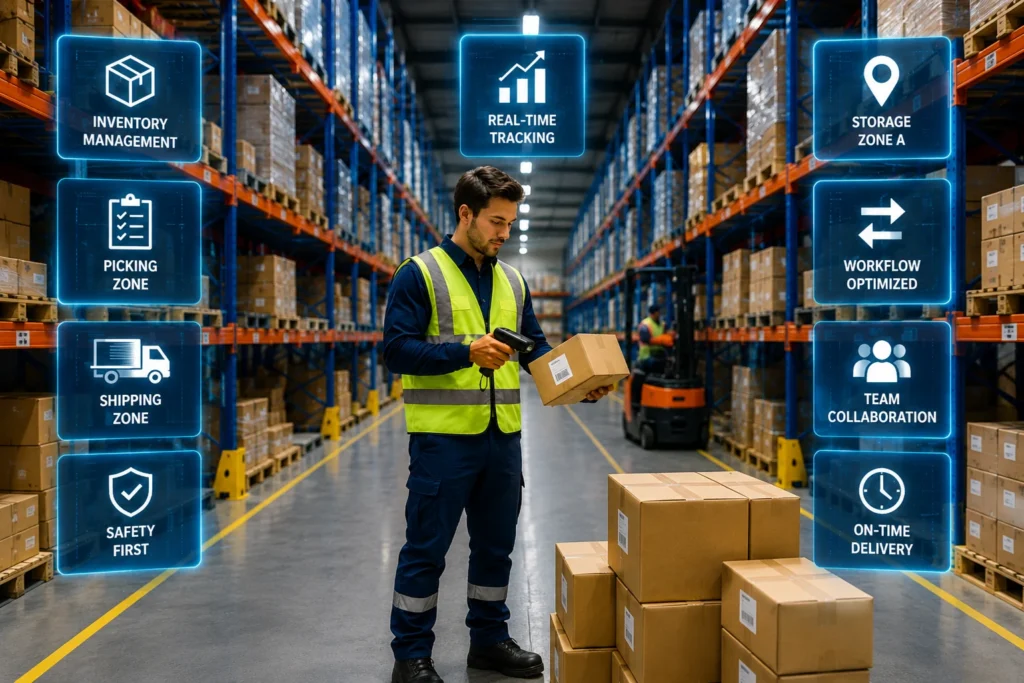
How Smart Warehouses Are Transforming Operations
Traditional warehouse management often relies on periodic inspections, manual reporting, and operator observations. While these methods remain valuable, they can become difficult to scale across multiple shifts, large storage areas, and distribution centers.
AI monitoring provides continuous operational awareness by observing warehouse activities in real time. This enables supervisors to respond quickly to safety issues, inventory movement, and process deviations before they affect productivity.
Key operational priorities include:
- Inventory accuracy
- Workplace safety
- Efficient material movement
- Loading dock performance
- Order fulfillment efficiency
- Compliance monitoring
- Asset utilization
Where AI Monitoring Delivers Value
Warehouse Function | AI Monitoring Capability | Business Benefit |
Inventory Storage | Detects empty or misplaced inventory | Improved stock accuracy |
Forklift Operations | Monitors vehicle movement and safety | Reduced workplace risk |
Loading Docks | Tracks loading and unloading activities | Faster shipment processing |
Restricted Areas | Detects unauthorized access | Improved facility security |
Employee PPE Compliance | Verifies protective equipment usage | Better workplace safety |
Order Picking | Monitors workflow efficiency | Improved productivity |
Aisle Congestion | Identifies traffic bottlenecks | Smoother warehouse operations |
Asset Tracking | Monitors equipment movement | Better asset utilization |
SOP Monitoring | Detects workflow deviations | Improved operational consistency |
Multi-Warehouse Visibility | Centralized operational dashboards | Better decision-making |
Technologies Shaping the Smart Warehouse
Modern warehouse monitoring combines several complementary technologies.
- AI Video Analytics for continuous operational monitoring
- Computer Vision for recognizing objects, equipment, and activities
- Edge AI for faster processing within warehouse environments
- Real-Time Analytics for immediate operational visibility
- AI Dashboards for centralized reporting
- Operational Intelligence for identifying performance trends
- Enterprise AI for multi-site warehouse management
- AI Automation for repetitive monitoring tasks
Together, these technologies provide warehouse managers with timely information that supports informed operational decisions.
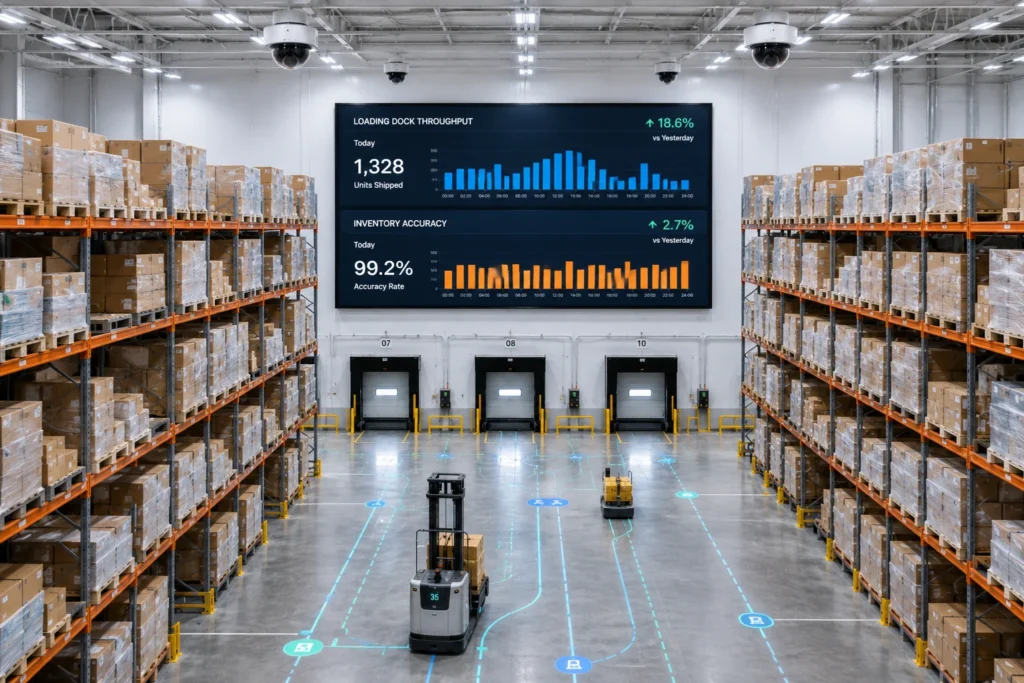
AI Monitoring vs Traditional Warehouse Oversight
Area | Traditional Monitoring | AI Monitoring |
Warehouse Observation | Periodic inspections | Continuous monitoring |
Inventory Visibility | Manual verification | Real-time operational insights |
Safety Monitoring | Staff supervision | Automated event detection |
Operational Reporting | Manual documentation | AI dashboards and analytics |
Multi-Site Management | Individual site reporting | Centralized oversight |
Scalability | Requires additional personnel | Easily expands across facilities |
Many warehouse operators combine AI with experienced supervisors to create a balanced approach that improves operational efficiency without removing human oversight.
Business Outcomes of AI-Powered Warehousing
Organizations investing in AI monitoring often focus on measurable operational improvements.
Common business outcomes include:
- Faster incident detection
- Improved inventory accuracy
- Reduced manual inspections
- Better workplace safety
- Improved compliance monitoring
- Faster loading and dispatch operations
- Increased operational visibility
- Better resource utilization
- Reduced operational bottlenecks
- Improved decision-making using real-time analytics
These outcomes enable warehouse operators to improve productivity while maintaining operational consistency across expanding distribution networks.
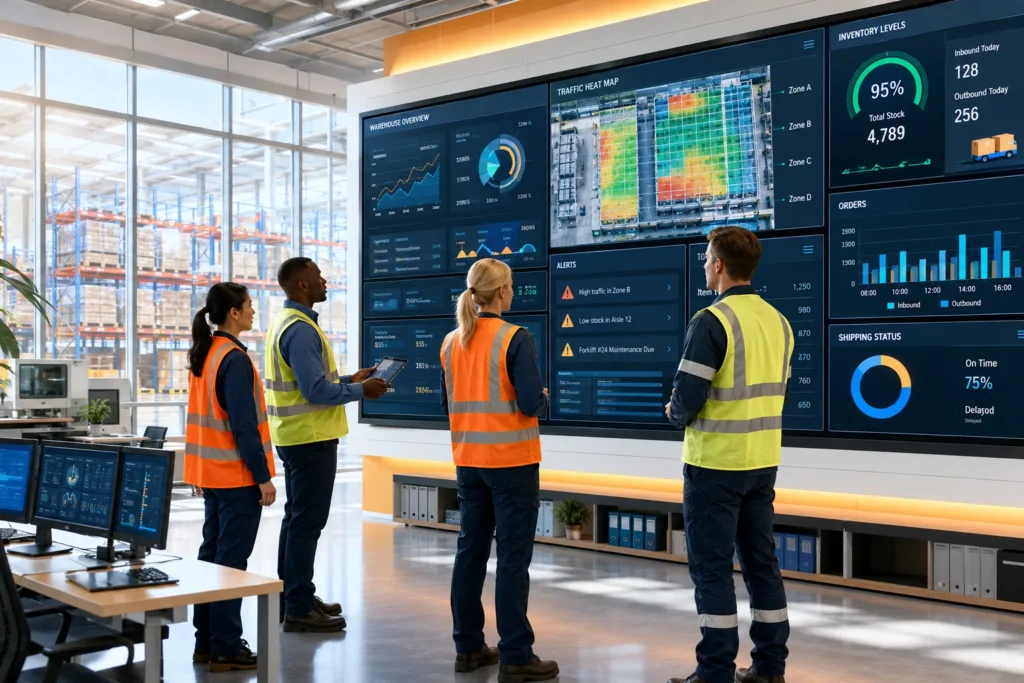
Preparing Warehouses for the Next Generation of Operations
The future of warehouse management extends beyond automation alone. AI monitoring provides the operational intelligence needed to support larger facilities, increasing inventory volumes, and more complex supply chains.
Organizations are expected to expand AI monitoring into additional areas such as predictive maintenance support, automated inventory verification, intelligent traffic management, and enhanced compliance monitoring. As these capabilities mature, warehouse teams will have greater access to real-time operational data that supports faster and more accurate decisions.
A phased implementation approach allows businesses to introduce AI into existing warehouse operations while maintaining established workflows and minimizing disruption.
The Road Ahead
Smart warehouses are becoming an important component of modern supply chains by combining AI monitoring with experienced operational teams. Continuous visibility into inventory, safety, equipment movement, and warehouse workflows enables organizations to improve efficiency without compromising operational control.
As warehouse operations continue to grow in scale and complexity, AI monitoring will play an increasingly important role in supporting safer workplaces, improving operational consistency, strengthening compliance, and delivering the real-time operational intelligence required for long-term business success.
FAQs
What is a smart warehouse?
A smart warehouse uses technologies such as AI video analytics, computer vision, and real-time analytics to improve operational visibility, inventory management, and warehouse efficiency.
How does AI improve warehouse operations?
AI continuously monitors warehouse activities, detects operational deviations, tracks inventory movement, supports workplace safety, and provides actionable operational insights.
Can AI monitor multiple warehouse locations?
Yes. Enterprise AI platforms provide centralized dashboards that enable managers to monitor multiple warehouses from a single location.
Which warehouse processes benefit most from AI monitoring?
Inventory management, forklift operations, loading docks, order picking, workplace safety, compliance monitoring, and asset tracking are among the most common applications.
What business benefits can organizations expect from AI monitoring in warehouses?
Businesses can improve inventory accuracy, strengthen workplace safety, reduce manual monitoring, increase operational visibility, optimize resource utilization, and make faster decisions using real-time analytics.