
AI Can Monitor Thousands of Operational Activities Simultaneously
Enterprise operations rarely stop moving. Manufacturing lines produce continuously, warehouses receive and dispatch inventory throughout the day, retail stores serve customers across multiple locations, and logistics facilities coordinate hundreds of vehicle movements. Every minute generates thousands of operational activities that influence safety, productivity, compliance, and customer service.
Relying on manual supervision to observe all these activities is no longer practical. Artificial intelligence enables organizations to monitor thousands of operational events simultaneously, providing continuous visibility across facilities without requiring teams to watch every camera or inspect every process.
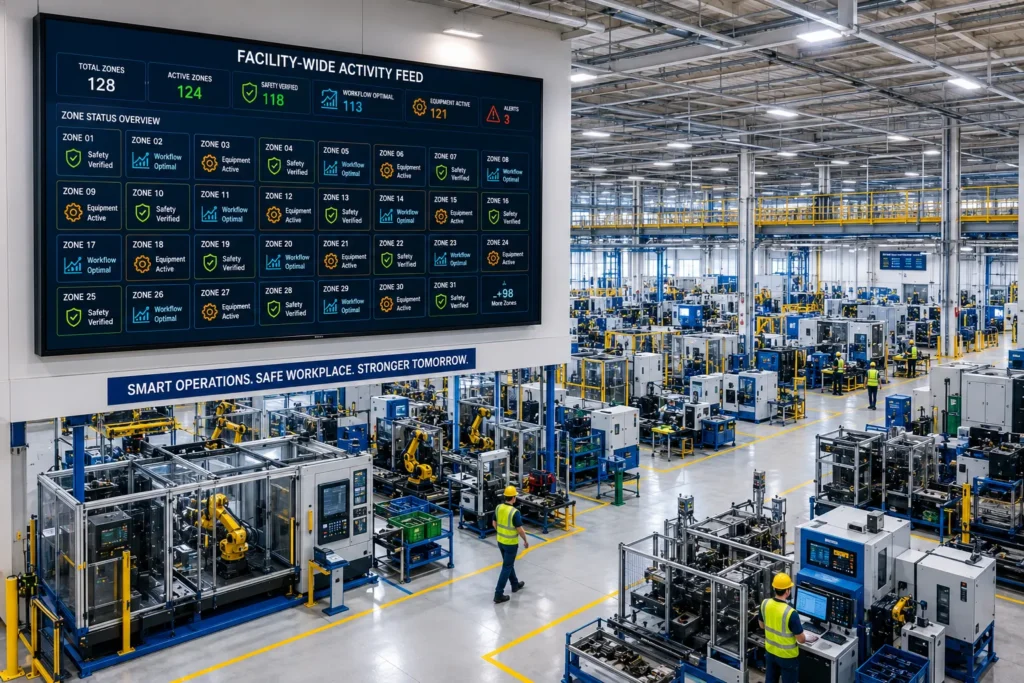
How AI Processes Multiple Activities at the Same Time
AI-powered video analytics continuously evaluates live video streams using computer vision, edge AI, and real-time analytics. Instead of focusing on a single camera or process, the system analyzes multiple operational activities simultaneously.
Examples include:
- PPE compliance verification
- Production workflow monitoring
- Equipment utilization tracking
- Loading dock operations
- Vehicle movement analysis
- Occupancy monitoring
- Queue management
- Restricted area access
- Material handling activities
- SOP compliance observation
Each activity is evaluated independently while contributing to a unified operational view across the enterprise.
Continuous Monitoring Without Continuous Manual Supervision
Traditional monitoring often depends on operators watching multiple displays and responding when something appears unusual. As the number of cameras and facilities increases, maintaining consistent attention becomes increasingly difficult.
AI changes this model by automatically evaluating every monitored activity and highlighting only events that require attention.
Manual Monitoring | AI-Assisted Monitoring |
Limited by human attention | Simultaneous analysis of multiple activities |
Continuous screen observation | Automated operational monitoring |
Reactive incident discovery | Real-time event detection |
Inconsistent monitoring | Standardized analysis across locations |
Higher manual workload | Focused operational decision-making |
Rather than replacing operational teams, AI allows them to spend less time observing routine activities and more time resolving meaningful operational issues.
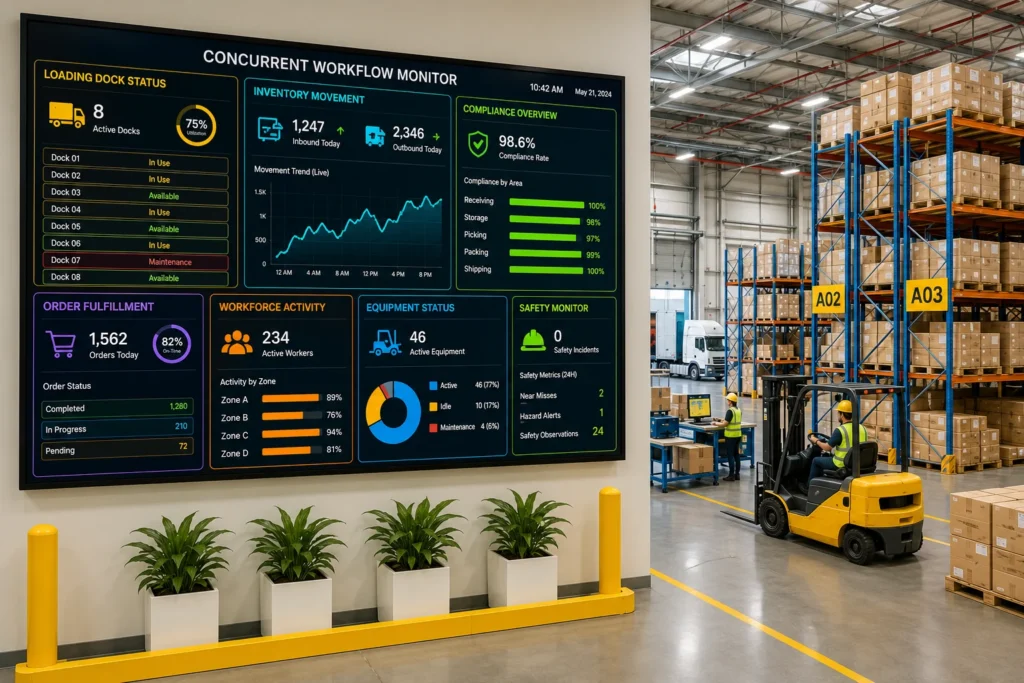
The Challenge of Monitoring Modern Operations
As organizations grow, operational complexity increases rapidly. Multiple facilities, hundreds of employees, numerous workflows, and continuous equipment activity create more information than supervisors can realistically monitor.
Common operational challenges include:
- Limited visibility across multiple sites
- Delayed identification of process deviations
- Manual observation of critical workflows
- Missed compliance issues
- Slow response to operational disruptions
- Inconsistent monitoring between shifts
These challenges are not caused by a lack of information. They result from having more operational activity than people can continuously observe.
Building Enterprise-Wide Operational Awareness
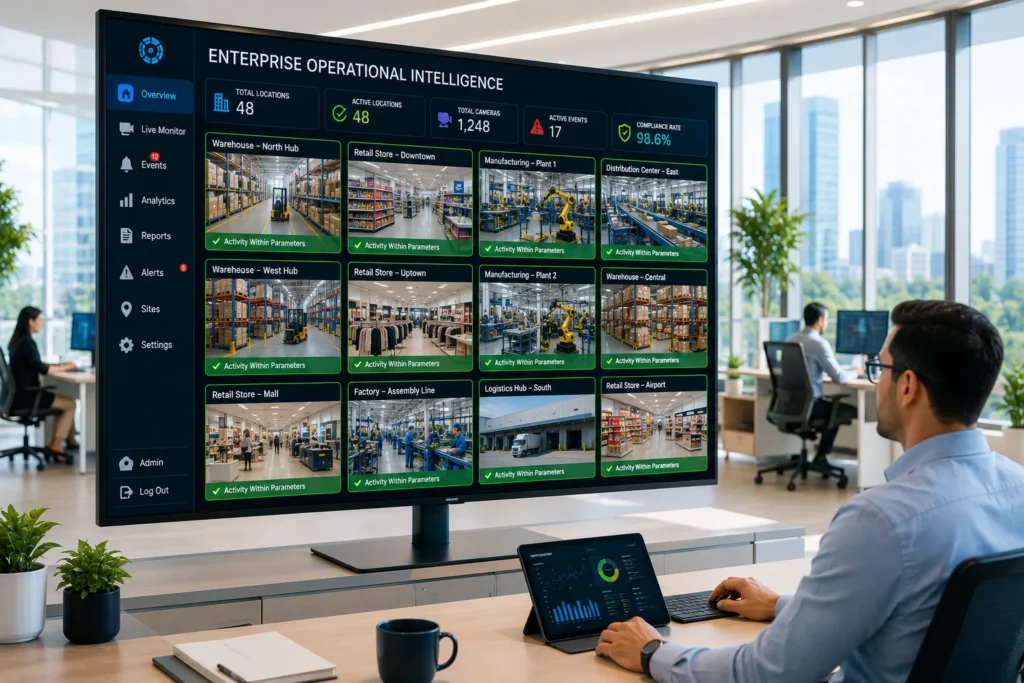
One of the greatest advantages of AI is its ability to combine information from multiple facilities into a single operational view.
Supervisors and executives can monitor:
- Manufacturing plants
- Distribution centers
- Warehouses
- Retail stores
- Corporate campuses
- Transportation hubs
- Healthcare facilities
- Construction sites
A centralized dashboard enables leadership teams to compare operational performance, identify recurring trends, and prioritize areas requiring immediate attention.
This level of visibility is difficult to achieve using manual monitoring alone.
Turning Continuous Observation Into Business Intelligence
Monitoring thousands of activities generates valuable operational data that extends beyond individual alerts.
Organizations can analyze long-term operational trends to:
- Improve workforce planning
- Optimize equipment utilization
- Identify recurring bottlenecks
- Strengthen compliance programs
- Improve workplace safety
- Measure operational consistency
- Support preventive maintenance
- Enhance resource allocation
Instead of simply responding to incidents, organizations continuously improve operations using measurable operational intelligence.
Business Benefits of Large-Scale AI Monitoring
Organizations using AI to monitor enterprise operations often achieve improvements across multiple business functions.
These include:
- Faster operational response
- Reduced manual monitoring effort
- Improved compliance visibility
- Better workplace safety oversight
- Increased operational transparency
- Higher productivity
- More consistent process execution
- Better multi-site coordination
- Stronger executive reporting
- Greater support for enterprise digital transformation
As operational complexity increases, scalable monitoring becomes an essential capability rather than an operational convenience.
Scaling Operational Visibility for the Future
Modern enterprises generate more operational activity than manual monitoring can effectively manage. AI provides the ability to observe thousands of simultaneous activities, identify meaningful operational events, and deliver actionable insights without overwhelming operational teams. By combining continuous monitoring with enterprise-wide analytics, organizations create a stronger foundation for safer workplaces, more efficient processes, and better-informed business decisions.
Frequently Asked Questions
How can AI monitor thousands of operational activities simultaneously?
AI processes multiple live video streams and operational inputs at the same time using computer vision and real-time analytics, allowing continuous evaluation without relying on manual observation.
Does AI replace human supervisors?
No. AI supports supervisors by identifying important operational events automatically, allowing teams to focus on investigation, decision-making, and process improvement.
What types of activities can AI monitor?
AI can monitor safety compliance, production workflows, equipment activity, occupancy, vehicle movement, loading operations, queue management, restricted areas, and many other operational processes.
Can AI monitor multiple facilities from one platform?
Yes. Centralized dashboards allow organizations to monitor and compare operational performance across multiple sites in real time.
Which industries benefit from large-scale operational monitoring?
Manufacturing, warehousing, logistics, retail, healthcare, transportation, construction, energy, and other operationally intensive industries benefit from AI-assisted enterprise monitoring.