
AI-Driven Compliance Management Platforms Explained
An audit is scheduled for next week, but the compliance team is still gathering inspection records, verifying safety logs, reviewing surveillance footage, and checking whether standard operating procedures were consistently followed. Meanwhile, production continues, contractors move across multiple sites, and new operational events are generated every minute.
This scenario is common across manufacturing plants, warehouses, healthcare facilities, food processing units, and corporate campuses. The challenge isn’t the absence of compliance processes—it’s managing them continuously instead of periodically. AI-driven compliance management platforms help organizations shift from reactive audits to continuous operational compliance.
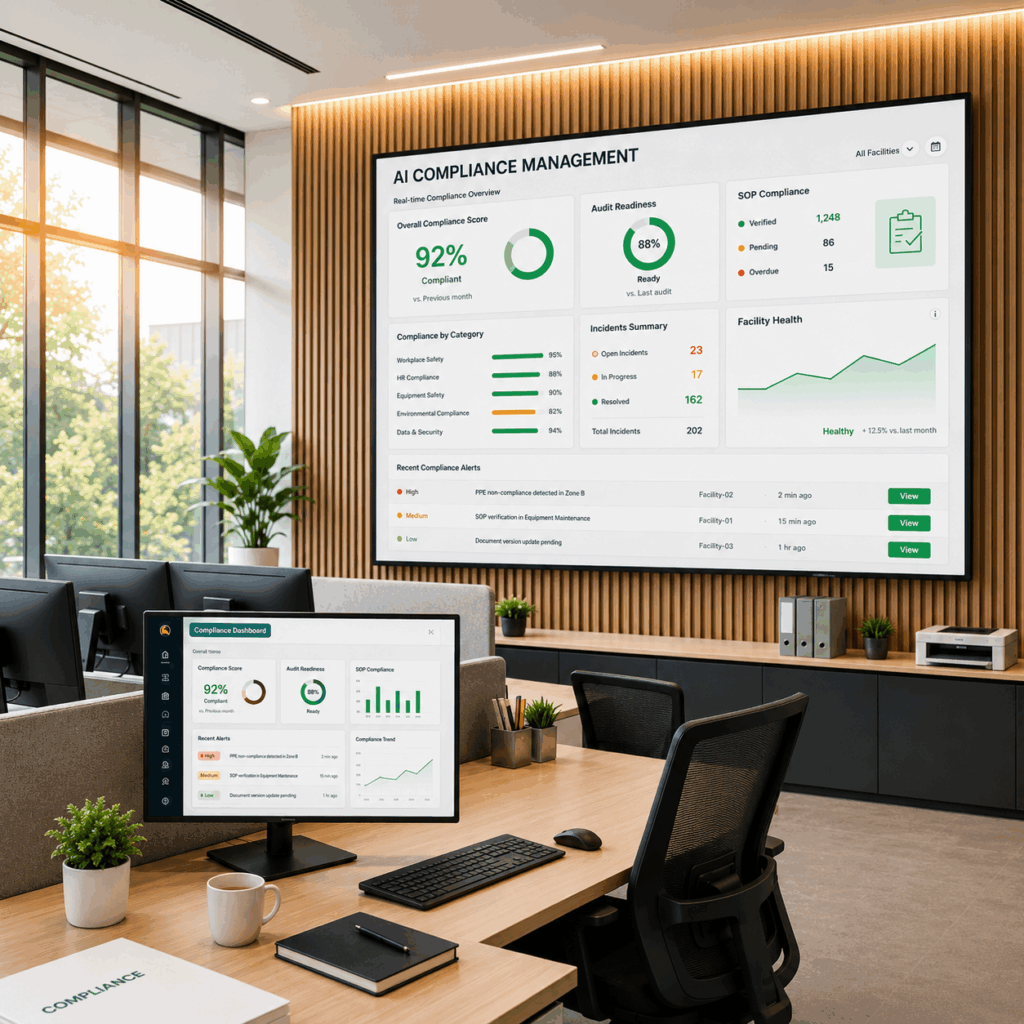
Compliance Is a Continuous Process
Most organizations monitor compliance through inspections, manual observations, and scheduled reporting. While effective for documentation, these approaches often identify issues after they have already affected operations.
A modern compliance platform continuously evaluates workplace activities, compares them against predefined policies, and alerts responsible teams when deviations occur.
Instead of reviewing yesterday’s problems, organizations gain visibility into today’s operational performance.
The Compliance Lifecycle Powered by AI
An AI-driven platform follows a structured workflow that transforms operational data into measurable compliance outcomes.
Compliance Stage | AI Contribution |
Observe | AI Video Analytics monitors live operations continuously |
Detect | Computer Vision identifies policy deviations and unsafe behaviors |
Notify | Real-time alerts are sent to supervisors and operations teams |
Document | Events are automatically recorded with supporting evidence |
Analyze | AI Dashboards identify recurring trends and compliance gaps |
Improve | Operational insights support process optimization and training |
Each stage builds on the previous one, creating a continuous cycle of monitoring and improvement.
What Makes These Platforms Intelligent?
Unlike traditional compliance software that relies primarily on manual reporting, AI-driven platforms automatically interpret operational activities.
Typical capabilities include:
- PPE verification
- Restricted-area monitoring
- SOP Monitoring
- Hygiene and sanitation verification
- Occupancy monitoring
- Vehicle and pedestrian safety analysis
- Event Monitoring
- Automated compliance documentation
By combining AI Video Analytics with Computer Vision, organizations gain immediate awareness of operational exceptions without relying solely on human
One Platform, Multiple Departments
Compliance is no longer limited to health and safety teams. Different business functions benefit from a shared operational platform.
Operations Teams
Monitor production flow, equipment usage, and operational consistency.
Safety Teams
Track Workplace Safety, hazardous zones, emergency exits, and PPE compliance.
Quality Assurance
Verify manufacturing procedures, sanitation activities, and production standards.
Facility Management
Monitor visitor access, occupancy levels, contractor movement, and restricted areas.
Executive Leadership
Review enterprise-wide Operational Intelligence through centralized AI Dashboards.
This unified approach reduces information silos and improves coordination across departments.
Comparing Traditional and AI-Driven Compliance
Traditional Compliance | AI-Driven Compliance Platform |
Periodic inspections | Continuous monitoring |
Manual observations | Automated event detection |
Paper or spreadsheet records | Digital evidence and centralized reporting |
Reactive investigations | Immediate operational alerts |
Historical reporting | Real-Time Analytics |
Limited operational visibility | Enterprise-wide Operational Intelligence |
The objective is not to replace compliance professionals but to provide them with better information, faster.
Business Value Beyond Regulatory Requirements
Organizations often discover that AI-powered compliance platforms improve operational performance as well as audit readiness.
Key business outcomes include:
- Faster incident response
- Reduced manual reporting
- Improved operational visibility
- Better Workplace Safety
- More consistent SOP adherence
- Stronger cross-site governance
- Data-driven operational decisions
- Lower administrative effort
These benefits support both regulatory compliance and long-term operational efficiency.
Building a Successful Compliance Program
Technology delivers the greatest value when supported by well-defined operational processes.
Organizations should:
- Identify high-risk compliance scenarios.
- Standardize monitoring policies across facilities.
- Integrate AI alerts with existing workflows.
- Review analytics to identify recurring operational issues.
- Update AI rules as regulations and procedures evolve.
- Train employees using insights generated by the platform.
- Expand deployments gradually across departments.
A structured implementation strategy helps organizations improve compliance without disrupting daily operations.
Creating a Smarter Compliance Culture
Compliance should not begin only when an inspection is scheduled. AI-driven compliance management platforms enable organizations to monitor operations continuously, identify risks earlier, and improve consistency across every facility. By combining AI Video Analytics, Computer Vision, Edge AI, Operational Intelligence, and Real-Time Analytics, enterprises can strengthen governance, improve Workplace Safety, support regulatory readiness, and create a culture where compliance becomes an integral part of everyday operations rather than a periodic activity.
FAQ
What is an AI-driven compliance management platform?
It is a software platform that combines AI Video Analytics, Computer Vision, and automation to continuously monitor operations, detect compliance issues, and support regulatory reporting.
Which industries commonly use AI-driven compliance platforms?
Manufacturing, food processing, healthcare, logistics, warehousing, retail, construction, energy, transportation, and corporate facilities are among the primary users.
Can AI automatically document compliance events?
Yes. Many platforms automatically record detected events with timestamps, supporting evidence, and audit-ready reports.
Does AI replace compliance officers?
No. AI assists compliance teams by automating monitoring and documentation, allowing professionals to focus on investigations, training, and process improvement.
How do AI-driven platforms improve operational performance?
They reduce manual monitoring, provide continuous visibility, identify recurring compliance issues, and deliver actionable insights that help organizations improve efficiency while maintaining regulatory standards