
AI-Powered CCTV Monitoring Workflow: From Camera to Intelligent Decision
A CCTV camera captures thousands of video frames every minute, yet only a small fraction contains information that requires action. Security teams, plant managers, and operations leaders face the challenge of separating routine activity from events that demand immediate attention. AI-Powered CCTV Monitoring addresses this challenge by transforming continuous video streams into structured operational insights, enabling faster and more consistent decision-making.
The workflow extends far beyond recording footage. It combines AI Video Analytics, Computer Vision, Edge AI, and Operational Intelligence to detect events, interpret activities, prioritize risks, and deliver meaningful information to the right people at the right time. The result is a process that supports security, workplace safety, operational governance, and business management without requiring constant manual observation.
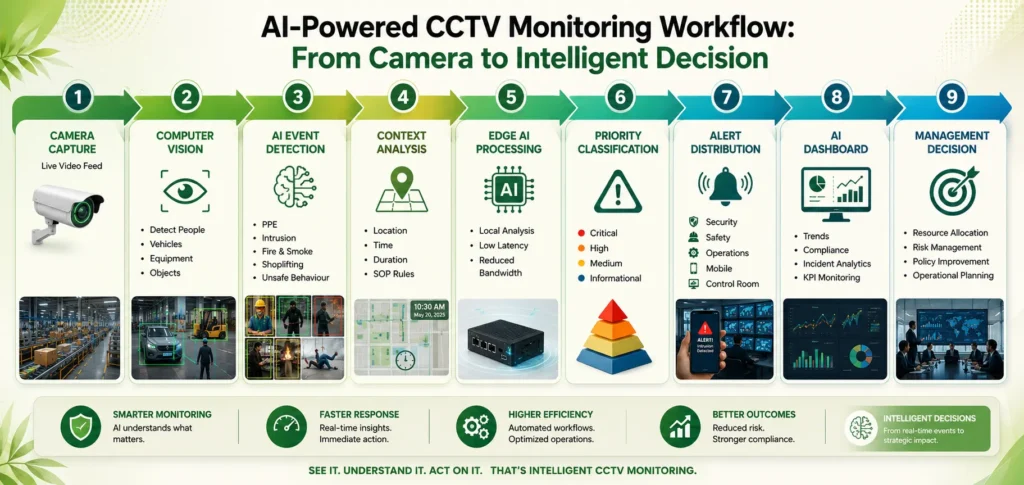
The Journey from Video to Business Action
1. Video Capture
Input Source
The process begins with CCTV cameras installed across operational areas such as:
- Manufacturing plants
- Warehouses
- Loading docks
- Retail stores
- Office facilities
- Parking areas
Modern AI Surveillance platforms can utilize existing camera infrastructure, allowing organizations to enhance monitoring capabilities without replacing their entire surveillance system.
2. Intelligent Video Processing
Instead of storing footage without analysis, Computer Vision continuously examines each frame to understand what is happening.
AI identifies visual elements including:
- People
- Vehicles
- Equipment
- Machinery
- Safety gear
- Restricted zones
- Objects entering or leaving monitored areas
Rather than simply recording movement, the system interprets activities within the operational context.
3. Event Detection
After understanding the scene, AI evaluates predefined operational conditions.
Typical monitored events include:
- PPE non-compliance
- Unauthorized access
- Intrusion detection
- Fire and smoke indications
- Object abandonment
- Shoplifting behaviour
- Vehicle violations
- Crowd formation
- Slip and fall incidents
- Equipment safety violations
Only relevant observations are promoted as operational events, significantly reducing unnecessary reviews.
4. Context Evaluation
Not every detected event requires the same response.
AI considers additional context such as:
Operational Factor | Decision Consideration |
Location | High-security or public area |
Time | Working hours or after-hours |
Object | Employee, visitor, contractor or vehicle |
Duration | Temporary activity or prolonged behaviour |
Operational rules | SOP or safety policy compliance |
This contextual understanding improves the quality of alerts while minimizing false positives.
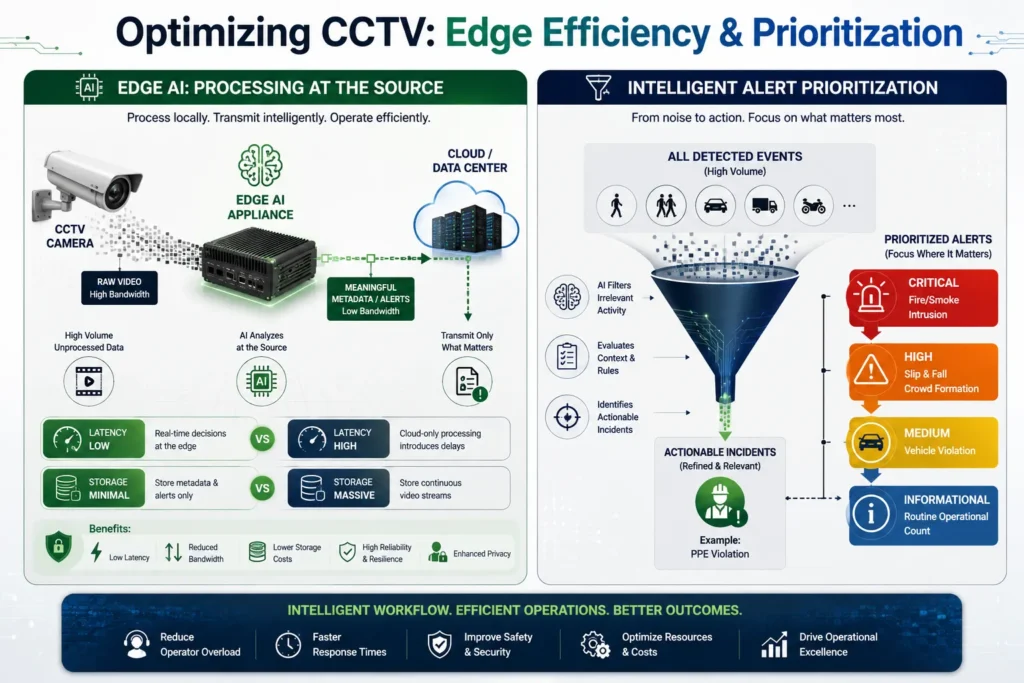
5. Edge AI Decision Processing
Edge AI performs analysis close to the camera, allowing rapid evaluation before transmitting only meaningful information.
Benefits include:
- Reduced network traffic
- Lower storage requirements
- Faster alert generation
- Reliable operation during network interruptions
- Efficient Real-Time Analytics
Local processing also supports privacy by limiting unnecessary video transmission.
6. Alert Prioritization
Rather than generating identical notifications for every event, AI classifies incidents according to business impact.
Common priority levels include:
- Critical
- High
- Medium
- Informational
This helps operators focus first on situations that require immediate attention while less urgent observations remain available for review.
7. Notification and Response
Relevant stakeholders receive alerts through appropriate communication channels.
Depending on operational requirements, notifications may reach:
- Security teams
- Safety managers
- Plant supervisors
- Control rooms
- Operations managers
- Mobile devices
- AI Dashboards
Each alert includes supporting evidence such as snapshots, timestamps, camera identification, and event descriptions to facilitate timely decision-making.
8. Operational Intelligence
Individual events become valuable operational records rather than isolated notifications.
Organizations can examine trends such as:
- Frequently violated safety procedures
- High-risk operational zones
- Peak incident periods
- Recurring security concerns
- Compliance performance
- Workforce behavioural patterns
These insights support better planning, policy refinement, and resource allocation.
9. Management Decision
The final stage is not surveillance—it is informed action.
Leadership teams use accumulated information to:
- Review operational risks
- Allocate supervisory resources
- Improve workplace policies
- Enhance facility planning
- Measure compliance performance
- Support governance initiatives
- Monitor operational consistency
The workflow concludes when observations are translated into practical management decisions that improve day-to-day operations.
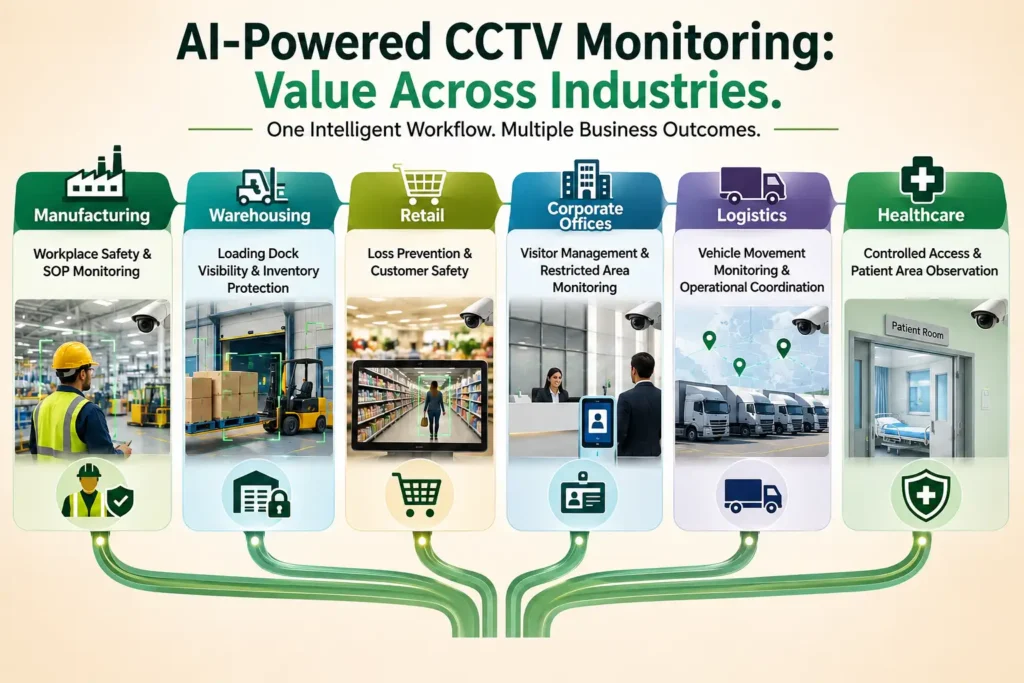
How the Workflow Creates Value Across Industries
Different environments benefit from the same workflow in different ways.
Operational Environment | Primary Outcome |
Manufacturing | Workplace Safety and SOP Monitoring |
Warehousing | Loading dock visibility and inventory protection |
Retail | AI Surveillance for loss prevention and customer safety |
Corporate Offices | Visitor management and restricted area monitoring |
Logistics | Vehicle movement monitoring and operational coordination |
Healthcare | Controlled access and patient area observation |
Although objectives vary, the underlying workflow remains consistent: convert visual information into actionable business knowledge.
Beyond Recording: Building a Decision-Oriented Monitoring Process
Traditional CCTV systems primarily preserve video for later investigation. AI-Powered CCTV Monitoring changes this role by introducing a structured workflow that continuously evaluates operational activities as they occur. Instead of relying solely on manual observation, organizations receive prioritized information that supports timely responses, policy oversight, and informed management decisions.
As facilities grow in size and operational complexity, the ability to transform visual data into dependable decision support becomes an important element of everyday management. The real value lies not in capturing more footage, but in ensuring that the right information reaches the right decision-makers when it matters most.
FAQs
Why is event prioritization important in AI-powered CCTV monitoring?
It prevents operators from being overwhelmed by notifications, allowing critical incidents to receive immediate attention while lower-priority events remain available for later review.
Can AI monitor both safety and security using the same CCTV infrastructure?
Yes. Depending on the configured rules, the same camera network can support workplace safety, security, compliance monitoring, and operational observations.
How does Edge AI improve CCTV monitoring performance?
Edge AI processes video near the camera, reducing bandwidth usage, accelerating alert generation, and maintaining monitoring capabilities even during network interruptions.
What types of operational insights can management obtain from AI video analytics?
Organizations can identify recurring safety issues, frequently accessed restricted areas, incident trends, compliance performance, and operational patterns that influence planning and governance.
Does every detected activity generate an alert?
No. AI evaluates the context of detected activities and generates alerts only when predefined operational conditions or business rules are met.