
AI-Powered SOP Monitoring Will Replace Traditional Manual Compliance Audits
A production supervisor notices that a critical operating procedure was not followed during a routine shift. By the time the next compliance audit takes place, the incident has already affected product quality and required additional investigation. This situation highlights one of the biggest limitations of traditional compliance audits—they often identify problems after operations have moved on.
As organizations pursue greater operational consistency, compliance monitoring is shifting from periodic inspections to continuous observation. AI-powered SOP monitoring enables businesses to verify adherence to standard operating procedures in real time, helping teams identify deviations as they occur rather than weeks or months later. This transition is changing how enterprises approach compliance, quality, and operational excellence.
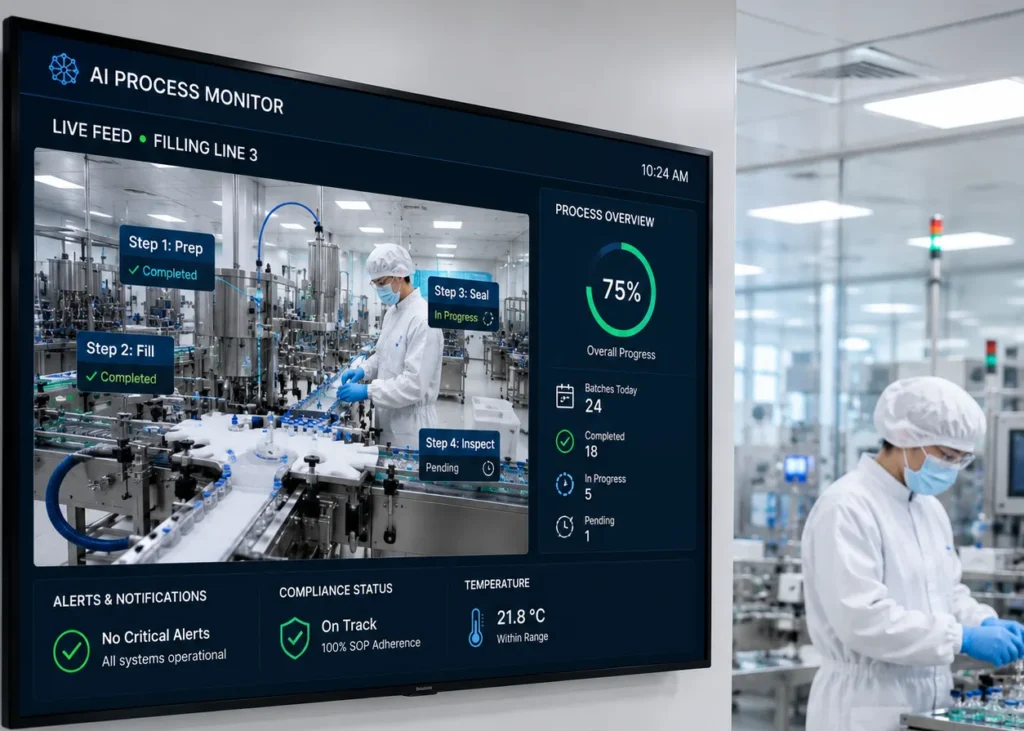
Why Periodic Compliance Audits Are Losing Effectiveness
Traditional compliance audits remain essential for regulatory verification, but they were designed for environments where operational data was limited and manual inspections were the primary source of evidence.
Today’s facilities generate continuous visual and operational data that cannot be fully evaluated through scheduled audits alone.
Manual auditing often presents several challenges:
- Limited visibility between audit cycles.
- Time-consuming evidence collection.
- Dependence on manual observations.
- Inconsistent audit outcomes across locations.
- Delayed identification of procedural deviations.
These limitations encourage organizations to adopt continuous monitoring methods that provide a more accurate picture of everyday operations.
Where AI Delivers the Greatest Value
Continuous SOP monitoring supports a wide range of operational environments.
Manufacturing
Production teams can verify whether critical process steps are consistently followed and identify procedural deviations before they affect product quality.
Pharmaceutical Facilities
AI helps monitor controlled production activities and supports documented process compliance by providing objective visual evidence.
Warehousing and Distribution
Standard operating procedures for loading, unloading, material handling, and restricted-area access can be monitored continuously to improve operational consistency.
Food and Beverage Processing
Organizations can monitor hygiene practices, production workflows, and equipment usage to support quality management programs.
Healthcare Operations
Hospitals can monitor operational procedures in selected non-clinical areas such as pharmacy access, logistics, and controlled facility zones.
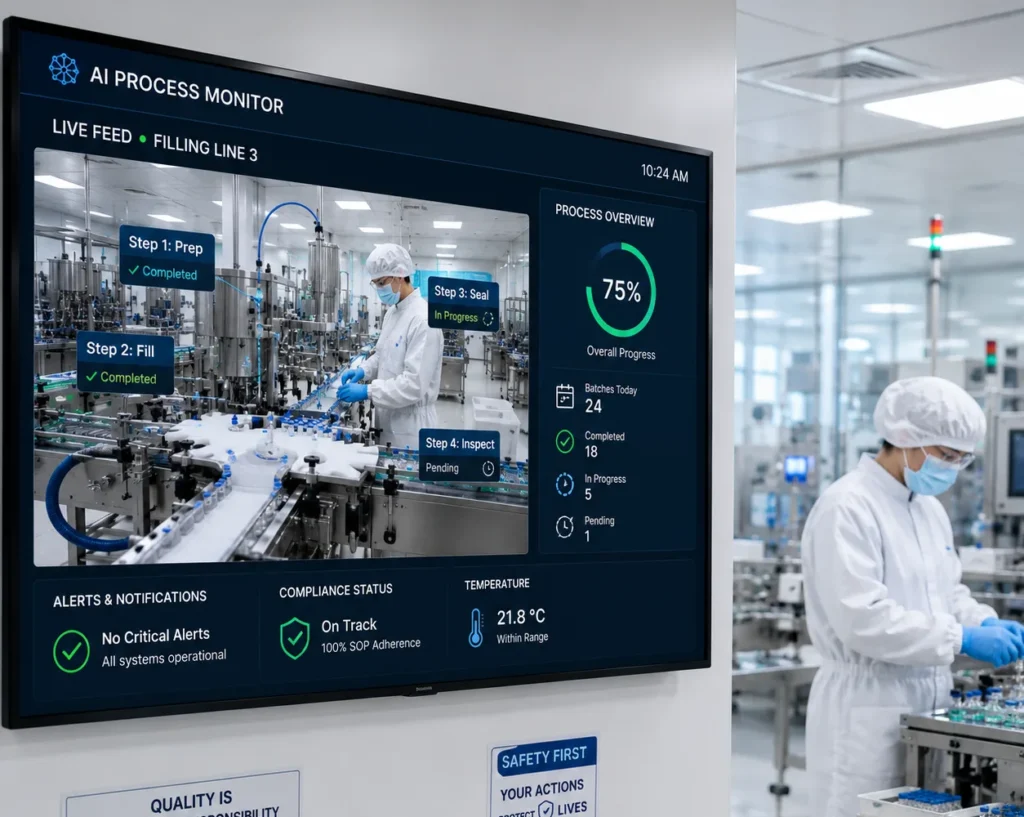
How Continuous SOP Monitoring Changes Compliance
AI-powered SOP monitoring transforms compliance from an event into an ongoing operational process.
Using Computer Vision and AI Video Analytics, the system continuously observes predefined activities such as equipment operation, material handling, access control, or employee workflows. Instead of waiting for an auditor to review records, operational events are evaluated automatically against established procedures.
When a deviation is detected, supervisors receive immediate notifications, allowing corrective action before the issue escalates into a larger operational or quality concern.
This proactive approach supports daily operational consistency while reducing reliance on retrospective investigations.
Manual Audits and AI Monitoring: Different Roles
Rather than replacing compliance professionals, AI changes how they spend their time.
Compliance Activity | Primary Approach |
Continuous SOP observation | AI-powered monitoring |
Immediate deviation alerts | AI-powered monitoring |
Visual evidence collection | AI-powered monitoring |
Regulatory verification | Manual audits |
Policy review and updates | Manual audits |
Compliance reporting and governance | Manual audits supported by AI insights |
This combination allows compliance teams to focus on analysis, governance, and process improvement instead of routine observation.
Preparing for Continuous Compliance Monitoring
Successful implementation begins with clearly defined operational objectives.
Organizations should:
- Identify high-priority SOPs suitable for continuous monitoring.
- Evaluate existing camera coverage and image quality.
- Define measurable compliance indicators.
- Integrate alerts with operational response workflows.
- Establish governance for data privacy and retention.
- Train operational teams to respond consistently to AI-generated alerts.
A phased rollout allows organizations to validate monitoring accuracy before expanding across additional processes or facilities.
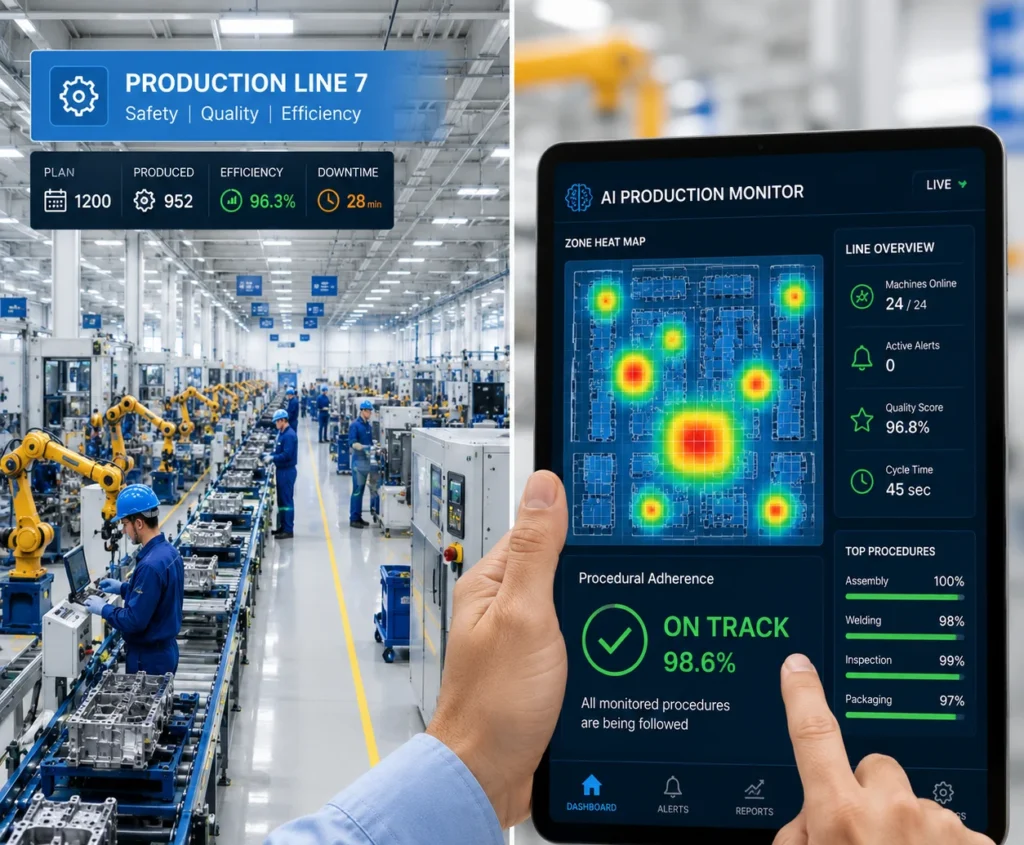
The Future of Enterprise Compliance
Compliance programs are evolving from periodic verification toward continuous operational assurance. AI-powered SOP monitoring enables organizations to detect procedural deviations in real time, capture objective evidence, and respond before small issues become significant operational risks.
As AI Video Analytics, Computer Vision, Edge AI, Operational Intelligence, and AI Automation continue to mature, compliance teams will increasingly rely on continuous monitoring to strengthen quality programs while maintaining the oversight required for formal audits. Manual audits will remain important, but their role will increasingly focus on validation, governance, and strategic improvement rather than discovering routine operational deviations.
Frequently Asked Questions
What types of standard operating procedures can AI monitor?
AI can monitor visually observable procedures such as equipment operation, material handling, access control, production workflows, loading activities, and safety-related operational practices.
Does AI-powered SOP monitoring eliminate compliance audits?
No. It complements traditional audits by continuously monitoring day-to-day operations, while formal audits continue to verify regulatory compliance and organizational governance.
How are SOP deviations identified?
The system compares live operational activities with predefined procedures and generates alerts when a monitored process differs from the expected workflow.
Which industries benefit most from continuous SOP monitoring?
Manufacturing, pharmaceuticals, food processing, warehousing, logistics, healthcare, and other regulated industries commonly benefit from continuous procedural monitoring.
What are the advantages of continuous monitoring over periodic inspections?
Continuous monitoring enables earlier detection of deviations, faster corrective actions, consistent evidence collection, and improved operational visibility between scheduled audits.
What should organizations monitor first when adopting AI-powered SOP monitoring?
Organizations typically achieve the greatest value by starting with high-impact procedures that directly influence product quality, operational consistency, workplace safety, or regulatory compliance, then expanding monitoring as results are validated.