
Predictive Analytics Using Computer Vision
Unexpected equipment failures, production delays, workplace incidents, and inventory shortages rarely happen without warning. In most cases, subtle operational patterns appear long before these problems become visible to managers. The challenge is recognizing those patterns early enough to take preventive action. Predictive analytics using computer vision helps organizations identify emerging risks by continuously analyzing visual information from operational environments and highlighting trends that indicate future issues.
Unlike traditional monitoring, which focuses on what is happening now, predictive analytics looks at how operational behaviors evolve over time. This enables businesses to shift from reactive problem-solving to proactive operational planning.
Why Looking Back Is No Longer Enough
Most organizations rely on historical reports to evaluate performance. Monthly production reports, safety audits, and inventory summaries provide useful information, but they only explain what has already happened.
By the time recurring problems appear in reports, they may have already affected productivity, customer service, or operating costs.
Predictive analytics fills this gap by continuously identifying gradual changes such as:
- Increasing equipment idle time
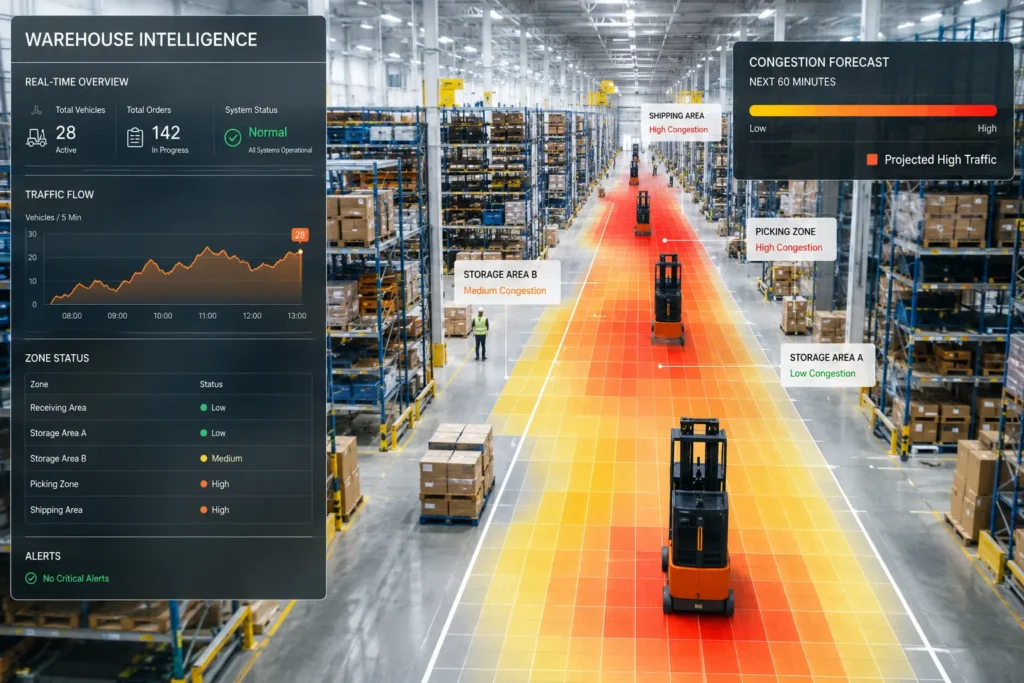
- Repeated congestion in warehouse aisles
- Growing customer queues
- Declining production consistency
- Frequent workflow interruptions
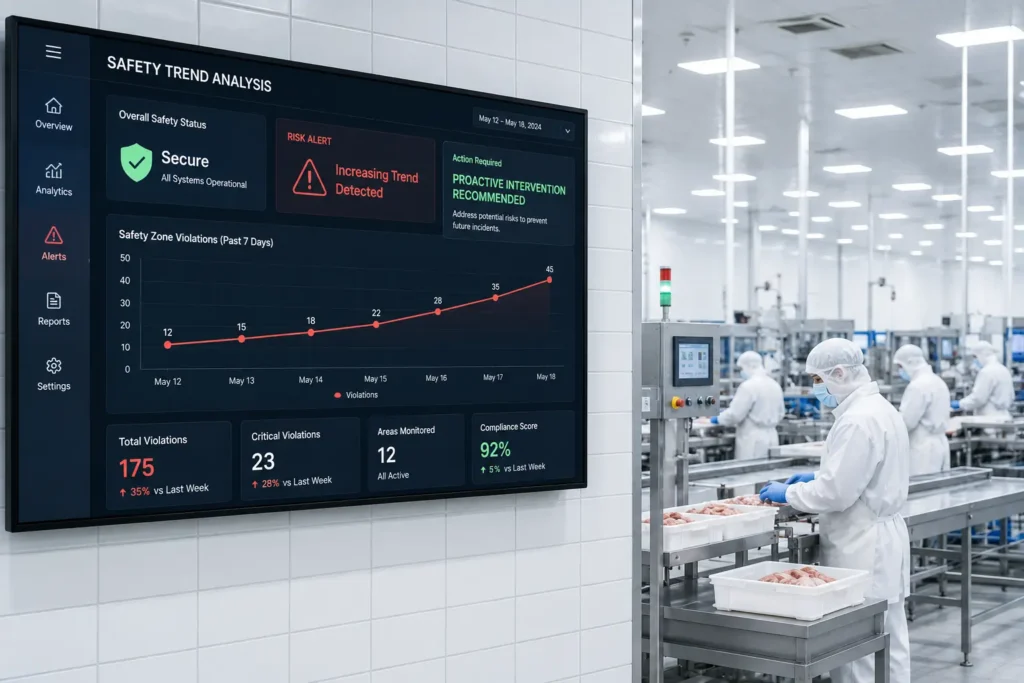
- Rising safety risks in specific work zones
These trends help organizations act before small issues develop into major operational challenges.
What Can Computer Vision Predict?
Computer vision does not predict the future with certainty. Instead, it identifies recurring visual patterns that have historically been associated with operational issues.
Examples include:
Operational Pattern | Potential Business Insight |
Forklift traffic increasing in one aisle | Future warehouse congestion |
Employees frequently waiting at one workstation | Production bottleneck developing |
Loading bays remaining occupied longer each day | Dispatch delays becoming likely |
Equipment operating below normal utilization | Maintenance or scheduling review required |
Customer queues gradually increasing | Additional staffing may be needed |
Repeated safety zone violations | Higher operational risk |
These insights allow organizations to investigate and address potential problems before they escalate.
From Prediction to Better Decisions
Predictive analytics is valuable only when it supports practical decision-making. Organizations typically use predictive insights to answer questions such as:
- Should staffing levels be adjusted for the next shift?
- Is a production line likely to experience delays?
- Which warehouse area requires workflow improvements?
- Are maintenance schedules still appropriate?
- Which operational processes need further investigation?
- Where should resources be allocated first?
The objective is to support managers with evidence-based recommendations rather than assumptions.
How Different Industries Apply Predictive Analytics
Manufacturing
Manufacturers use predictive analytics to recognize production trends, monitor equipment utilization, and identify recurring quality issues before they reduce output.
Warehousing and Logistics
Warehouse operators evaluate inventory movement, forklift traffic, and loading dock activity to anticipate congestion and improve resource planning.
Retail
Retail businesses analyze customer movement and queue patterns to optimize staffing schedules, improve store layouts, and enhance customer service during peak hours.
Healthcare
Hospitals and healthcare facilities monitor patient flow and waiting areas to improve resource allocation and reduce service delays.
Transportation
Logistics hubs use operational trends to improve vehicle movement, loading schedules, and facility utilization.
Although each industry has different priorities, the objective remains the same—anticipating operational changes before they become costly problems.
Common Mistakes When Implementing Predictive Analytics
Many organizations focus on technology while overlooking operational objectives. Successful implementations begin with business questions rather than AI models.
Common mistakes include:
- Trying to predict every operational event at once.
- Measuring too many performance indicators.
- Ignoring historical operational context.
- Failing to validate AI predictions with business teams.
- Treating predictive analytics as a replacement for operational expertise.
Organizations that begin with one high-impact operational challenge often achieve better long-term results than those attempting enterprise-wide deployment immediately.
Measuring Success Beyond Predictions
The effectiveness of predictive analytics should be evaluated through operational improvements rather than the number of predictions generated.
Useful performance indicators include:
- Reduction in operational disruptions
- Improved production planning
- Shorter equipment downtime
- Lower warehouse congestion
- Better staffing efficiency
- Faster operational response
- Improved workflow consistency
- Reduced safety incidents
These metrics demonstrate whether predictive insights are creating measurable business value.
Preparing for Predictive Operations
As AI continues to mature, organizations are moving beyond monitoring individual events toward understanding long-term operational behavior. Computer vision is becoming an important source of predictive intelligence by helping businesses recognize trends, anticipate operational risks, and make proactive decisions based on continuously evolving visual data.
Organizations that combine predictive analytics with experienced operational teams are better positioned to improve efficiency, reduce disruptions, and support continuous improvement through informed, forward-looking decision-making.
FAQ
What is predictive analytics in computer vision?
Predictive analytics uses computer vision to analyze historical and real-time visual data, identify recurring patterns, and estimate potential future operational issues.
How is predictive analytics different from real-time monitoring?
Real-time monitoring identifies events as they occur, while predictive analytics evaluates trends over time to anticipate future operational conditions.
Which industries benefit most from predictive analytics?
Manufacturing, warehousing, logistics, retail, healthcare, transportation, and food processing commonly use predictive analytics to improve planning and operational efficiency.
Can predictive analytics prevent equipment failures?
It can identify patterns that may indicate developing operational issues, allowing maintenance teams to investigate before failures affect production.
What should organizations measure when evaluating predictive analytics?
Businesses should focus on measurable improvements such as reduced downtime, improved planning accuracy, lower operational delays, better resource utilization, and stronger workflow consistency.