
Can AI Improve Food Safety Compliance?
Food safety compliance has become more challenging as food manufacturers, processors, distributors, and restaurants face stricter regulations, higher consumer expectations, and increasingly complex operations. Manual inspections and periodic audits often identify issues only after they have occurred, leaving businesses vulnerable to contamination risks, product recalls, regulatory penalties, and reputational damage.
Artificial Intelligence (AI) is helping organizations shift from reactive compliance to continuous monitoring. By analyzing video feeds, sensor data, and operational workflows in real time, AI can identify potential food safety issues early, enabling faster corrective actions and more consistent adherence to food safety standards.
Where Traditional Compliance Falls Short
Many food facilities still depend on manual processes that have inherent limitations:
- Periodic rather than continuous inspections
- Inconsistent adherence to standard operating procedures (SOPs)
- Human error during monitoring and documentation
- Delayed identification of hygiene violations
- Time-consuming compliance reporting
- Limited visibility across multiple facilities
These challenges can increase operational risk, particularly in large-scale food production environments.
How AI Strengthens Food Safety Compliance
Rather than replacing existing food safety programs, AI enhances them by continuously monitoring critical activities and alerting teams when deviations occur.
Some common capabilities include:
- Determining whether workers are using the necessary personal protective equipment (PPE)
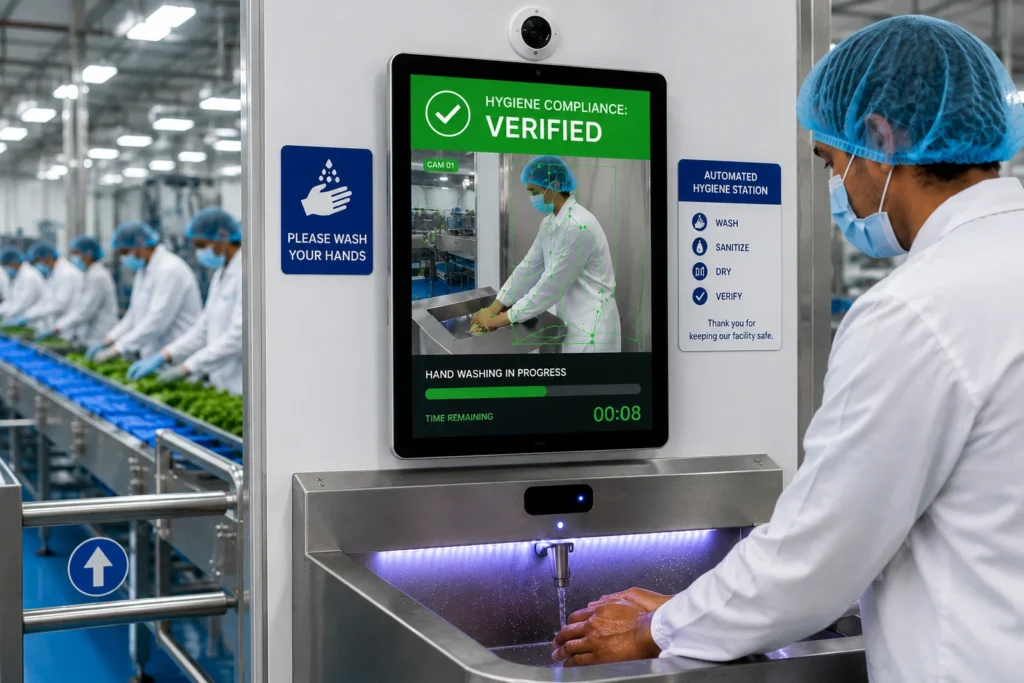
- Monitoring hand hygiene compliance at designated stations
- Identifying unauthorized entry into food preparation zones
- Verifying sanitation procedures in production areas
- Monitoring cleaning schedules and equipment usage
- Detecting blocked emergency exits or unsafe work practices
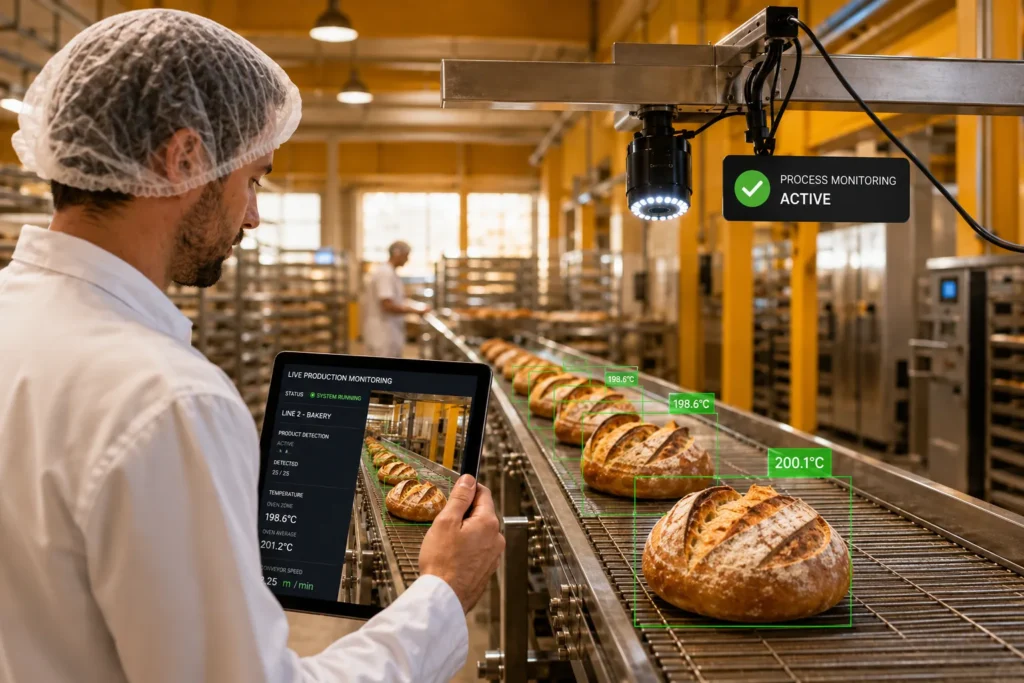
- Tracking operational activities that may affect food quality
Continuous monitoring helps compliance teams address issues before they become larger problems.
Food Safety Tasks AI Can Monitor
Operational Area | AI Monitoring Capability | Business Benefit |
Employee Hygiene | PPE and hand hygiene verification | Better compliance consistency |
Production Lines | Process monitoring | Reduced contamination risks |
Cold Storage | Temperature and operational alerts | Improved product quality |
Packaging Areas | SOP adherence | Fewer packaging errors |
Loading Docks | Handling and movement monitoring | Safer product transportation |
Restricted Zones | Access monitoring | Stronger facility security |
From Alerts to Corrective Action
One of AI’s advantages is its ability to provide timely alerts instead of relying solely on scheduled inspections.
When an issue is detected, organizations can:
- Notify supervisors immediately
- Capture evidence for investigation
- Initiate corrective and preventive action (CAPA) workflows
- Document resolution activities
- Maintain records for compliance audits
This approach helps reduce response times while improving accountability.
Business Benefits Beyond Compliance
Improving food safety compliance also delivers measurable operational value.
Some common outcomes include:
- Faster identification of food safety risks
- Improved adherence to hygiene protocols
- Reduced manual monitoring efforts
- Better audit preparedness
- Greater operational visibility across multiple facilities
- Lower likelihood of product recalls
- Improved workplace safety
- More consistent operating procedures
These improvements support both regulatory compliance and day-to-day operational efficiency.
Best Practices for Implementing AI
Organizations considering AI for food safety should focus on practical implementation rather than deploying technology everywhere at once.
Recommended practices include:
- Identify high-risk operational areas first.
- Define measurable compliance objectives.
- Combine AI with current procedures for compliance and quality.
- Train employees on AI-assisted workflows.
- Review alerts regularly to refine detection accuracy.
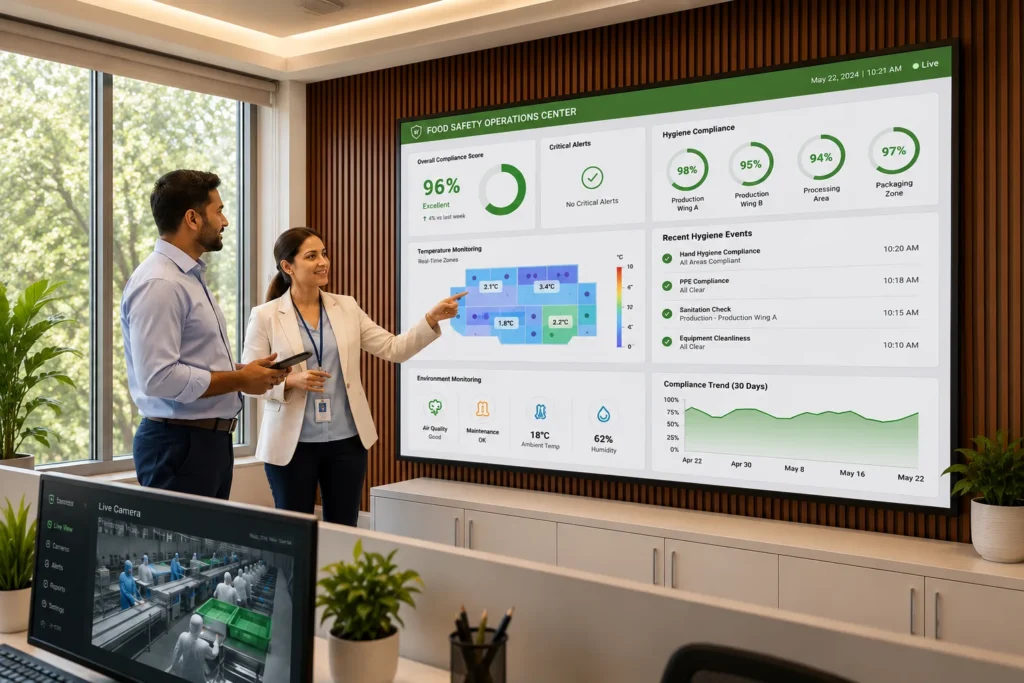
- Use dashboards to monitor trends across facilities.
- Continuously update monitoring rules as regulations and operations evolve.
A phased rollout often delivers better results than attempting a full-scale deployment immediately.
Measuring Success
Businesses can evaluate the effectiveness of AI by tracking key performance indicators such as:
- Compliance audit scores
- Number of hygiene violations
- Incident response times
- SOP adherence rates
- Corrective action completion times
- Manual inspection hours
- Workplace safety incidents
- Operational downtime related to compliance issues
Monitoring these metrics helps demonstrate both compliance improvements and operational value.
Building a More Consistent Food Safety Program
Periodic inspections and manual checklists are no longer the only ways to ensure food safety. AI enables organizations to monitor critical operations continuously, identify potential risks earlier, and respond more effectively when issues arise. When integrated into existing quality and compliance programs, AI helps businesses maintain consistent standards, improve operational efficiency, and strengthen confidence in food safety across the entire production and distribution process.
FAQs
Can AI replace food safety inspectors?
No. AI supports inspectors by providing continuous monitoring and highlighting areas that require human review and decision-making.
Is AI appropriate for small food processing businesses?
Yes. AI solutions can often be implemented in stages, allowing organizations to begin with their highest-risk processes.
Can AI help during regulatory audits?
Yes. AI-generated records, event histories, and compliance documentation can simplify audit preparation and support evidence-based reporting.
What types of facilities benefit from AI food safety monitoring?
Food manufacturing plants, commercial kitchens, food processing facilities, cold storage warehouses, distribution centers, and restaurant chains can all benefit from AI-assisted monitoring.
Does AI only improve compliance?
No. In addition to strengthening compliance, AI can improve operational visibility, reduce manual monitoring, support workplace safety, and enable faster responses to potential issues.