
Can AI Monitor Employee Safety?
Employee safety remains a top priority across industrial, commercial, and corporate environments. Organizations invest in safety policies, employee training, protective equipment, and regular inspections to reduce workplace risks. However, maintaining continuous oversight is difficult, particularly in large facilities, multiple work zones, or operations that run around the clock. Supervisors cannot be everywhere at once, and many hazards develop between scheduled inspections.
AI-powered video analytics helps address this challenge by continuously monitoring workplace activities, identifying potential safety risks, and notifying responsible teams when predefined conditions require attention. Rather than replacing established safety programs, AI provides an additional layer of operational awareness that supports faster intervention and better-informed decision-making.
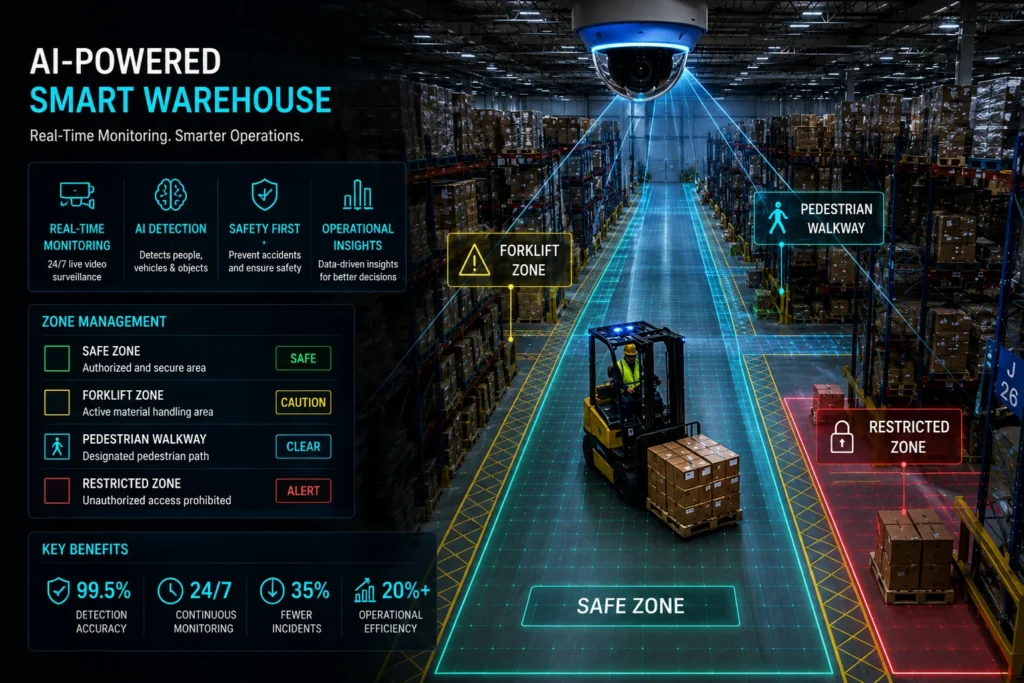
What Can AI Monitor?
AI can analyze live video streams to identify observable workplace conditions and activities associated with safety. Organizations define the monitoring rules based on their operational policies and risk assessments.
Examples of monitored conditions include:
- Personal Protective Equipment (PPE) compliance.
- Unauthorized entry into restricted areas.
- Unsafe proximity between people and machinery.
- Worker presence in hazardous zones.
- Blocked emergency exits or evacuation routes.
- Slip, trip, or fall incidents.
- Vehicle and pedestrian interactions.
- Unsafe equipment operation.
- Overcrowding in designated work areas.
- Emergency response activities.
The objective is to detect visible risks that may require immediate attention.
How AI Supports Workplace Safety
AI continuously evaluates video from connected cameras and compares observed activities against predefined safety rules.
Monitoring Stage | System Function |
Video Capture | Cameras observe workplace activities. |
Object Detection | AI identifies people, equipment, and operational zones. |
Rule Evaluation | Activities are compared with configured safety policies. |
Risk Identification | Potential safety concerns are detected automatically. |
Notification | Alerts are sent to supervisors or monitoring teams. |
Documentation | Events are recorded for investigations and compliance reporting. |
This automated workflow enables organizations to identify potential issues without requiring constant manual observation.
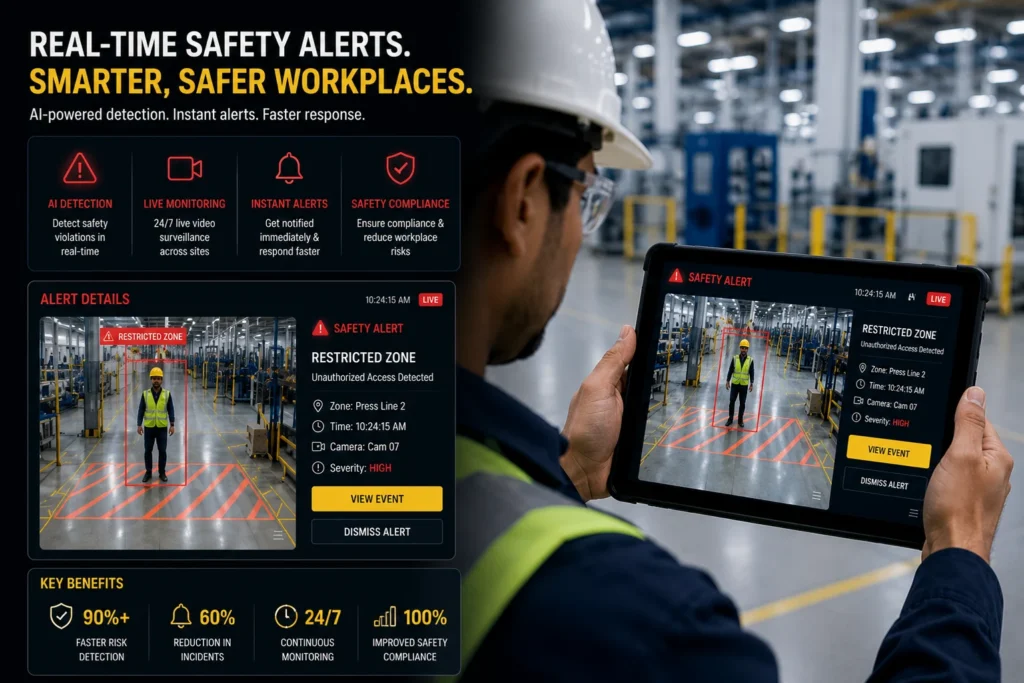
Benefits Beyond Incident Detection
AI monitoring contributes to broader workplace safety objectives by supporting continuous operational visibility.
Some practical benefits include:
- Earlier identification of unsafe conditions.
- Reduced reliance on manual patrols.
- Faster response to developing risks.
- Consistent application of safety policies.
- Better documentation for audits and investigations.
- Improved visibility across multiple facilities.
- Reduced time spent reviewing recorded footage.
- More informed safety management decisions.
These improvements help organizations strengthen existing safety programs rather than replace them.
Key Considerations Before Deployment
Successful implementation requires careful planning and clearly defined objectives.
Organizations should evaluate:
- Which workplace hazards require continuous monitoring.
- Camera coverage of critical operational areas.
- Environmental conditions that may affect detection quality.
- Alert priorities and escalation procedures.
- Integration with existing safety workflows.
- Privacy and regulatory requirements.
- Procedures for reviewing and validating AI-generated alerts.
A structured deployment approach helps improve both system performance and operational acceptance.
Understanding AI’s Role in Safety Management
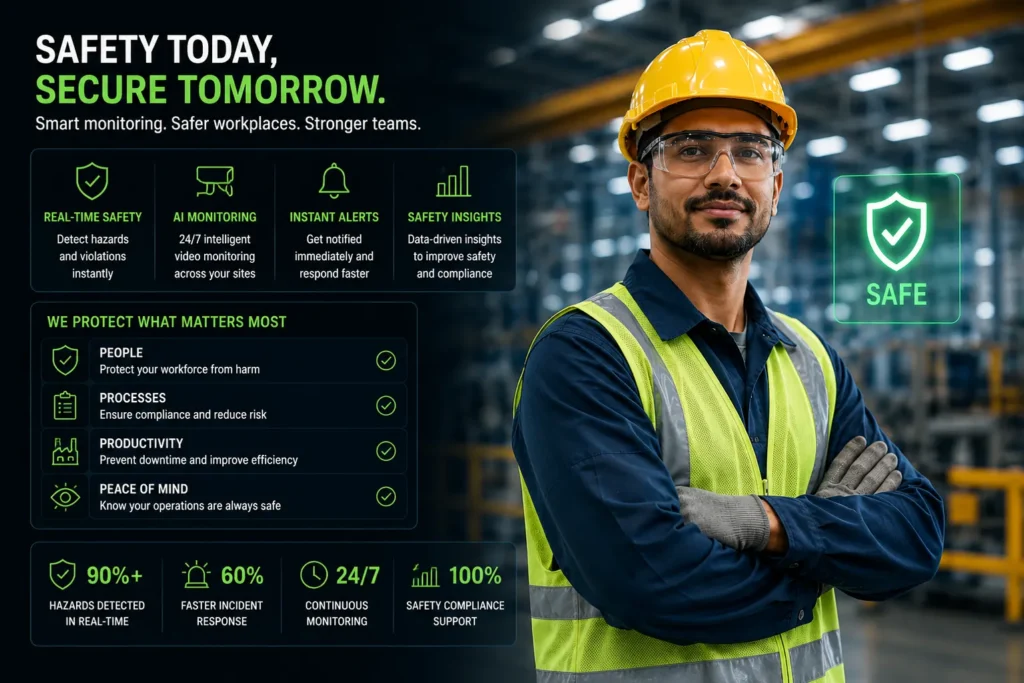
AI is designed to assist safety teams, not replace them.
Human supervisors remain responsible for:
- Investigating reported events.
- Assessing operational context.
- Making safety decisions.
- Coordinating emergency responses.
- Implementing corrective actions.
AI contributes by continuously observing workplace activities and drawing attention to situations that might otherwise go unnoticed.
Limitations to Consider
Although AI provides valuable operational support, organizations should understand its practical limitations.
- It can monitor only what is visible to connected cameras.
- Poor lighting or obstructed views may affect detection performance.
- Monitoring rules must be configured correctly.
- Detection accuracy depends on camera placement and image quality.
- Human verification remains important for critical safety decisions.
Recognizing these limitations helps organizations set realistic expectations for deployment.
Frequently Asked Questions
Can AI prevent workplace accidents?
AI cannot prevent accidents by itself, but it can identify visible safety risks early, allowing personnel to take corrective action before incidents escalate.
Does AI replace safety officers or supervisors?
No. AI supports safety professionals by automating continuous observation while people remain responsible for evaluating situations and making operational decisions.
Can AI monitor safety across multiple facilities?
Yes. AI platforms can analyze video streams from multiple locations through centralized monitoring systems.
Can AI identify risky behaviour in real time?
Yes. When configured appropriately, AI can identify predefined unsafe activities or conditions and generate immediate alerts for review.
Which kinds of businesses profit from AI safety monitoring?
Any organization that requires continuous workplace oversight, safety compliance, or operational visibility can benefit, provided the monitored activities are observable through camera systems.