
Computer Vision Applications Across Modern Industries
Production delays, safety incidents, quality defects, and operational inefficiencies often share one common problem—organizations have vast amounts of visual data but limited ability to interpret it in real time. Cameras are installed across factories, warehouses, offices, hospitals, and retail stores, yet much of the footage remains unused unless an incident occurs. This reactive approach limits operational visibility and slows decision-making.
Computer Vision is changing how businesses use visual information. Instead of simply recording events, AI-powered systems analyze images and video continuously, detect patterns, identify anomalies, and deliver actionable insights. As organizations pursue Digital Transformation, Computer Vision has become an essential technology for improving safety, productivity, compliance, and operational intelligence across multiple industries.
What Is Computer Vision?
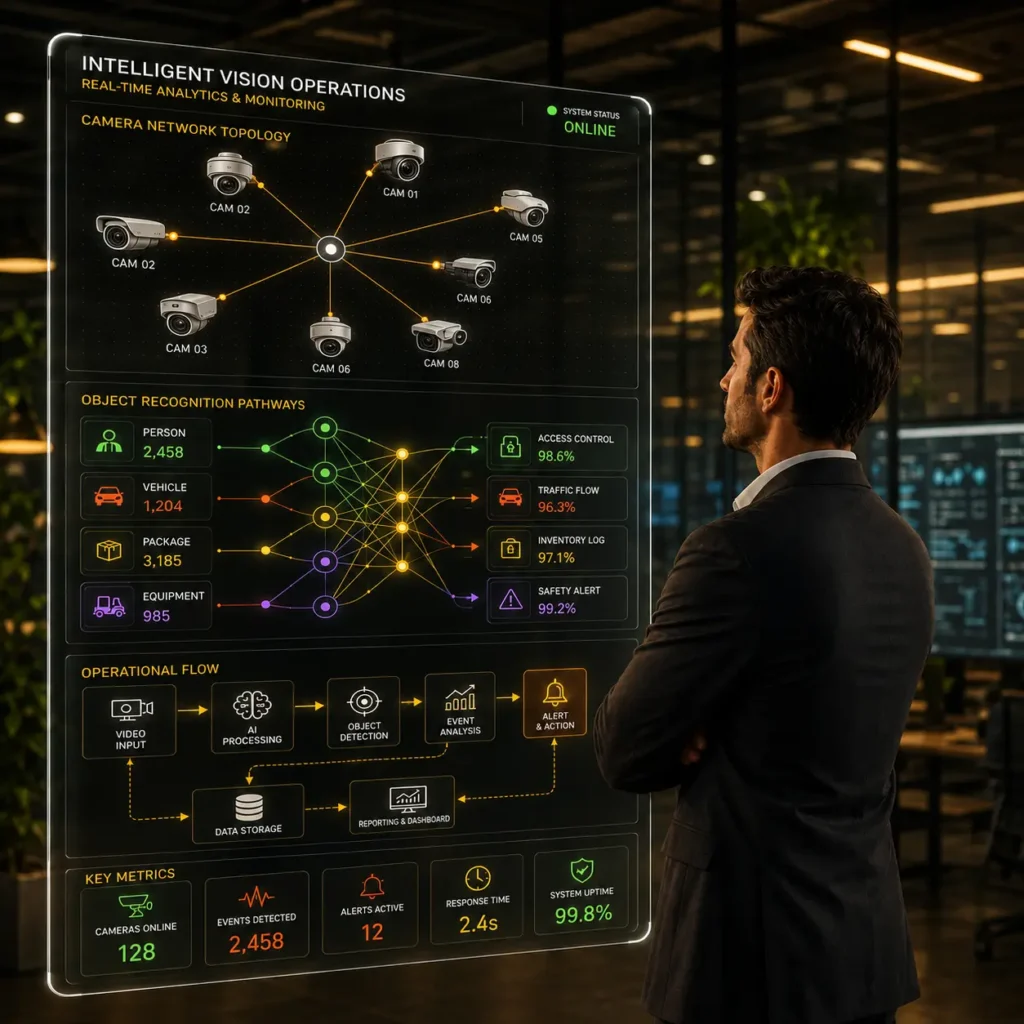
Computer Vision is a branch of artificial intelligence that enables computers to interpret and analyze images and video similarly to how humans observe their surroundings. Using AI models, cameras become intelligent sensors capable of recognizing people, objects, equipment, movements, and activities in real time.
Modern Computer Vision systems support capabilities such as:
- Object and person detection
- PPE and Workplace Safety monitoring
- Defect identification
- Facial and vehicle recognition
- Event Monitoring
- SOP Monitoring
- Automated Compliance Monitoring
- Real-Time Analytics
These capabilities help organizations automate routine monitoring while providing valuable operational insights.
How Computer Vision Works
A Computer Vision solution combines cameras, AI algorithms, and analytics platforms to convert visual data into meaningful information.
Stage | Purpose |
Image Capture | Cameras collect live video streams. |
AI Processing | Computer Vision models identify people, objects, and activities. |
Event Recognition | Predefined conditions or anomalous behaviour are detected by the system. |
Alert Generation | Notifications are sent when specific events occur. |
Operational Dashboard | AI Dashboards present insights, trends, and performance metrics. |
Key Applications Across Modern Industries
Manufacturing
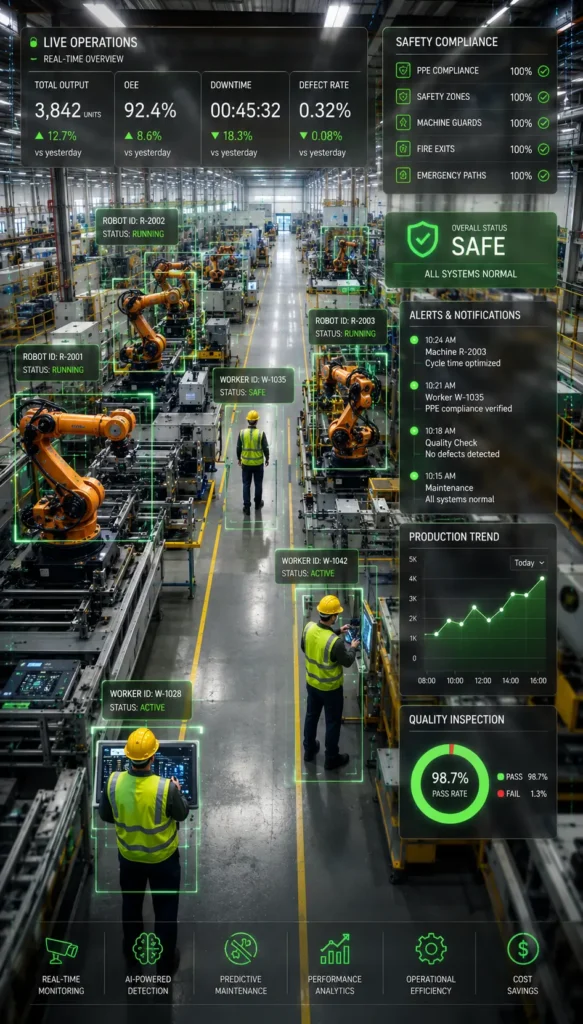
Manufacturers use Computer Vision to improve Smart Manufacturing by automating quality inspection, monitoring production lines, detecting missing PPE, identifying equipment abnormalities, and ensuring workers follow operational procedures. These capabilities reduce manual inspections while improving product consistency and Workplace Safety.
Retail
Retail businesses apply Retail Analytics to understand customer movement, monitor checkout queues, identify shelf availability, detect unauthorized access, and improve store operations. AI-powered monitoring also supports loss prevention and enhances customer service through better operational visibility.
Warehousing and Logistics
Distribution centers rely on Computer Vision to monitor inventory movement, loading docks, forklift operations, pallet handling, and restricted zones. Real-Time Analytics help warehouse managers optimize workflows while improving employee safety and reducing operational delays.
Healthcare
AI-powered visual monitoring is used by hospitals and healthcare facilities to detect equipment movement, monitor restricted areas, promote patient safety, and guarantee adherence to safety procedures. Automated alerts help staff respond quickly to operational events without continuously monitoring camera feeds.
Banking and Corporate Offices
Financial institutions and enterprise offices use Intelligent CCTV Monitoring to secure entrances, verify access permissions, monitor visitor activity, and improve compliance with organizational policies. Computer Vision also assists in occupancy monitoring and emergency response management.
Transportation and Smart Cities
Transportation hubs and municipalities use Computer Vision to analyze traffic flow, detect incidents, monitor pedestrian movement, and improve public safety. These systems provide Operational Intelligence that supports efficient infrastructure management.
Business Benefits of Computer Vision
Organizations implementing Computer Vision often achieve measurable improvements in both security and operations.
Key benefits include:
- Faster incident detection and response
- Improved Compliance Monitoring
- Reduced manual monitoring efforts
- Better Workplace Safety
- Enhanced Operational Intelligence
- Increased productivity
- Lower operational costs
- More informed business decisions
- Centralized visibility across multiple facilities
Traditional Monitoring vs Computer Vision
Traditional Monitoring | Computer Vision |
Manual observation | Automated AI analysis |
Reactive investigations | Proactive event detection |
Continuous human supervision | Intelligent AI Automation |
Limited operational insights | Enterprise-wide Operational Intelligence |
Time-consuming video review | Instant event search and alerts |
Static reporting | Live AI Dashboards and Real-Time Analytics |
This transition enables organizations to move beyond surveillance and use visual data as a strategic business resource.
Best Practices for Successful Implementation
Organizations planning to deploy Computer Vision should consider the following:
- Define clear business objectives before implementation.
- Focus on high-value operational use cases.
- Configure AI models based on industry-specific requirements.
- Combine Edge Analytics with centralized reporting when appropriate.
- Continuously evaluate AI performance and alert accuracy.
- Integrate insights with existing operational workflows.
- Review analytics regularly to identify improvement opportunities.
A phased deployment allows organizations to optimize system performance while ensuring user adoption across departments.
Supporting Smarter Business Decisions
Computer Vision is no longer limited to security applications. Across manufacturing, retail, healthcare, logistics, and transportation, organizations are using AI to transform video into actionable intelligence. By combining Computer Vision with Enterprise AI, AI Video Analytics, and Intelligent Operations, businesses gain continuous visibility into their environments, helping them improve compliance, increase efficiency, reduce operational risks, and make faster, data-driven decisions. As visual data continues to grow, organizations that leverage intelligent analytics will be better positioned to support long-term operational excellence.
FAQ
Which sectors stand to gain the most from computer vision?
Manufacturing, retail, healthcare, warehousing, transportation, banking, education, hospitality, construction, and smart cities commonly use Computer Vision to improve operations and safety.
Is Computer Vision only used for security?
No. It supports quality inspection, operational monitoring, workplace safety, inventory management, compliance monitoring, traffic analysis, and many other business applications.
What is the difference between Computer Vision and AI Video Analytics?
Computer Vision enables machines to interpret visual information, while AI Video Analytics applies those capabilities to analyze live video streams, detect events, and generate actionable insights.
Can existing camera systems support Computer Vision?
In many cases, existing IP camera infrastructure can be integrated with Computer Vision platforms, minimizing additional hardware investments.
How does Computer Vision improve operational efficiency?
By automating monitoring, identifying anomalies in real time, reducing manual inspections, and providing actionable analytics, Computer Vision helps organizations improve productivity, safety, and decision-making.