
The Evolution of CCTV From Traditional Surveillance to Intelligent Operational Intelligence
A CCTV system once had a single responsibility—record what happened and preserve footage for later review. If an incident occurred, security personnel searched through hours of recordings to understand the sequence of events. While this approach provided visual evidence, it offered little support for preventing operational issues or helping managers make timely decisions.
Today, cameras contribute far more than security recordings. Combined with AI Video Analytics and Computer Vision, they have become continuous sources of operational information that assist production, safety, quality, logistics, and facility management. This evolution has transformed CCTV from a passive surveillance tool into an active component of operational decision-making.
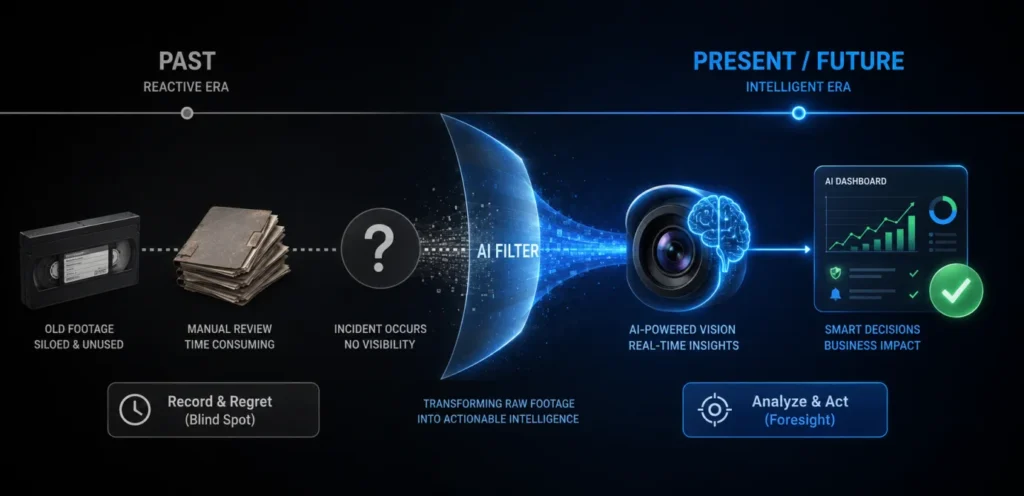
The Recording Era: Capturing Events for Investigation
Recording activities was the main objective of the initial CCTV systems. While digital recorders saved video for later use, cameras kept an eye on public areas, warehouses, production facilities, and entrances.
Typical characteristics included:
- Continuous video recording
- Manual playback
- Incident-based investigations
- Security-focused deployment
- Limited operational involvement
- Human observation of multiple screens
Although effective for evidence collection, this approach depended heavily on operators noticing events or reviewing recordings after an issue had already occurred.
The Monitoring Phase: Expanding Beyond Security
As organizations installed more cameras across their facilities, CCTV began supporting broader operational responsibilities.
Supervisors started using live video to observe:
- Production areas
- Warehouse activities
- Loading operations
- Visitor movement
- Vehicle access
- Equipment utilization
Despite broader usage, decision-making still relied on people watching video feeds and interpreting situations manually.
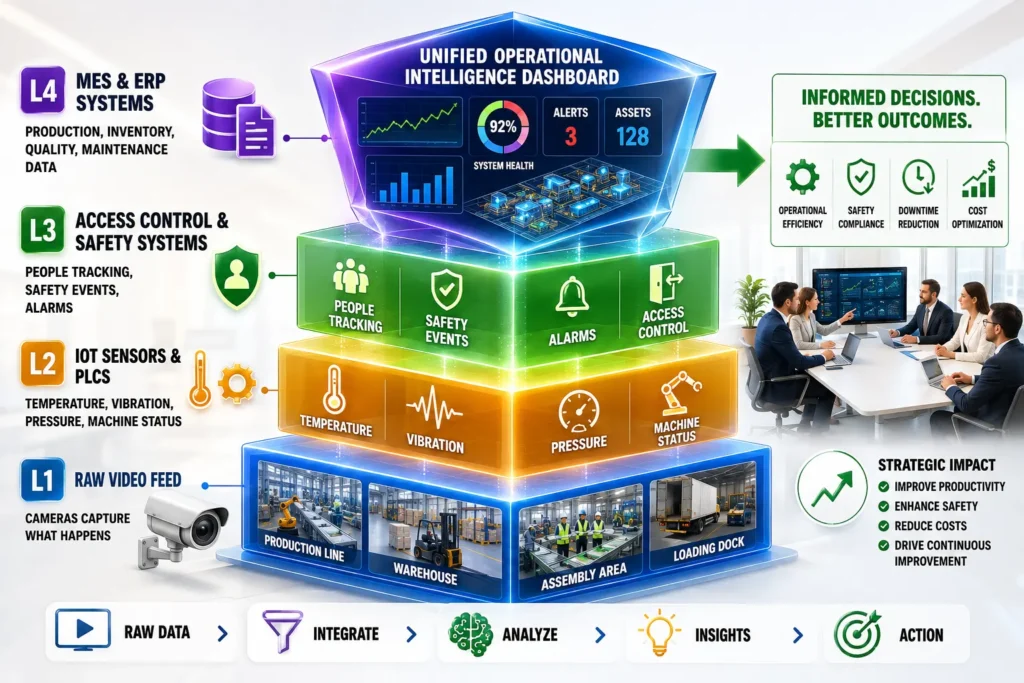
The AI Transition: Understanding What Cameras See
The introduction of Computer Vision changed the role of industrial cameras. Instead of simply displaying images, AI began analysing visual information to identify objects, activities, and workplace conditions.
Computer Vision can recognize:
- People
- Vehicles
- Machinery
- Safety equipment
- Products
- Material movement
- Operational zones
- Workplace interactions
This capability shifted CCTV from passive observation to automated interpretation
From Images to Operational Events
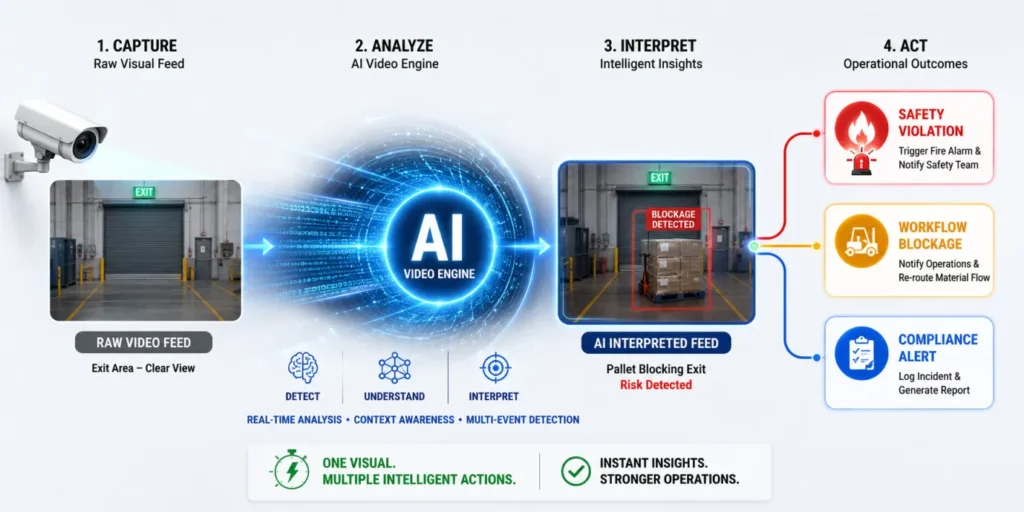
Organizations started creating operational rules that turned ordinary observations into significant occurrences as soon as visual data could be analyzed.
Visual Observation | Operational Meaning |
PPE not detected | Safety compliance review |
Forklift enters pedestrian area | Traffic management event |
Conveyor remains inactive | Production interruption |
Emergency exit obstructed | Facility compliance issue |
Unauthorized area access | Security notification |
Product accumulation detected | Workflow imbalance |
Instead of reviewing footage manually, managers receive structured information about situations requiring attention.
Connecting CCTV with Industrial Operations
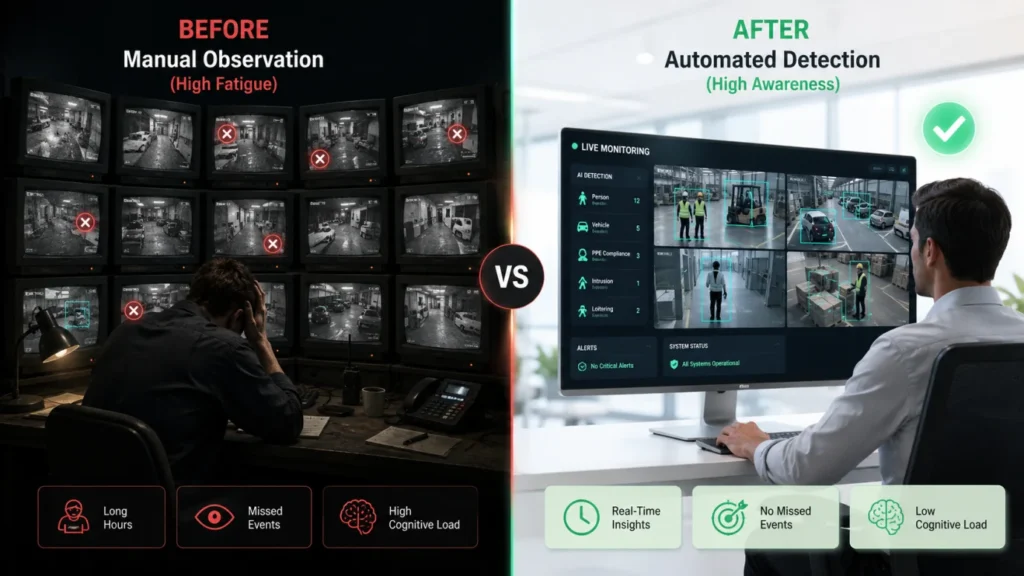
Modern CCTV platforms no longer operate independently. They exchange information with operational technologies to provide broader business context.
Common integrations include:
- PLC systems
- SCADA platforms
- Industrial IoT sensors
- Access control systems
- Fire and safety systems
- AI Dashboards
- Maintenance platforms
- Manufacturing execution systems
This connected environment enables visual events to be evaluated alongside machine data and process information.
Supporting Different Business Functions
As CCTV capabilities expanded, its value extended beyond security departments.
Different teams now use video analytics for different purposes:
- Operations managers review workflow execution.
- Safety teams monitor workplace practices.
- Quality departments verify production procedures.
- Warehouse supervisors oversee inventory movement.
- Maintenance teams investigate equipment-related events.
- Leadership reviews operational trends through management dashboards.
This shared use of visual information encourages more coordinated decision-making across the organization.
Turning Operational History into Business Insight
Every verified event contributes to a growing operational knowledge base rather than remaining an isolated incident.
Organizations can evaluate:
- Recurring safety observations
- Process deviations
- Equipment interaction trends
- Facility activity patterns
- Shift-based operational differences
- Response performance over time
Historical analysis helps managers identify where process adjustments, training, or resource allocation may be required.
Business Perspective
Stage of Evolution | Primary Business Purpose |
Traditional CCTV | Recording incidents for later investigation |
Live Monitoring | Observing ongoing activities |
AI Video Analytics | Detecting operational events automatically |
Computer Vision | Interpreting workplace activities |
Integrated Operations | Combining visual data with industrial systems |
Operational Intelligence | Supporting evidence-based management decisions |
Expanding the Purpose of Every Camera
The greatest change in CCTV has not been higher image resolution or larger storage capacity; it has been the ability to convert visual information into operational knowledge. Cameras that once served only as recording devices now contribute to production oversight, safety verification, quality management, logistics coordination, and facility governance. When combined with Computer Vision, Edge AI, AI Surveillance, Intelligent CCTV Monitoring, Industrial AI, and Real-Time Analytics, CCTV becomes an information source that helps managers understand how operations are actually performed rather than simply documenting what occurred.
FAQ
How is AI Video Analytics different from traditional CCTV recording?
Traditional CCTV stores footage for later review, while AI Video Analytics analyses live video to identify operational events and predefined conditions automatically.
Can existing CCTV systems be upgraded with AI capabilities?
In many cases, yes. Existing IP camera infrastructure can often be integrated with AI software without replacing every camera.
Does Computer Vision replace human security personnel?
No. Computer Vision automates routine observation and highlights significant events, while personnel continue making operational and security decisions.
Which departments benefit most from intelligent CCTV systems?
Operations, safety, quality, warehouse management, maintenance, security, and executive leadership can all use AI-generated insights according to their operational responsibilities.