Edge AI Hardware Ecosystem: NVIDIA Jetson, Intel OpenVINO, ARM AI, Google Coral, and Industrial Edge Servers
An AI application is only as effective as the hardware supporting it. A production line that requires immediate safety alerts, a warehouse monitoring hundreds of cameras, or a remote industrial site with limited network connectivity all demand different computing capabilities. Selecting the right Edge AI platform is therefore an operational decision rather than simply a technology choice.
The Edge AI hardware ecosystem provides organizations with multiple deployment options based on processing requirements, environmental conditions, scalability, and operational objectives. From compact embedded devices to industrial-grade edge servers, each platform serves a different role in bringing AI closer to where industrial data is generated.
Understanding the Layers of Edge AI Infrastructure
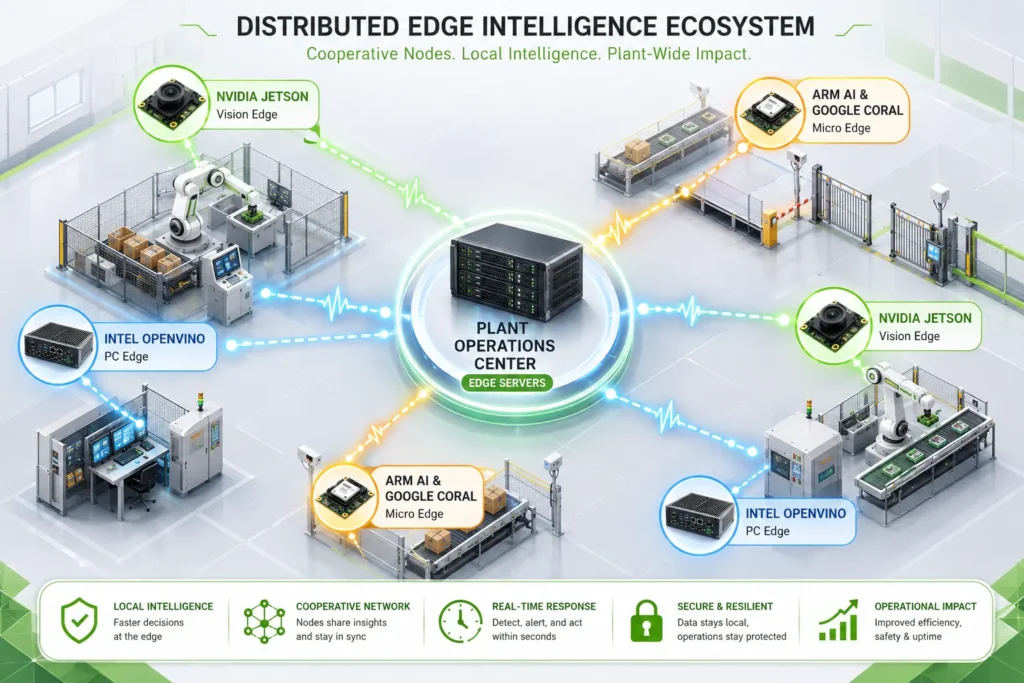
Edge AI hardware is not built around a single device. Instead, it consists of multiple computing layers that support different operational responsibilities across an industrial environment.
Typical deployment layers include:
- Embedded AI devices
- Industrial gateways
- Edge computing appliances
- Industrial edge servers
- Local AI clusters
- Enterprise data centers
- Cloud platforms for long-term analytics
Each layer processes information according to its computational capacity and operational purpose.
NVIDIA Jetson: AI for Embedded Industrial Applications
NVIDIA Jetson platforms are widely deployed where AI processing must occur directly beside industrial equipment or cameras.
Typical applications include:
- AI Video Analytics
- Machine vision
- PPE compliance monitoring
- Equipment inspection
- Autonomous mobile robots
- Production line monitoring
- Quality verification
- Intelligent CCTV Monitoring
Their compact design makes them suitable for installations where space and power availability are limited.
Intel OpenVINO: Optimizing AI Across Intel-Based Systems
Intel OpenVINO is an AI inference toolkit that enables optimized deployment across Intel processors, integrated graphics, and AI accelerators.
Organizations commonly use it for:
- Factory inspection systems
- Industrial Computer Vision
- Existing x86 industrial PCs
- Vision-based quality control
- Edge AI inference
- Manufacturing analytics
Its flexibility allows facilities to utilize existing Intel-based infrastructure while introducing AI capabilities.
ARM AI: Enabling Efficient Embedded Intelligence
Many industrial devices already operate on ARM-based processors due to their energy-efficient architecture. ARM AI extends these platforms by enabling local AI inference without requiring high-power computing hardware.
Common deployment scenarios include:
- Smart industrial sensors
- Portable inspection devices
- Embedded monitoring systems
- Environmental monitoring
- Wearable industrial devices
- Mobile diagnostic equipment
This approach supports distributed intelligence across industrial environments where compact hardware is preferred.
Google Coral: Accelerating Lightweight AI Workloads
Google Coral is designed for applications that require fast inference with relatively low power consumption.
Operational Requirement | Typical Google Coral Application |
Entry monitoring | Person detection |
Occupancy analysis | Crowd counting |
Equipment observation | Object detection |
Retail monitoring | Customer movement analysis |
Smart facilities | Space utilization monitoring |
Warehouse operations | Basic visual inspection |
Coral devices are commonly selected for focused AI workloads that do not require extensive computational resources.
Industrial Edge Servers: Centralizing Local AI Processing
Larger facilities often process information from hundreds of devices simultaneously. Industrial edge servers provide centralized computing resources capable of handling multiple AI workloads within the facility.
They commonly support:
- Multi-camera AI Video Analytics
- Industrial IoT platforms
- SCADA data processing
- Machine Learning inference
- AI Dashboards
- Operational data aggregation
- Computer Vision applications
- Enterprise reporting
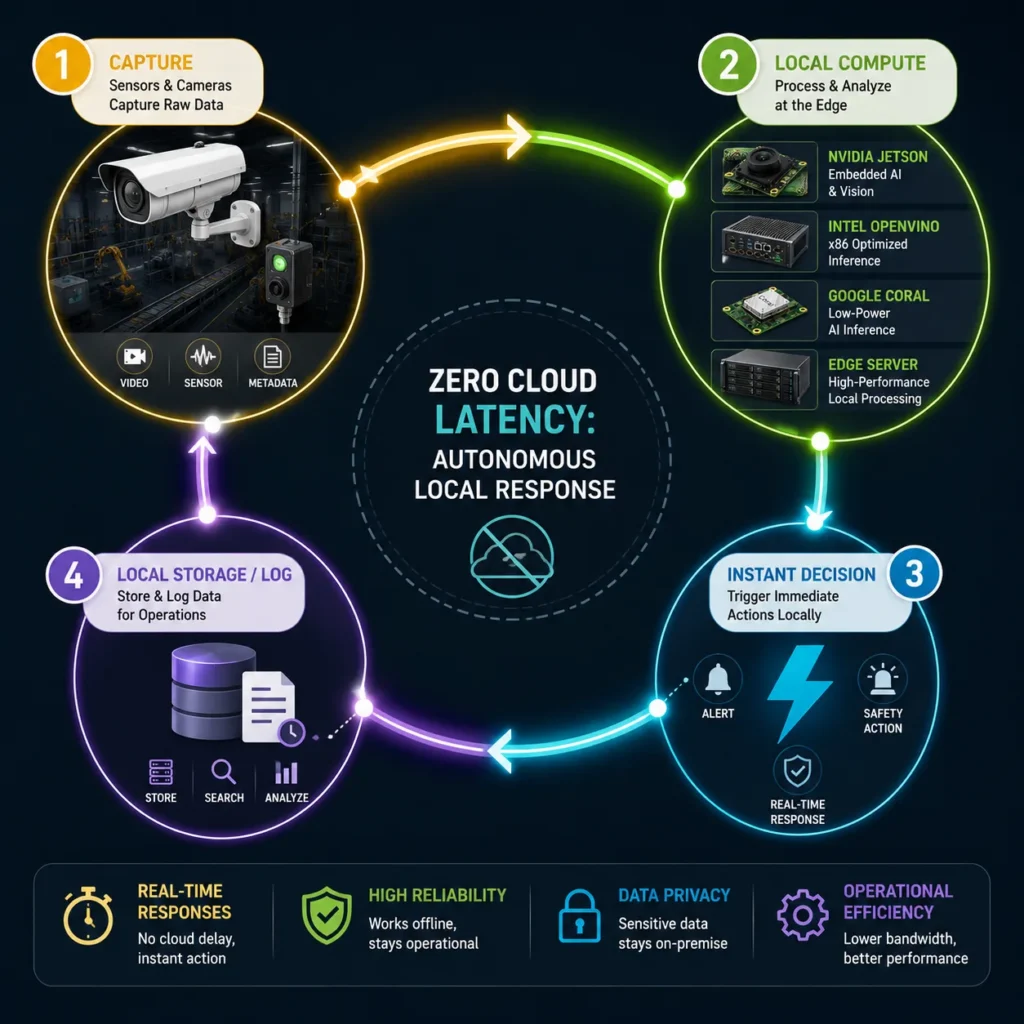
These servers reduce dependence on external cloud infrastructure while supporting facility-wide AI operations.
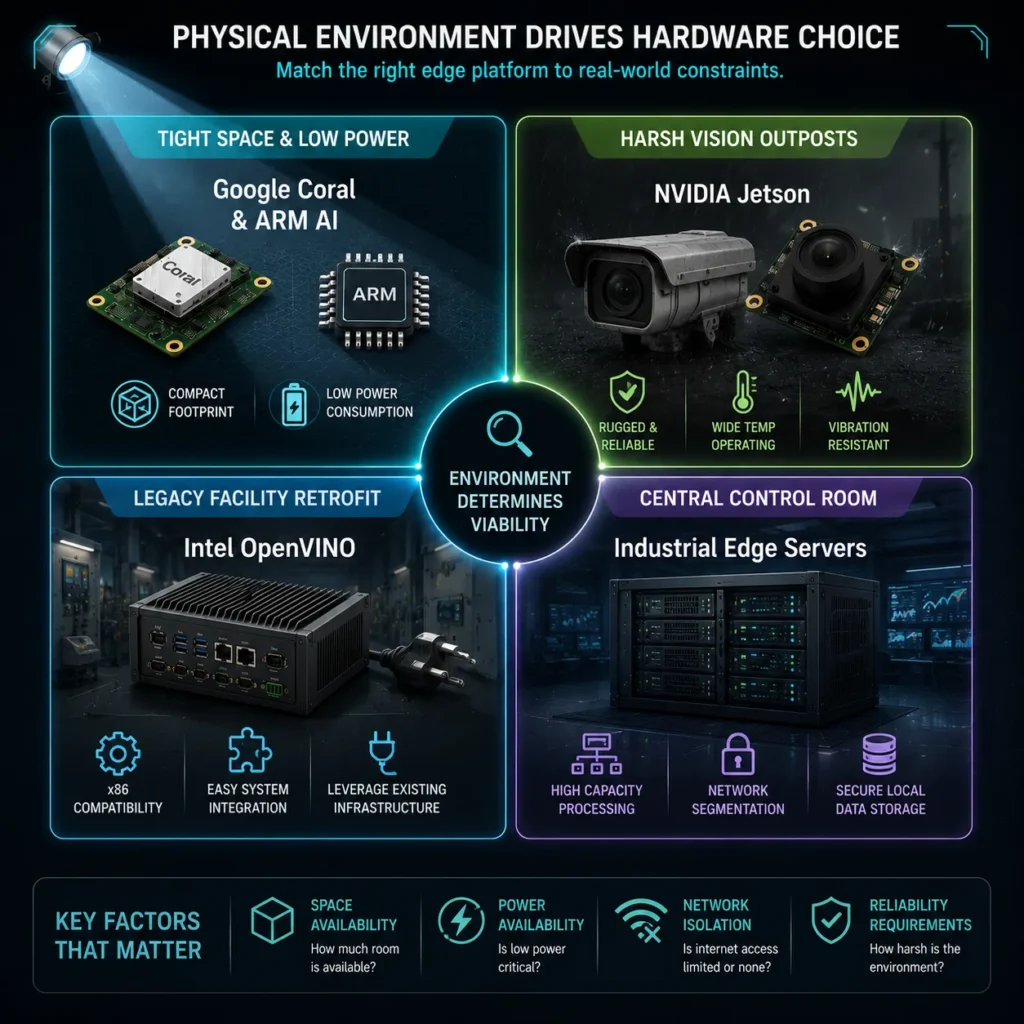
Selecting Hardware Based on Operational Requirements
Different operational environments require different computing capabilities.
Operational Scenario | Suitable Hardware Platform |
Single machine inspection | NVIDIA Jetson |
Existing Intel-based industrial PCs | Intel OpenVINO |
Low-power embedded devices | ARM AI |
Focused AI inference tasks | Google Coral |
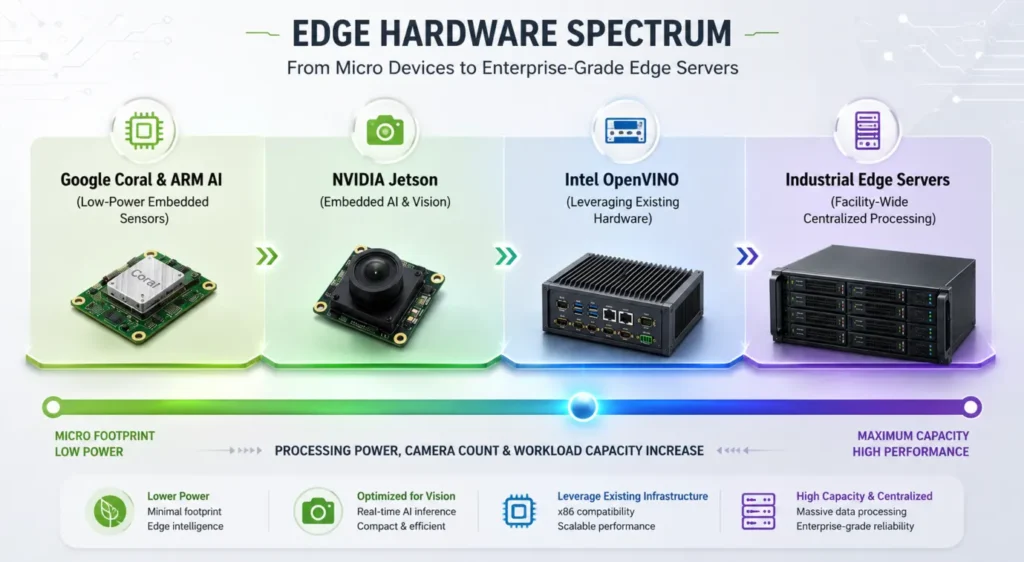
Large industrial facilities | Industrial Edge Servers |
Choosing hardware according to operational needs helps organizations balance performance, scalability, maintenance, and deployment costs.
Factors That Influence Hardware Selection
Beyond computing performance, several practical considerations influence hardware decisions.
Organizations typically evaluate:
- Number of AI cameras
- Environmental conditions
- Processing latency requirements
- Available installation space
- Power availability
- Existing automation infrastructure
- Future expansion plans
- Maintenance accessibility
Considering these factors during planning helps ensure long-term operational suitability.
Matching Computing Power with Operational Needs
There is no universal Edge AI platform that fits every industrial application. Compact embedded devices support localized monitoring, while industrial edge servers coordinate large-scale facility operations. Platforms such as NVIDIA Jetson, Intel OpenVINO, ARM AI, Google Coral, and industrial edge servers each contribute to a broader computing ecosystem where AI processing takes place as close as practical to operational activities. Combined with Computer Vision, AI Automation, Industrial AI, Smart Manufacturing, Edge Analytics, and Operational Intelligence, these hardware platforms provide the computational foundation required for dependable industrial AI deployments.
FAQ
Why are different Edge AI hardware platforms needed in industrial environments?
Industrial applications vary significantly in processing requirements, deployment scale, environmental conditions, and available computing resources, making different hardware platforms suitable for different use cases.
Is NVIDIA Jetson intended only for Computer Vision applications?
No. While it is widely used for Computer Vision, it can also support robotics, industrial automation, sensor processing, and other Edge AI workloads.
Can Intel OpenVINO operate on existing industrial computers?
Yes. OpenVINO is designed to optimize AI inference on compatible Intel processors, allowing many existing industrial PCs to support AI applications.
When are industrial edge servers preferred over embedded devices?
Industrial edge servers are generally used when multiple AI applications, cameras, or industrial systems need centralized local processing within a facility.