
SCADA, PLC, DCS, HMI, and AI Integration Architecture for Smart Industries
A manufacturing facility rarely relies on a single control system. PLCs execute machine logic, DCS platforms regulate continuous processes, SCADA supervises plant-wide operations, and HMIs provide operators with real-time control. Although each system performs its intended role effectively, valuable operational information often remains distributed across multiple platforms. This separation makes it difficult to understand how production events, equipment performance, workplace activities, and management decisions influence one another.
Integrating these operational systems with AI establishes a connected architecture where industrial data is interpreted collectively rather than in isolation. Instead of replacing existing automation, AI adds an analytical layer that transforms machine events, visual observations, and process information into practical decision support for industrial operations.
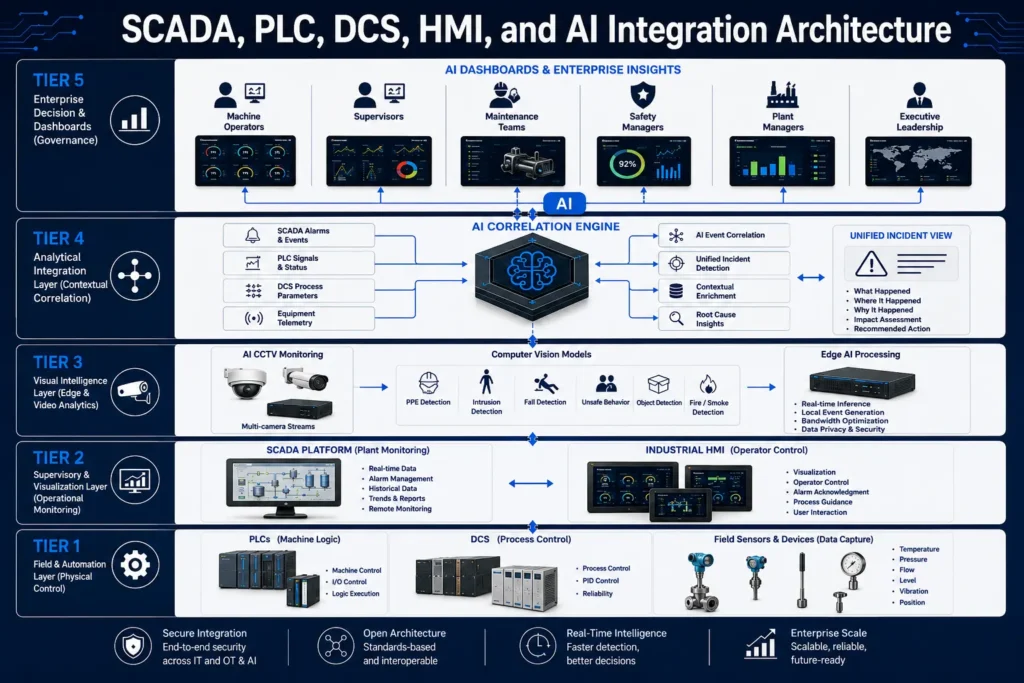
Understanding the Role of Each Operational System
Every industrial control platform contributes a specific function within the production environment.
Industrial System | Primary Responsibility |
PLC | Executes machine control logic and equipment sequencing |
DCS | Manages continuous industrial processes and process variables |
SCADA | Supervises plant-wide operations and collects operational data |
HMI | Provides operators with visualization and machine interaction |
AI Platform | Interprets operational patterns and supports decision-making |
Together, these systems create the operational backbone of a modern industrial facility.
Building a Unified Information Flow
An integrated architecture connects information from multiple operational layers instead of treating each platform as an independent system.
The information typically flows through these stages:
- Machines generate operational events.
- PLCs execute equipment control logic.
- DCS regulates continuous production processes where applicable.
- SCADA gathers operational status from plant assets.
- HMIs display information for operators.
- AI analyses operational data alongside Computer Vision observations.
- AI Dashboards present insights for supervisors and management.
Each stage contributes information that strengthens the overall understanding of plant operations.
Adding Visual Intelligence to Industrial Automation
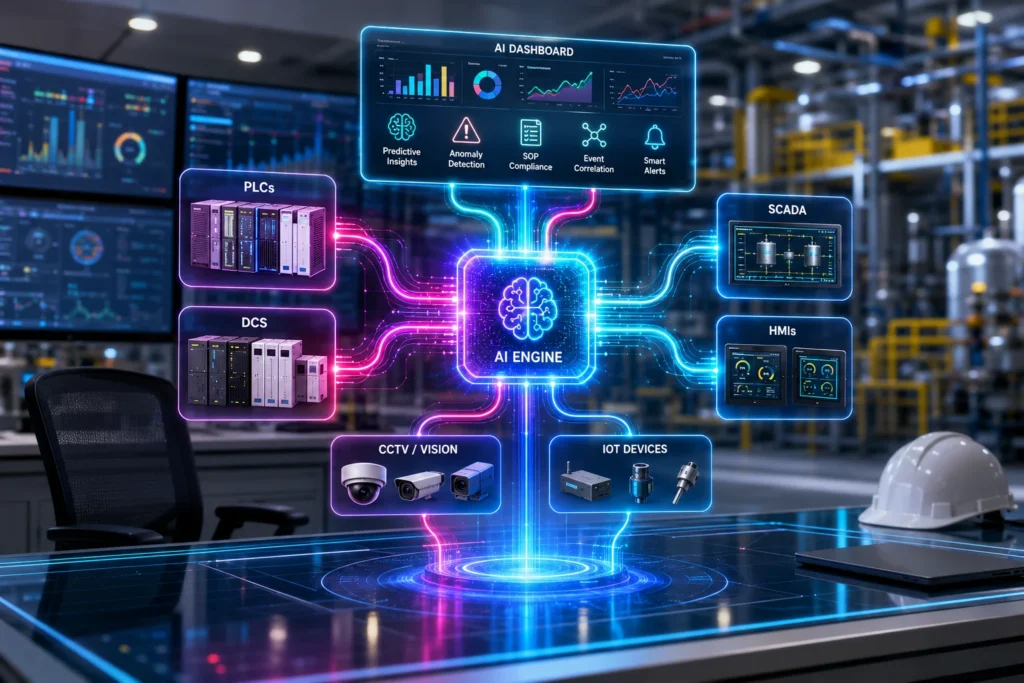
Traditional automation primarily evaluates machine-generated signals. AI extends this capability by interpreting visual events occurring around industrial equipment.
Examples include:
- PPE compliance
- Restricted area access
- Operator presence
- Material handling activities
- Equipment occupancy
- Manual assembly verification
- Loading and unloading operations
- Safety barrier monitoring
By combining machine signals with Intelligent CCTV Monitoring, organizations gain additional operational context that cannot be obtained from sensors alone.
Connecting Production Data with Operational Events
Machine data becomes more meaningful when viewed alongside surrounding operational activities.
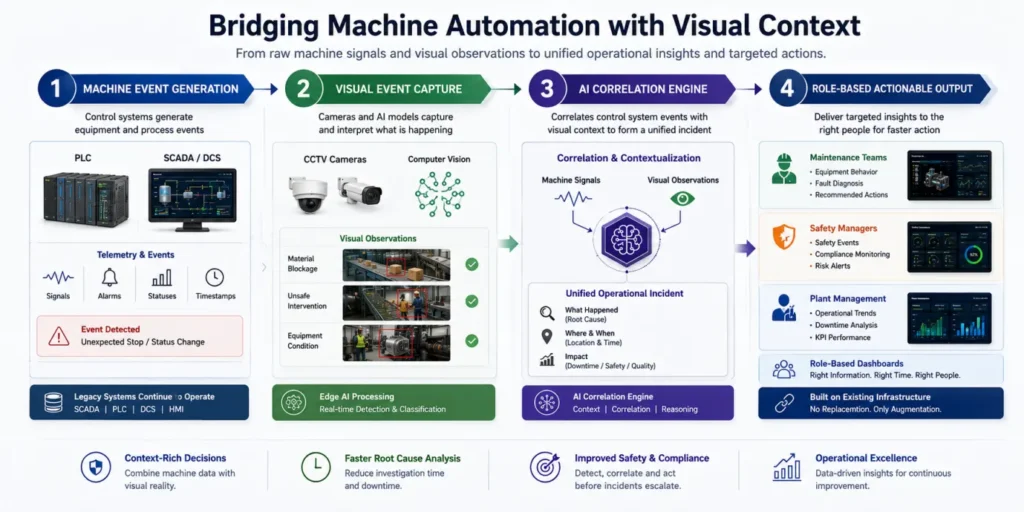
For example:
- A PLC reports an unexpected production stop.
- SCADA records the equipment status.
- CCTV footage shows a material blockage.
- Computer Vision identifies an unsafe manual intervention.
- AI correlates these events into a single operational incident.
This combined interpretation reduces investigation time by presenting related information as one coordinated event rather than multiple disconnected observations.
Supporting Different Levels of Decision-Making
Integrated architectures serve personnel across several operational levels.
User Group | Information Required |
Machine Operators | Equipment status and process information through HMI |
Supervisors | Production events and SOP compliance observations |
Maintenance Teams | Equipment behaviour and recurring machine issues |
Safety Managers | Workplace activities and compliance events |
Plant Managers | Facility-wide operational trends and performance indicators |
Executive Leadership | Consolidated business insights across multiple facilities |
Providing information appropriate to each role improves decision quality throughout the organization.
Where AI Delivers Operational Value
AI contributes by analysing relationships between machine behaviour, operational activities, and historical performance rather than simply generating additional alarms.
Common applications include:
- SOP compliance monitoring
- Equipment behaviour analysis
- Process deviation identification
- Production sequence verification
- Workplace Safety observations
- Quality inspection support
- Operational event correlation
- Resource utilization analysis
These applications allow managers to investigate operational conditions using evidence gathered from multiple systems.
Operational Perspective
Management Priority | Contribution of the Integrated Architecture |
Production oversight | Combines machine status with operational observations |
Equipment management | Connects control signals with equipment behaviour |
Workplace Safety | Adds visual verification alongside automation systems |
Process governance | Evaluates adherence to defined operating procedures |
Cross-functional coordination | Presents shared operational information across departments |
Performance review | Consolidates operational history into management dashboards |
Maintaining Existing Industrial Investments
Most industrial facilities have invested in automation infrastructure over many years. An AI integration architecture is designed to complement these investments rather than replace them.
Organizations can continue using:
- Existing PLC programs
- SCADA platforms
- DCS installations
- Industrial HMIs
- CCTV infrastructure
- IoT devices
- Industrial communication networks
This approach allows facilities to expand analytical capabilities while preserving established operational processes.
Strengthening Operational Coordination
Industrial performance depends not only on reliable automation but also on how effectively information moves between people, machines, and management. When SCADA, PLC, DCS, HMI, Industrial AI, AI Video Analytics, Edge AI, and Operational Intelligence operate within a unified architecture, operational decisions become based on connected evidence rather than isolated system outputs. This coordinated view supports consistent oversight, informed planning, and stronger collaboration across the entire industrial operation.
FAQ
Why do industrial facilities use both PLC and DCS systems?
PLCs are typically used for discrete machine control, while DCS platforms manage continuous processes involving multiple interconnected control loops.
Can AI analyse information from both automation systems and CCTV cameras?
Yes. AI can correlate machine data with visual observations to provide broader operational context for industrial events.
Does integrating AI require replacing an existing SCADA system?
No. AI is generally implemented as an analytical layer that works alongside established SCADA platforms.
How does HMI benefit from AI-generated insights?
Operators can receive additional contextual information about equipment conditions, compliance observations, or operational events through existing visualization interfaces.
Which industrial sectors commonly implement this architecture?
Manufacturing, pharmaceuticals, food processing, chemicals, oil and gas, power generation, mining, logistics, and water treatment facilities frequently adopt integrated industrial architectures.