
AI Video Analytics Use Cases Across, Warehousing, Retail, Healthcare, Manufacturing & Logistics
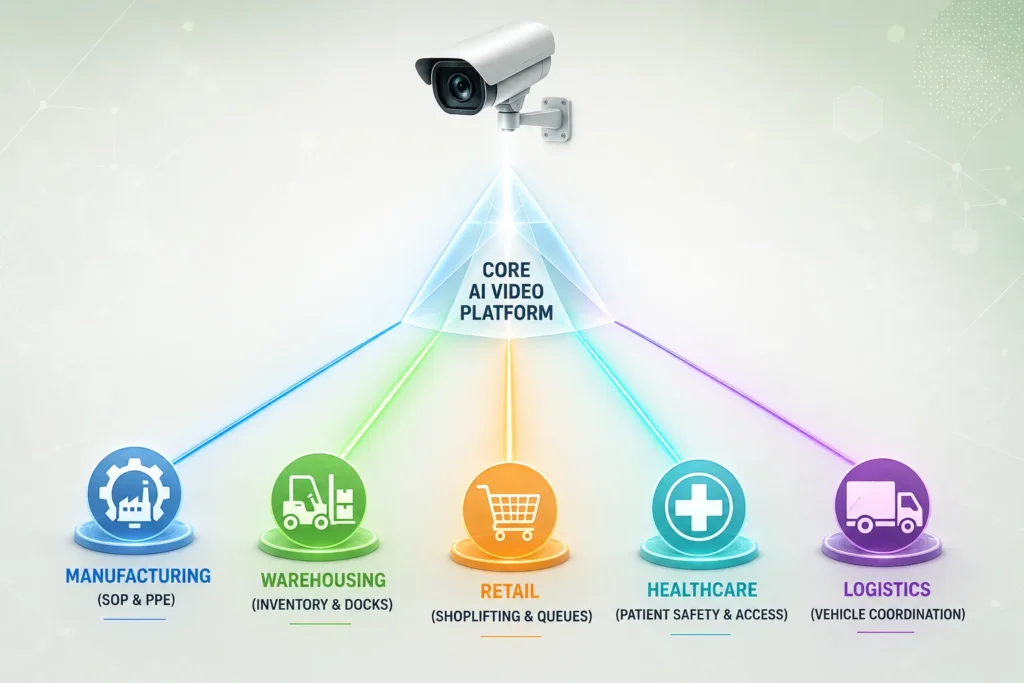
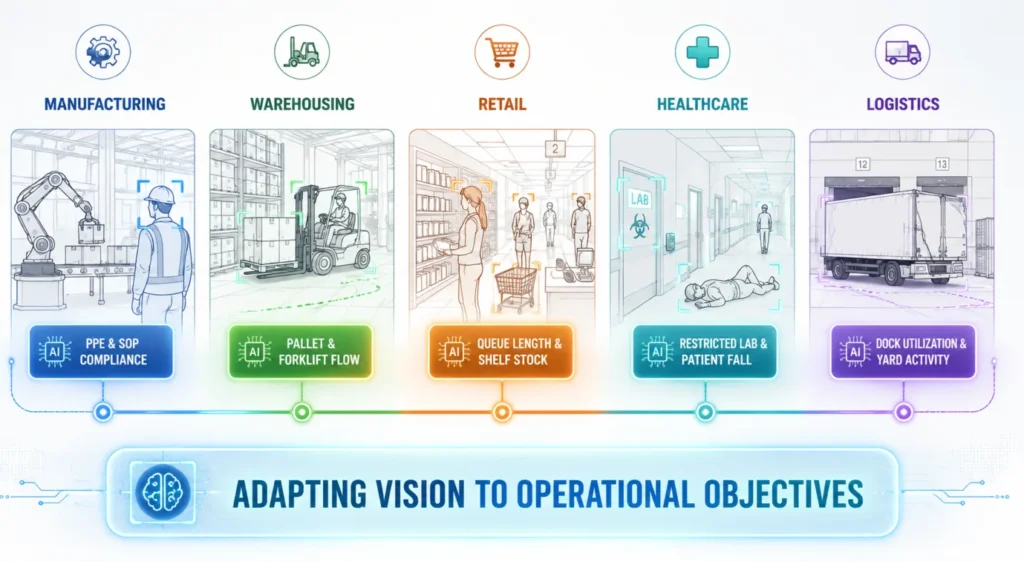
The same CCTV camera can serve very different purposes depending on where it is installed. In a manufacturing plant, it may verify production procedures. Inside a warehouse, it can monitor loading operations. A retail store may use it to identify inventory risks, while a hospital focuses on patient safety and restricted areas. The technology remains the same, but the operational priorities change with every industry.
AI Video Analytics adapts to these varying environments by interpreting workplace activities according to industry-specific objectives rather than simply recording footage. Through Computer Vision, AI Surveillance, and Edge AI, organizations can convert visual observations into operational information that supports everyday management decisions. The following examples illustrate how AI Video Analytics addresses practical challenges across different sectors.
Manufacturing: Improving Process Consistency
Manufacturing operations depend on repeatable processes, coordinated workflows, and adherence to operating procedures. Manual supervision becomes increasingly difficult as production expands across multiple lines and shifts.
AI Video Analytics can support manufacturing by monitoring:
- SOP compliance
- PPE usage
- Machine occupancy
- Assembly verification
- Material flow between workstations
- Production bottlenecks
- Restricted production zones
- Finished goods movement
Instead of relying on random inspections, production managers receive continuous visibility into how operational procedures are executed throughout the facility.
Warehousing: Managing Inventory Movement
Warehouses involve constant movement of goods, vehicles, and personnel. Maintaining visibility across receiving, storage, picking, and dispatch areas is essential for efficient warehouse operations.
Typical applications include:
- Pallet movement tracking
- Forklift route monitoring
- Loading dock supervision
- Storage area occupancy
- Inventory handling verification
- Unauthorized access detection
- Queue monitoring
- Vehicle dispatch observation
Retail: Supporting Store Operations
Retail environments present different operational priorities, where customer movement, merchandise protection, and store compliance become equally important.
AI Video Analytics can monitor:
- Shoplifting behaviour
- Billing counter activity
- High-value merchandise zones
- Shelf availability
- Customer queue length
- Employee-only areas
- Store opening and closing procedures
- Cash handling environments
Healthcare: Observing Critical Care Environments
Healthcare facilities require continuous awareness without disrupting patient care. AI Video Analytics provides an additional layer of observation across areas where safety and procedural compliance are essential.
Common healthcare applications include:
- Restricted laboratory access
- Patient fall detection
- PPE compliance
- Emergency exit monitoring
- Medical equipment availability
- Pharmacy access control
- Corridor occupancy
- Isolation area observation
Visual monitoring helps hospital employees by spotting operational issues that need to be addressed right away.
Logistics: Coordinating Transport Operations
Logistics facilities operate under strict schedules where loading accuracy, vehicle movement, and shipment coordination directly influence delivery performance.
AI Video Analytics assists by observing:
- Vehicle arrival and departure
- Dock utilization
- Trailer positioning
- Loading sequence verification
- Cargo movement
- Driver safety compliance
- Yard activity
- Dispatch area congestion
This operational visibility helps logistics managers coordinate transportation activities more effectively throughout the day.
Comparing Operational Priorities
Industry | Primary Operational Focus |
Manufacturing | Process execution and production compliance |
Warehousing | Inventory movement and storage operations |
Retail | Merchandise protection and customer-facing operations |
Healthcare | Patient safety and controlled access |
Logistics | Vehicle coordination and shipment handling |
Although every industry has different priorities, each relies on accurate operational observations to support timely decision-making.
Adapting AI to Industry Requirements
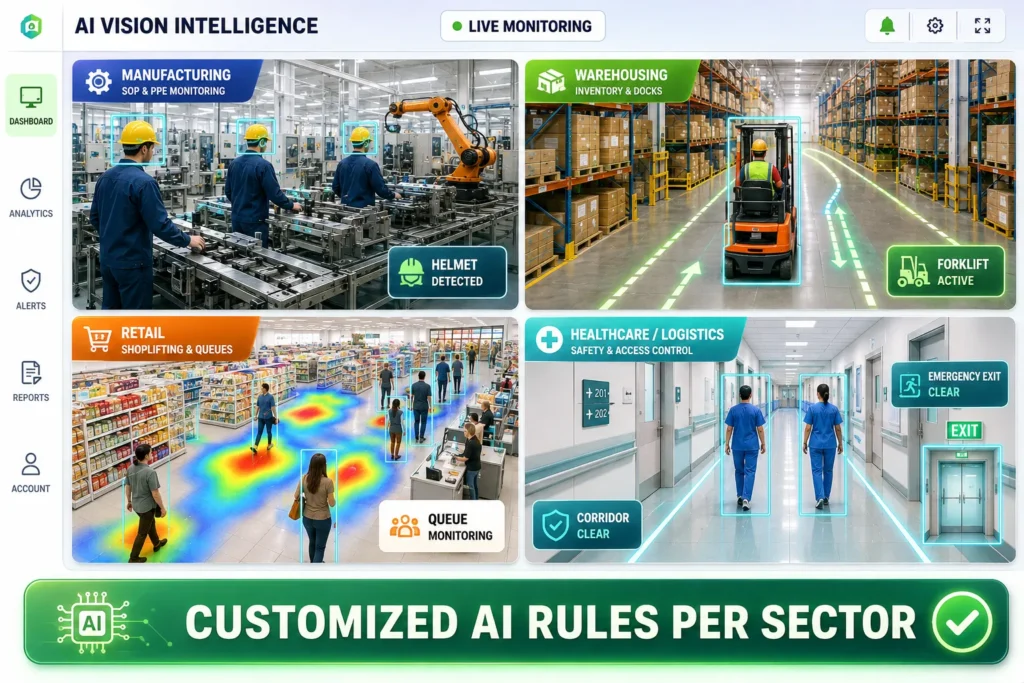
AI Video Analytics does not follow a one-size-fits-all approach. Monitoring rules are configured according to the operational responsibilities of each facility.
Examples include:
- Safety rules for industrial environments
- Inventory workflows for warehouses
- Customer behaviour analysis for retail
- Clinical access policies for hospitals
- Vehicle movement rules for logistics centres
This flexibility allows organizations to tailor monitoring according to their operational objectives instead of applying generic surveillance practices.
Turning Observations into Practical Decisions
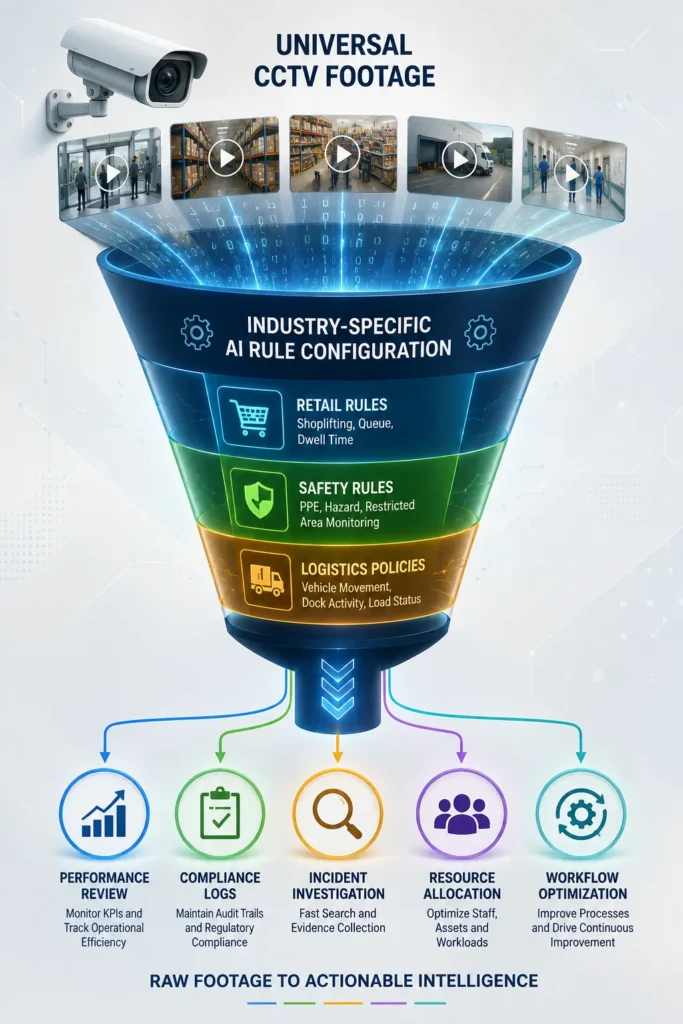
Visual observations become more valuable when they contribute to everyday management activities rather than remaining isolated events.
Organizations can use AI-generated information to:
- Review operational performance
- Identify recurring workflow issues
- Evaluate compliance trends
- Allocate supervisory resources
- Investigate operational incidents
- Improve workplace coordination
The ability to organize visual information into meaningful operational records creates a stronger foundation for planning and continuous improvement.
Operational Value Across Industries
Business Requirement | Practical Contribution |
Activity verification | Confirms whether operational procedures are being followed |
Workplace awareness | Provides visibility across critical operational areas |
Resource supervision | Helps managers understand facility activity levels |
Compliance oversight | Documents observations for operational reviews |
Incident investigation | Preserves visual evidence for analysis |
Performance evaluation | Supports management reviews using operational data |
Designing Solutions Around Operational Priorities
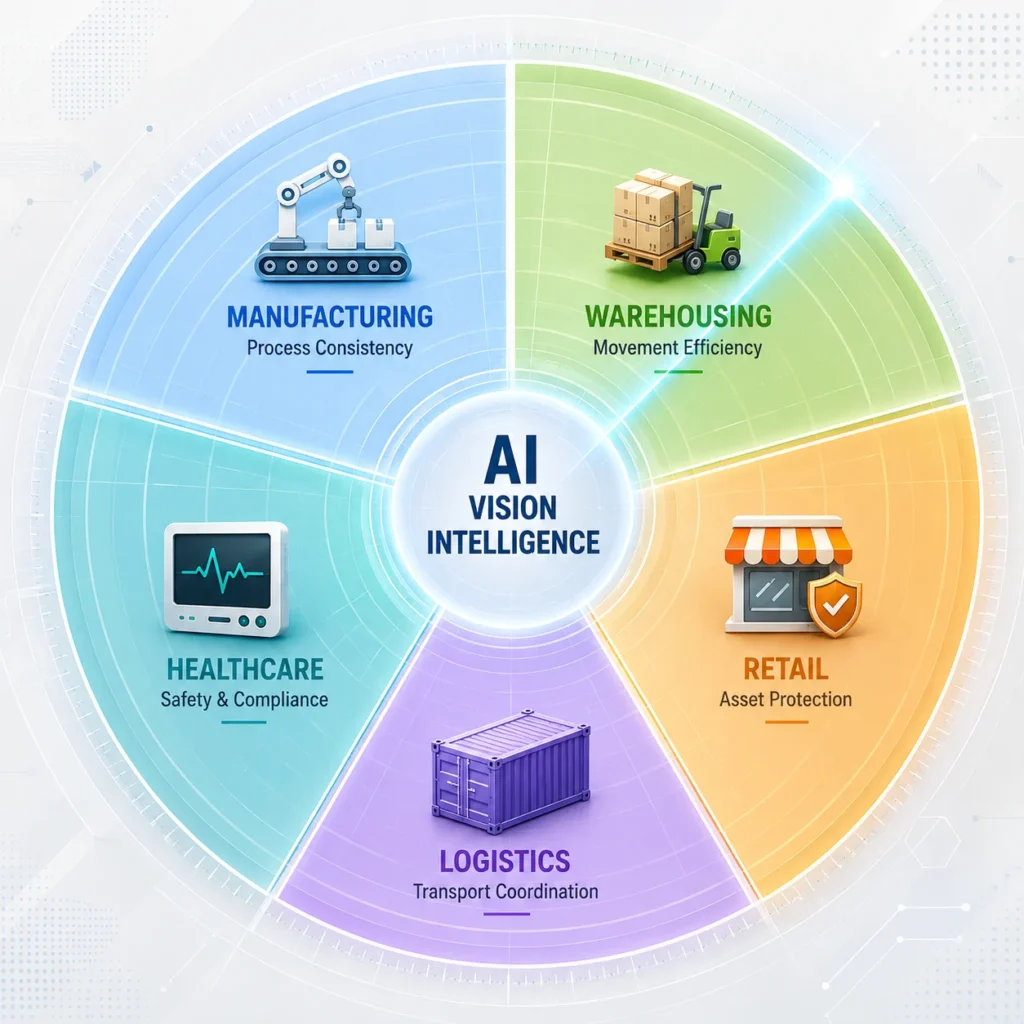
Successful AI Video Analytics deployments begin with understanding how each industry operates rather than selecting technology first. Manufacturing seeks production consistency, warehouses focus on movement efficiency, retailers protect merchandise, healthcare facilities prioritize patient safety, and logistics centres coordinate transport activities. By aligning Computer Vision, Intelligent CCTV Monitoring, Industrial AI, Edge Analytics, AI Automation, and AI Dashboards with these operational priorities, organizations create monitoring strategies that reflect the unique responsibilities of each business environment.
FAQ
Can the same AI Video Analytics platform support multiple industries?
Yes. The core platform remains the same, while monitoring rules, AI models, and reporting are configured according to each industry’s operational requirements.
Which manufacturing activities are commonly monitored using AI Video Analytics?
Manufacturing facilities frequently monitor SOP compliance, PPE usage, machine occupancy, production workflows, material movement, and safety practices.
How does AI Video Analytics assist warehouse supervisors?
It provides visibility into inventory movement, forklift operations, loading activities, storage utilization, and dispatch processes, helping supervisors review warehouse workflows more effectively.
Why do healthcare facilities use AI Video Analytics differently from retail stores?
Healthcare monitoring emphasizes patient safety, controlled access, and clinical procedures, whereas retail focuses on merchandise protection, customer activity, and store operations.