
The Complete AI SOP Compliance Monitoring Process Explained
A production line can appear to be operating normally while small procedural deviations quietly accumulate. A missing inspection step, an unlocked safety gate, or a technician skipping equipment verification may not stop production immediately, but these inconsistencies often become the root cause of quality issues, safety incidents, and compliance failures. Supervisors cannot continuously observe every activity across multiple shifts and facilities, making consistent SOP enforcement an ongoing management challenge.
AI SOP Compliance Monitoring addresses this challenge by turning existing CCTV infrastructure into a continuous process verification system. Instead of merely recording events, AI Video Analytics and Computer Vision interpret workplace activities, compare them with predefined Standard Operating Procedures (SOPs), and notify responsible teams when deviations require attention. The result is a structured workflow that supports operational discipline without increasing manual supervision.
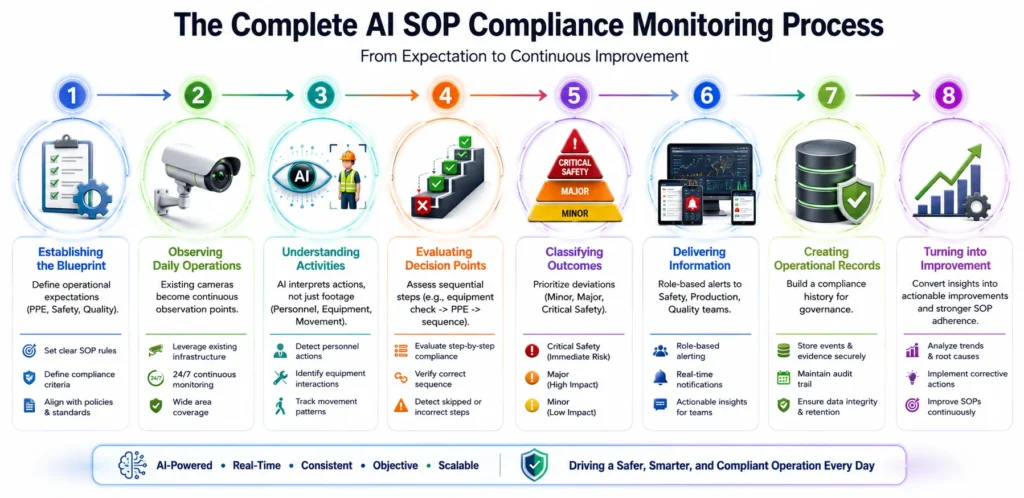
Establishing the Compliance Blueprint
Every monitoring program begins with clearly defined operational expectations. Rather than treating all activities equally, organizations identify the procedures that have the greatest impact on safety, quality, productivity, or regulatory compliance.
Typical SOPs monitored include:
- PPE usage before entering work zones
- Equipment start-up and shutdown sequences
- Material handling procedures
- Lockout/Tagout verification
- Housekeeping standards
- Loading and unloading operations
- Restricted area access
- Inspection checkpoints
This operational blueprint provides the reference against which workplace activities are evaluated.
Observing Daily Operations
Once SOPs are defined, existing CCTV cameras become continuous observation points across operational environments.
These environments may include:
- Manufacturing lines
- Assembly stations
- Warehouses
- Dispatch areas
- Utility rooms
- Chemical storage locations
- Maintenance workshops
- Logistics yards
Using Edge AI, video is processed close to the camera whenever appropriate, reducing unnecessary data movement while supporting Real-Time Analytics for operational events.
Understanding Activities Instead of Recording Footage
Traditional surveillance captures what happened. AI focuses on understanding what is happening.
Computer Vision continuously identifies:
- Personnel
- Equipment
- Tools
- Safety gear
- Vehicles
- Objects
- Movement patterns
- Workplace interactions
Instead of analysing isolated images, the system evaluates sequences of actions to determine whether a task is progressing according to the defined procedure.
Evaluating Every Operational Decision Point
Many operational tasks consist of several mandatory steps rather than a single action. AI assesses each stage independently before determining overall compliance.
Operational Checkpoint | AI Evaluation |
Required equipment available | Verified before task begins |
PPE correctly worn | Confirmed throughout the activity |
Safety barriers positioned | Checked before operation starts |
Operator follows sequence | Compared with defined SOP |
Restricted access maintained | Unauthorized entry detected |
Task completed correctly | Compliance status recorded |
This structured evaluation provides greater operational confidence than relying solely on periodic inspections.
Classifying Compliance Outcomes
Not every deviation carries the same level of operational risk. AI categorizes observations to help supervisors prioritize their response.
Examples include:
- Fully compliant activity
- Minor procedural deviation
- Critical safety violation
- Missed inspection step
- Unauthorized equipment usage
- Incorrect work sequence
- Incomplete procedure
This classification allows management teams to focus attention where intervention delivers the greatest operational value.
Delivering Information to the Right Teams
Once a deviation is confirmed, information is distributed according to organizational responsibilities instead of simply generating a generic alert.
Different teams receive different operational context:
- Safety managers receive workplace safety violations.
- Production supervisors receive process deviations.
- Quality teams receive inspection-related exceptions.
- Maintenance teams receive equipment misuse notifications.
- Security personnel receive restricted area breaches.
- Plant leadership receives summarized operational trends through AI Dashboards.
This role-based distribution reduces unnecessary notifications while improving response quality.
Creating an Operational Record That Supports Governance
Each observation becomes part of a continuously growing operational history rather than a standalone incident.
Recorded information typically includes:
- Time and location
- Camera identification
- SOP category
- Compliance status
- Supporting images
- Response actions
- Resolution time
- Department ownership
Turning Compliance into Continuous Improvement
The greatest value of SOP monitoring often emerges over weeks and months rather than during a single shift.
Operational reviews can answer practical management questions such as:
- Which procedures generate the highest number of deviations?
- Which production shift demonstrates the strongest compliance?
- Are similar issues appearing across multiple facilities?
- Which departments require additional training?
- Which operational changes have reduced recurring violations?
Business Outcomes Across Daily Operations
Management Objective | Operational Contribution |
Process consistency | Standard procedures are followed more uniformly across shifts. |
Workplace Safety | Unsafe practices are identified before they become routine. |
Quality assurance | Critical operating steps are less likely to be overlooked. |
Supervisory effectiveness | Managers spend less time on manual observation. |
Audit preparation | Compliance evidence remains readily available for review. |
Resource allocation | Training and improvement efforts focus on recurring issues. |
Building a Culture Where Procedures Matter
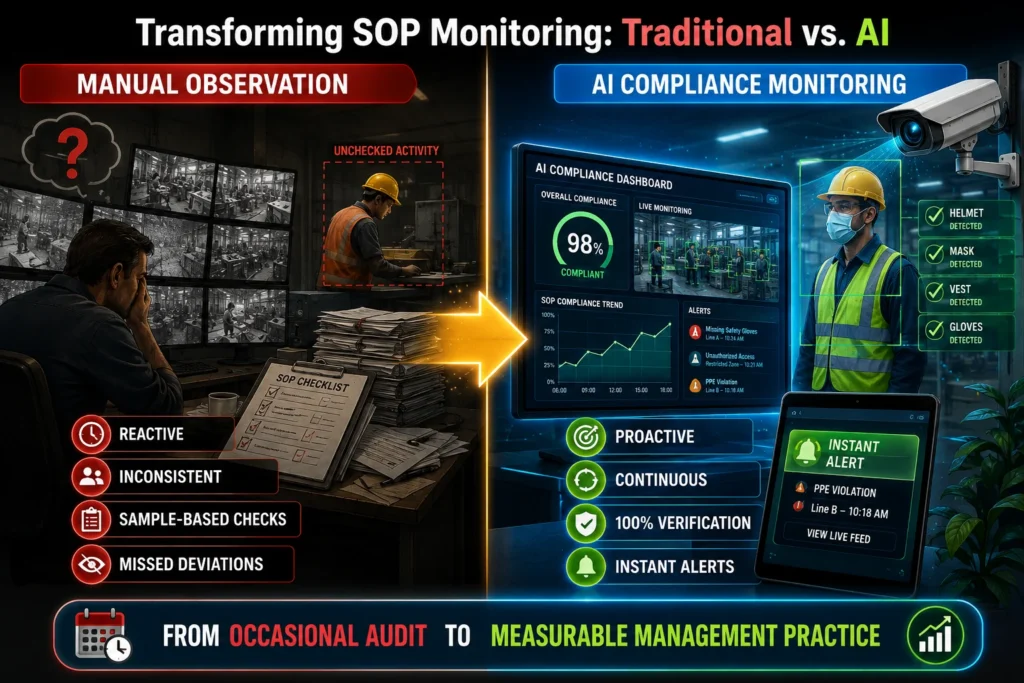
Successful operations depend as much on consistent execution as they do on well-designed procedures. Written SOPs provide direction, but lasting operational discipline comes from knowing whether those procedures are followed every day. By combining AI Surveillance, Industrial AI, Intelligent CCTV Monitoring, AI Automation, Edge Analytics, and Operational Intelligence, organizations create an environment where compliance becomes a measurable management practice rather than an occasional audit exercise.
FAQs
Can AI monitor different SOPs within the same facility?
Yes. Multiple SOPs can be configured for different production areas, departments, equipment, or operational activities.
Does AI evaluate the order of procedural steps?
Yes. AI can verify whether defined actions occur in the required sequence, depending on the configured workflow.
Can temporary contractors be included in SOP monitoring?
Yes. Compliance monitoring applies to everyone working within monitored operational areas, regardless of employment type.
How does AI distinguish between a minor deviation and a critical violation?
Organizations define severity levels during configuration based on operational risk, safety requirements, or regulatory obligations.
Which departments typically use SOP compliance reports?
Production, safety, quality, maintenance, operations, and plant management teams commonly use these reports to review performance and guide process improvements.