AI Oil & Gas Pipeline Monitoring Pipeline Integrity Intelligence
Oil and gas pipelines form the backbone of energy transportation, connecting production facilities, processing plants, storage terminals, and distribution networks across vast and often remote regions. Maintaining the integrity of these assets requires continuous awareness of operational activities, environmental conditions, maintenance practices, and external interactions that could affect pipeline performance. Pipeline Integrity Intelligence provides a comprehensive operational perspective that helps operators identify emerging risks, coordinate field operations, and protect critical energy infrastructure before issues develop into safety, environmental, or operational incidents. AI Monitoring strengthens this approach by improving visibility across the entire pipeline corridor while supporting safe, reliable, and uninterrupted energy transportation

Executive Summary
An energy infrastructure operator sought to strengthen operational visibility across an extensive oil and gas pipeline network while improving the coordination of maintenance, inspection, and security activities. Existing monitoring systems provided valuable operational data, but understanding conditions across long pipeline corridors and responding quickly to developing risks remained a challenge.
SPGS introduced a Pipeline Integrity Intelligence framework using AI Monitoring to improve awareness of pipeline corridor activities, maintenance operations, and environmental conditions. The initiative enabled earlier identification of integrity risks, improved coordination between field teams, and strengthened the protection of critical energy infrastructure without disrupting ongoing pipeline operations.
Customer Profile
Industry: Oil & Gas Pipeline Operations (Anonymous)
Project Scope
- Long-distance pipeline corridors
- Pumping and compressor stations
- Valve stations
- Right-of-way monitoring
- Remote operational sites
- Central pipeline operations centre
- Continuous 24×7 operational oversight
Operational Environment
The pipeline network extended across industrial zones, remote landscapes, environmentally sensitive areas, and utility corridors. Daily operations included routine inspections, maintenance activities, right-of-way management, contractor access, equipment servicing, and continuous transportation of energy products. Although operational systems monitored pipeline performance, maintaining comprehensive visibility into corridor activities and external conditions required a broader operational intelligence approach.
Business Challenges
- Monitoring extensive pipeline corridors.
- Protecting critical energy transportation assets.
- Improving visibility across remote operational locations.
- Detecting activities that could affect pipeline integrity.
- Coordinating inspection and maintenance teams efficiently.
- Reducing environmental and operational risks.
Supporting regulatory compliance and asset governance
Project Objectives
- Strengthen pipeline integrity management.
- Improve corridor-wide operational visibility.
- Enhance coordination of field operations.
- Reduce integrity-related operational risks.
- Improve maintenance planning.
- Protect energy transportation infrastructure.
Establish a Pipeline Integrity Intelligence framework
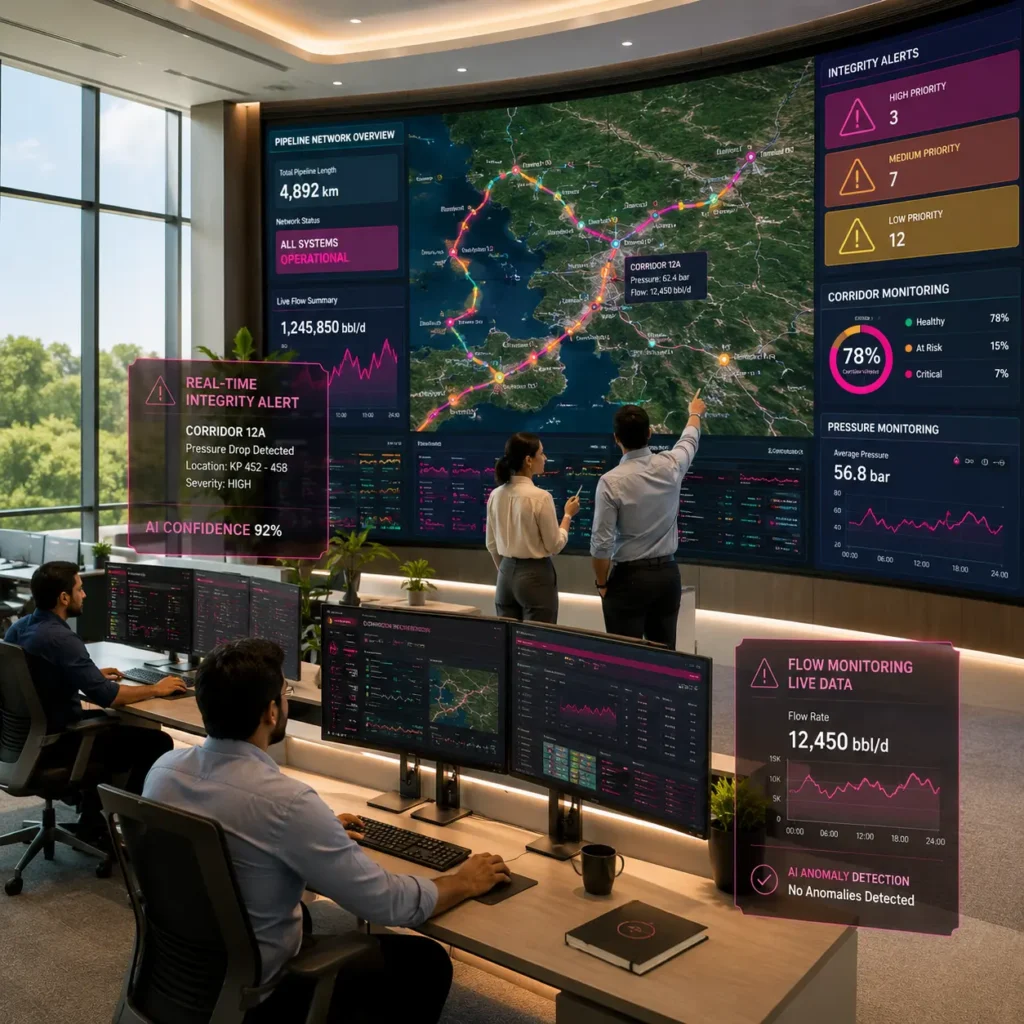
Safeguarding the Lifeline of Energy Distribution
The transformation focused on protecting the operational integrity of the pipeline corridor rather than monitoring isolated incidents. Maintenance activities, right-of-way conditions, contractor access, environmental changes, and operational workflows were viewed as interconnected elements of pipeline management. This broader operational perspective enabled field teams to recognise developing risks earlier, coordinate inspections more effectively, and initiate preventive actions before pipeline reliability, environmental protection, or energy transportation were affected.
Solution Architecture
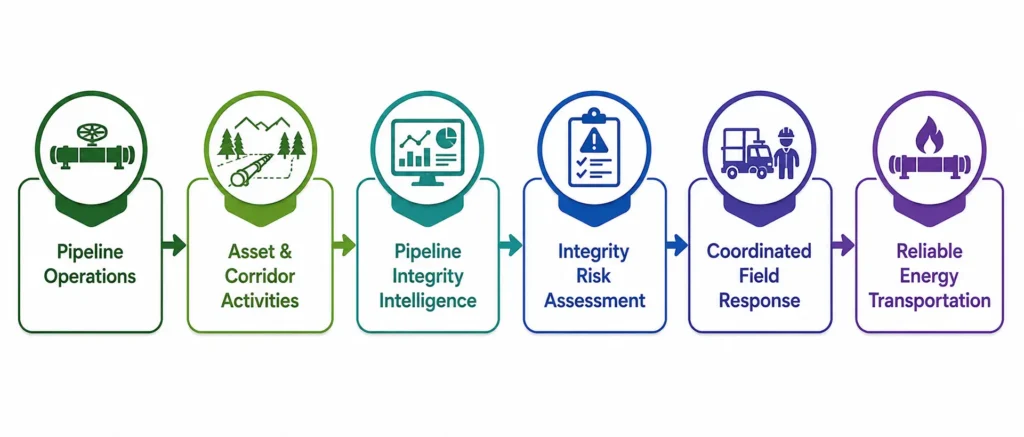
Operational Flow
Operational Technology Ecosystem
Technology | Business Contribution |
AI Monitoring | Continuous visibility across pipeline operations |
Computer Vision | Observation of corridor and field activities |
AI Video Analytics | Identification of operational anomalies |
Edge AI | Immediate analysis at remote pipeline locations |
SCADA Integration | Operational process context |
Geographic Information System (GIS) | Spatial awareness of pipeline assets |
Enterprise AI Dashboard | Network-wide operational visibility |
REST APIs | Enterprise interoperability |
Implementation Methodology
The programme began with an operational assessment of the pipeline network, right-of-way conditions, maintenance workflows, and inspection practices. Critical operational areas, including compressor stations, valve stations, access roads, environmentally sensitive locations, and remote pipeline corridors, were prioritised for phased deployment. AI Monitoring capabilities were introduced alongside existing operational systems, enabling field teams to validate alerts, refine response procedures, and integrate intelligent monitoring into routine pipeline management without interrupting energy transportation.
Enterprise Integrations
System | Business Contribution |
SCADA | Operational process monitoring |
Geographic Information System (GIS) | Pipeline location intelligence |
Enterprise Asset Management (EAM) | Maintenance planning |
ERP | Operational reporting |
Enterprise AI Dashboard | Central operational visibility |
REST APIs | Enterprise interoperability |
Business Outcomes
- Improved protection of pipeline infrastructure.
- Earlier identification of integrity-related operational risks.
- Better coordination between field and operations teams.
- Enhanced visibility across remote pipeline corridors.
- Improved maintenance planning and execution.
- Reduced environmental and operational exposure.
- Greater resilience of energy transportation operations.
- Increased confidence in pipeline asset management.
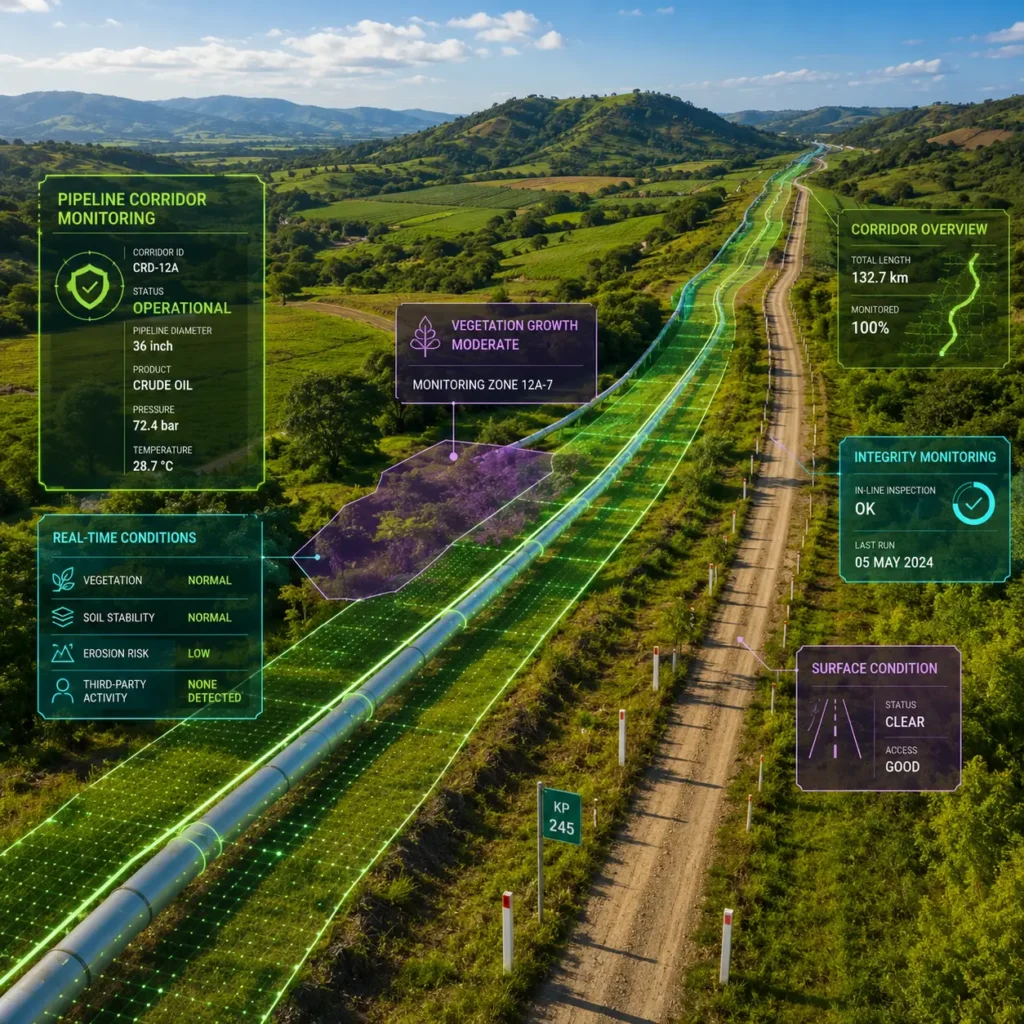
ROI & Business Value
The initiative strengthened pipeline operations by enabling earlier recognition of conditions that could affect asset integrity, operational reliability, or environmental performance. Improved coordination between field teams, enhanced visibility across distributed assets, and more informed maintenance planning reduced operational disruptions and supported efficient utilisation of inspection resources. This contributed to safer operations, improved asset longevity, and more reliable energy transportation across the pipeline network.
Future Roadmap
The operator plans to expand Pipeline Integrity Intelligence through:
- Predictive Pipeline Risk Analytics
- AI-Assisted Right-of-Way Assessment
- Vision-Language Models for Field Operations
- Digital Twin Integration for Pipeline Networks
- Autonomous Inspection Coordination
- Enterprise Pipeline Performance Dashboards
Related Industry Pages
- Oil & Gas Production
- Pipeline Transportation
- LNG Facilities
- Refineries
- Petrochemical Plants
- Energy Utilities
Related Technology Pages
- AI Monitoring
- Computer Vision
- AI Video Analytics
- Edge AI
- SCADA Integration
- GIS Analytics
- Enterprise AI Dashboards
Contact SPGS
Energy transportation depends on the continuous integrity of pipeline infrastructure. SPGS helps pipeline operators establish Pipeline Integrity Intelligence through AI Monitoring, Computer Vision, Edge AI, and intelligent operational analytics that improve corridor visibility, strengthen asset protection, support preventive maintenance, and enable safe, reliable, and resilient pipeline operations.