
Smart Warehouse Monitoring Using AI, Edge Computing, and Industrial IoT Integration
Business Background
A leading logistics and distribution enterprise operating multiple warehouses wanted to improve operational efficiency without replacing its existing Warehouse Management System (WMS) and automation infrastructure. While inventory accuracy and order management were well controlled, warehouse leaders recognised that physical operations often behaved differently from what business systems reported.
The objective was to understand how warehouse activities evolved throughout the day and identify operational changes before they affected productivity, customer commitments, or warehouse throughput.
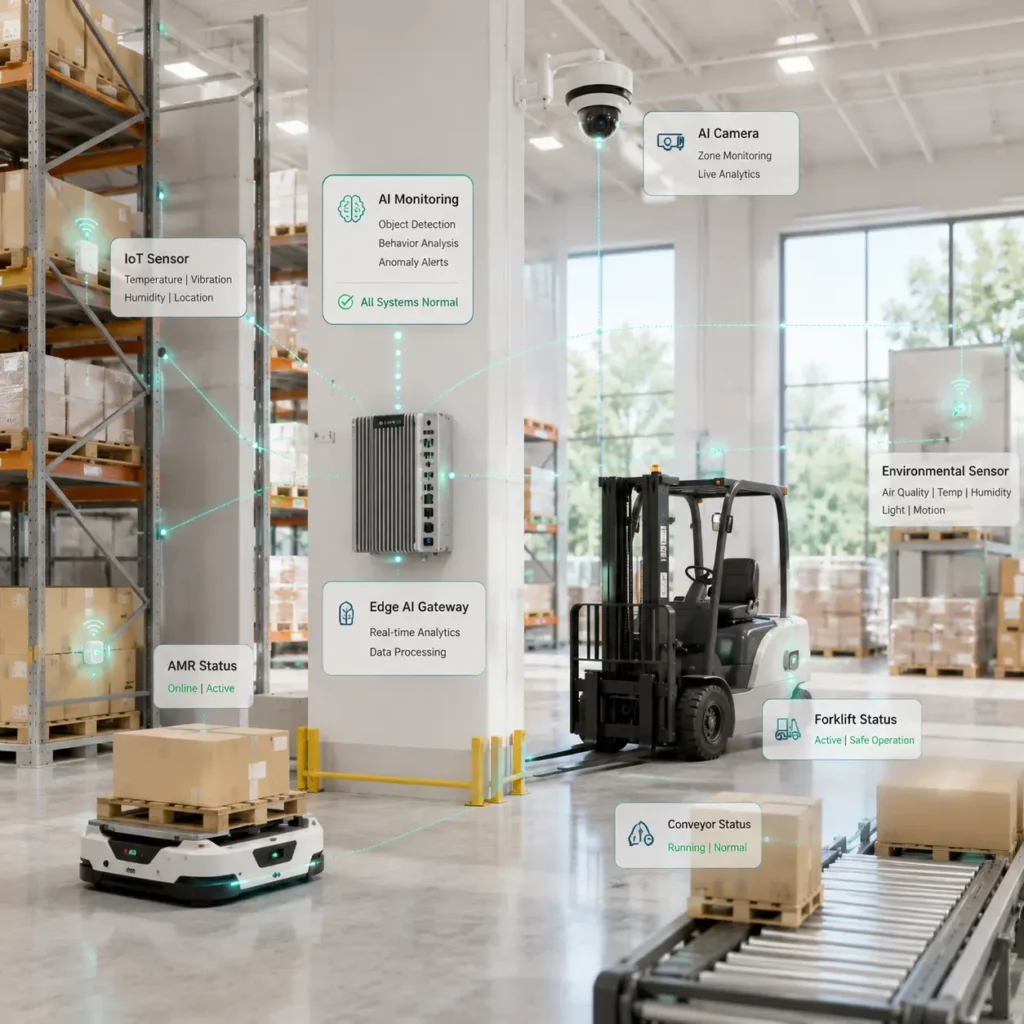
The Warehouse as a Living Operational System
Inbound deliveries trigger unloading operations. Forklifts transport materials to storage locations. Picking teams prepare customer orders while replenishment activities maintain inventory availability. Packing stations, staging areas, and loading docks work together to maintain continuous order fulfilment.
When this operational rhythm changes, delays begin to spread across the warehouse. Congestion develops, travel distances increase, equipment waits for work, and dispatch schedules become increasingly difficult to maintain.
Although traditional warehouse systems recorded completed transactions, they could not explain how operational behaviour was changing in real time.
Why Traditional Monitoring Was No Longer Enough
Warehouse managers could measure productivity using reports generated by the WMS and ERP systems, yet several operational questions remained unanswered.
- Why did congestion repeatedly occur in specific warehouse zones?
- Which travel routes created unnecessary forklift movement?
- Why were some loading docks consistently overloaded while others remained underutilised?
- How did workforce movement affect warehouse flow?
- Which operational activities disrupted receiving and dispatch balance?
- Where did idle time begin before productivity declined?

SPGS Warehouse Flow Intelligence Platform
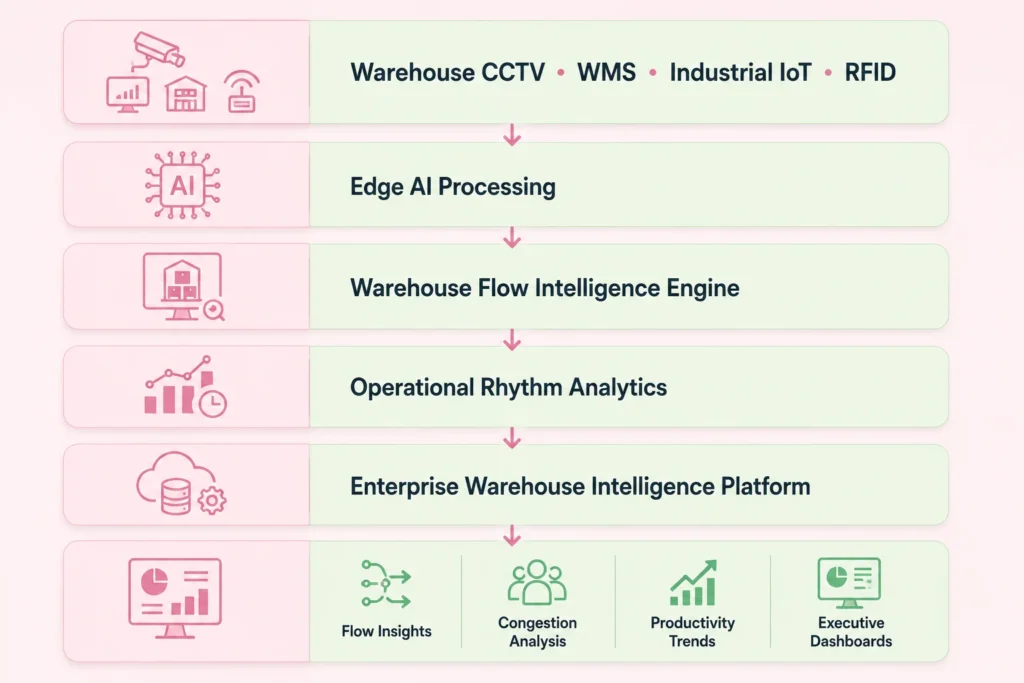
SPGS implemented a Warehouse Flow Intelligence Platform that combined AI Video Analytics, Computer Vision, Edge Computing, Industrial IoT, Smart CCTV, RFID, and warehouse operational systems.
Instead of analysing isolated activities, the platform continuously interpreted how people, vehicles, equipment, inventory, and operational zones interacted throughout the warehouse.
Edge AI processed events locally to identify congestion, travel inefficiencies, idle resources, queue formation, and workflow interruptions. Industrial IoT supplied equipment information, while WMS and ERP systems contributed inventory status and business priorities.
Technology Ecosystem
Operational Source | Business Contribution |
Smart CCTV | Continuous warehouse observation |
Computer Vision | Movement and activity recognition |
Edge AI | Immediate operational analysis |
Industrial IoT | Equipment status and environmental data |
Warehouse Management System | Inventory and workflow context |
ERP | Order priorities and business impact |
RFID | Asset location tracking |
AI Analytics | Warehouse flow interpretation |
Enterprise Dashboard | Operational performance insights |
Reference Architecture
Operational Rhythm Intelligence
Deployment Strategy
Implementation began with a detailed assessment of warehouse operations, including receiving docks, storage aisles, picking zones, replenishment routes, packing stations, staging areas, and dispatch locations.
Baseline operational patterns were established to define normal warehouse behaviour. AI models were then configured to recognise changes in movement, traffic density, resource utilisation, and operational flow.
Existing warehouse applications remained unchanged while the intelligence platform continuously enriched operational information with behavioural insights. This allowed multiple warehouse facilities to measure operational rhythm using the same enterprise-wide framework.
AI Intelligence Capabilities
Operational Focus | AI Capability |
Receiving Operations | Dock activity analysis |
Material Movement | Pallet and inventory flow tracking |
Equipment Activity | Forklift movement analysis |
Congestion Management | Queue and bottleneck detection |
Workforce Behaviour | Movement pattern analysis |
Storage Operations | Space utilisation assessment |
Dispatch Activities | Loading efficiency monitoring |
Warehouse Rhythm | Workflow continuity analysis |
Enterprise Connectivity
The platform’s seamless integration with the company’s current operating technology.
Connected systems included:
- Warehouse Management System (WMS)
- ERP
- Smart CCTV
- AI Video Analytics
- Computer Vision
- Industrial IoT Platforms
- RFID Infrastructure
- Fleet Management Systems
- MQTT Communication Services
- Enterprise AI Dashboards
Business Impact
The project enabled warehouse managers to evaluate warehouse health through operational rhythm rather than isolated productivity measurements.
Key improvements included:
- Greater consistency across receiving, storage, picking, packing, and dispatch operations.
- Earlier identification of congestion before service levels were affected.
- Improved utilisation of forklifts, loading docks, and warehouse space.
- Better coordination between inbound and outbound activities.
- Reduced unnecessary travel across operational zones.
- More balanced workforce deployment throughout each shift.
- Increased predictability of warehouse operations.
- Enterprise-wide visibility across multiple warehouse facilities.
Business Value Achieved
The primary business benefit was the ability to maintain operational rhythm across the warehouse.
Earlier recognition of workflow disruption improved resource utilisation, reduced waiting time, balanced operational workloads, and strengthened dispatch reliability. Existing warehouse infrastructure delivered greater value because decisions were based on live operational behaviour rather than historical transaction reports alone.
Project Insights
One of the most significant findings was that warehouse efficiency is determined by how smoothly operational activities interact, rather than by the performance of individual tasks.
Receiving, storage, picking, replenishment, packing, and dispatch are interconnected processes. Measuring their collective rhythm provided earlier warning of operational imbalance and supported more informed decision-making across warehouse operations.
Future Vision
The organisation plans to extend the platform with predictive congestion forecasting, Digital Twin warehouse simulation, AI-assisted workforce planning, autonomous forklift coordination, Vision-Language Models (VLMs) for operational investigations, adaptive dock scheduling, cross-site warehouse benchmarking, and predictive warehouse flow optimisation.
Industry Applications
- Warehousing & Logistics
- Distribution Centres
- E-commerce Fulfilment
- Manufacturing Warehouses
- Cold Storage Facilities
- Third-Party Logistics (3PL)
- Supply Chain Operations
Related Technologies
- AI Video Analytics
- Computer Vision
- Edge Computing
- Industrial IoT
- Smart CCTV
- RFID Integration
- Warehouse Management Systems
- Enterprise AI
- Operational Intelligence
- Intelligent Warehouse Monitoring
Let’s Build Smarter Warehouse Operations
SPGS enables warehouse and logistics organisations to move beyond traditional monitoring by introducing Operational Rhythm Intelligence. Through the integration of AI Video Analytics, Computer Vision, Edge Computing, Industrial IoT, Smart CCTV, RFID, and Warehouse Management Systems, warehouse leaders gain continuous insight into material flow, operational behaviour, and resource utilisation. The result is a more balanced, predictable, and resilient warehouse operation that improves performance while making full use of existing technology investments.