
Reducing Equipment Downtime Through Predictive Maintenance Using AI, IoT Sensors, and Computer Vision
1. Customer Profile
Industry: Process Manufacturing
Customer: Multi-Plant Industrial Manufacturer (Anonymous)
The customer operates continuous manufacturing facilities where production depends on the reliable performance of pumps, compressors, conveyors, mixers, motors, heat exchangers, and utility equipment. Although the plants had invested in SCADA, PLCs, CMMS, and Industrial IoT sensors, maintenance activities were still largely driven by predefined service intervals and reactive inspections. The organisation wanted to improve equipment reliability without replacing existing automation infrastructure.
2. Operational Environment
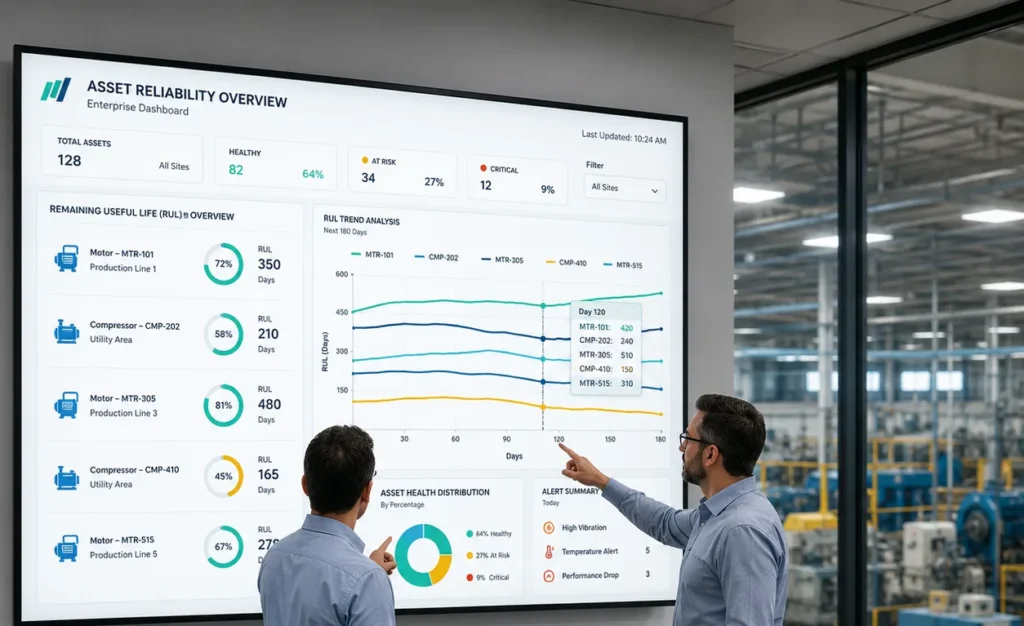
Every critical asset leaves behind a behavioural signature. A motor may begin drawing slightly higher current, a pump may generate subtle vibration changes, a conveyor may develop minor belt misalignment, or an operator may repeatedly inspect the same machine during a shift. Individually, these observations rarely trigger maintenance action, but together they reveal how equipment health is evolving.
The client acknowledged that unexpected equipment breakdowns were uncommon. The challenge was not collecting more data, it was recognising gradual behavioural changes before they disrupted production.
3. Business Challenges
The maintenance team relied on SCADA alarms, periodic inspections, maintenance history, and sensor readings to assess equipment health. However, each source described only one aspect of asset performance.
Temperature sensors identified overheating, vibration sensors detected mechanical changes, operators reported abnormal observations, and CCTV footage captured visual conditions. These independent information sources rarely formed a complete picture, making it difficult to distinguish routine variations from developing equipment issues.
As a result, some components were serviced earlier than necessary, while others continued operating until unexpected failures interrupted production.
4. SPGS Solution
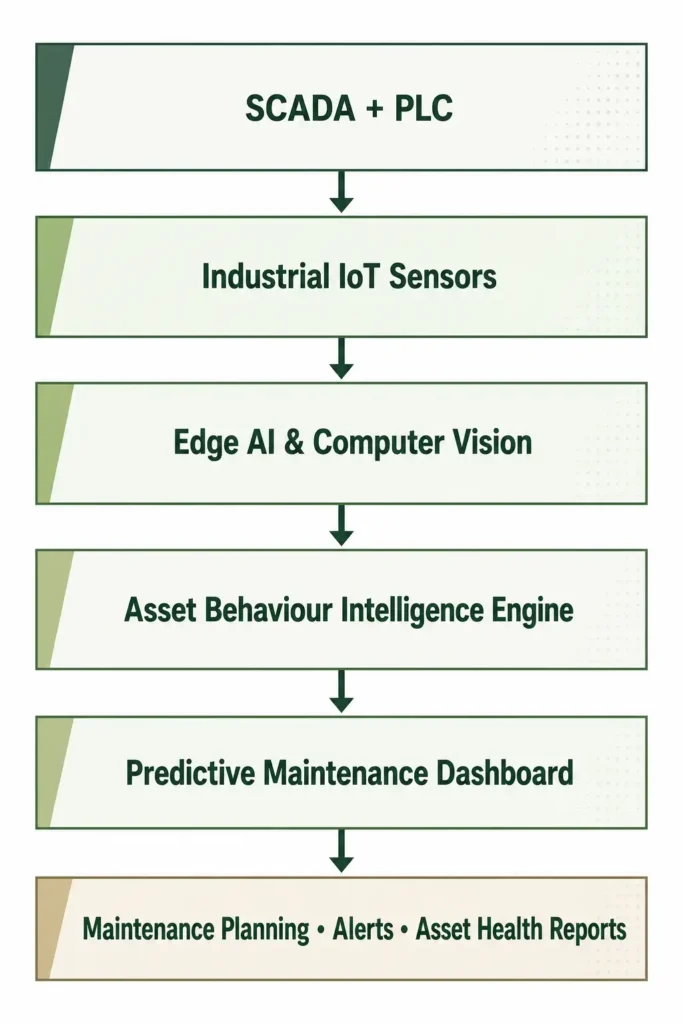
SPGS developed an Asset Behaviour Intelligence platform that continuously observed equipment from multiple perspectives.
Instead of treating SCADA, Industrial IoT, and Computer Vision as separate technologies, the platform synchronised process values, sensor measurements, and visual observations into a unified equipment behaviour profile.
Edge AI processed live video close to the equipment, IoT devices supplied environmental and operational measurements, and SCADA provided process context. By correlating these inputs, the platform highlighted behavioural deviations that conventional maintenance methods often overlooked.
Maintenance teams no longer evaluated isolated alarms—they assessed the overall condition of each asset.
5. Technology Stack
Technology | Operational Purpose |
Edge AI | Local AI inference near equipment |
Computer Vision | Visual equipment monitoring |
Industrial IoT | Vibration, temperature and environmental sensing |
SCADA | Process operating conditions |
PLC | Equipment operating status |
MQTT | Real-time event communication |
OPC UA | Industrial interoperability |
Cloud AI | Enterprise asset analytics |
NVIDIA Jetson | Edge computing platform |
TensorRT | GPU optimisation |
Intel OpenVINO | CPU acceleration |
ONNX Runtime | AI model deployment |
6. Solution Architecture Diagram Asset Behaviour Intelligence Flow
7. Implementation Methodology
Rather than selecting equipment based solely on replacement value, the project began by identifying assets whose failure would have the greatest operational impact.
Critical equipment was prioritised, sensor information was synchronised with process data, and Computer Vision models were configured to monitor visible indicators such as leaks, abnormal movement, smoke, conveyor alignment, rotating equipment, and maintenance activities. Prior to the introduction of predictive models, behaviour baselines were developed so that maintenance teams could compare future observations to typical operating patterns.
8. AI Models & Video Analytics Features
The platform used several AI models to track the behaviour of the equipment.
Asset Category | AI Capability |
Motors | Thermal condition observation |
Pumps | Leak detection |
Conveyors | Belt alignment monitoring |
Compressors | Visual equipment inspection |
Rotating Equipment | Abnormal motion detection |
Utility Areas | Smoke and fluid leak detection |
Maintenance Zones | Tool and personnel activity monitoring |
Production Lines | Equipment occupancy and operating status |
9. System Integrations
The solution integrated with existing operational platforms.
- SCADA
- PLC
- CMMS
- ERP
- Industrial IoT Gateways
- MQTT Brokers
- OPC UA Servers
- REST APIs
Instead of replacing existing maintenance workflows, the platform enriched them with continuous operational intelligence.
10. Business Outcomes & KPIs
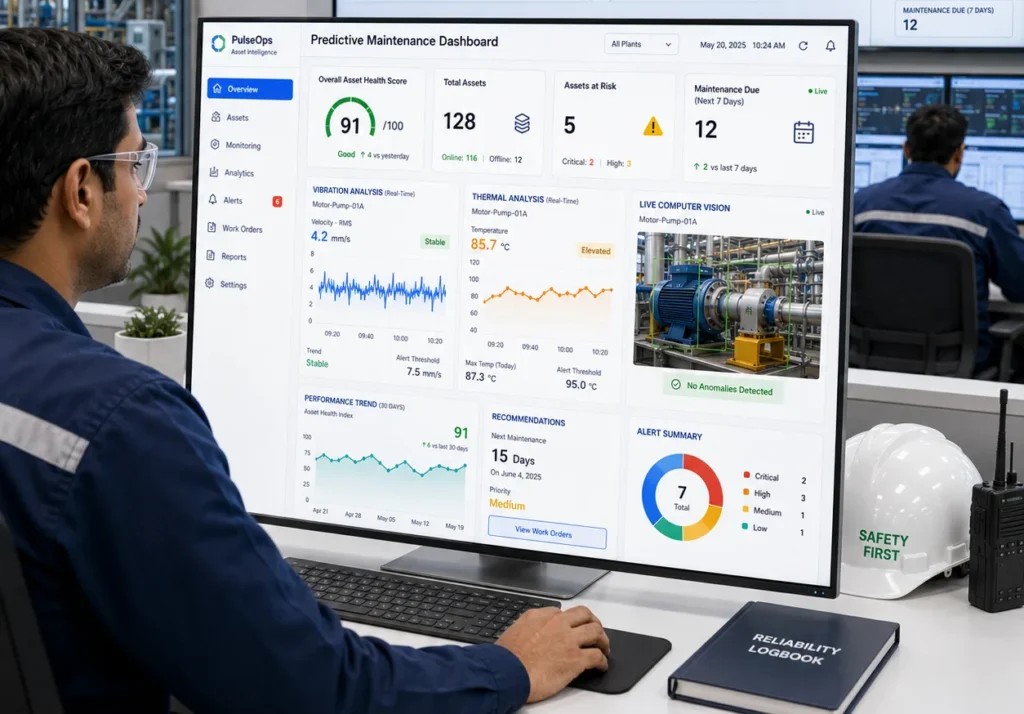
The deployment changed how maintenance priorities were established.
Rather than responding to individual alarms, engineering teams evaluated behavioural patterns across multiple information sources before scheduling maintenance activities.
Key outcomes included:
- Improved visibility into equipment condition.
- Better maintenance prioritisation.
- Reduced unplanned production interruptions.
- Earlier identification of developing equipment issues.
- Improved coordination between operations and maintenance.
- More effective utilisation of maintenance resources.
11. ROI & Cost Savings
Business value was achieved by improving maintenance decision quality rather than increasing maintenance activity.
The customer extended the value of existing SCADA systems, Industrial IoT sensors, and CCTV infrastructure while reducing unnecessary inspections and improving equipment availability. Maintenance planning became increasingly data-driven, supporting higher production continuity and better utilisation of engineering resources.
12. Lessons Learned
The project demonstrated that equipment rarely fails without exhibiting measurable behavioural changes. Combining process information, sensor measurements, and visual observations provided a broader understanding of asset health than any individual monitoring system could deliver. Success depended on recognising relationships between multiple indicators instead of reacting to isolated events.
13. Future Enhancements
The manufacturer plans to expand the platform with Digital Twin integration, AI-assisted root cause analysis, remaining useful life estimation, automated maintenance recommendations, Vision-Language Models (VLMs) for engineering support, and enterprise-wide asset benchmarking across multiple production facilities.
14. Related Industry Pages
- Predictive Maintenance for Process Manufacturing
- Industrial AI for Smart Factories
- AI Solutions for Asset Reliability
- Manufacturing Equipment Monitoring
- Enterprise Operational Intelligence
15. Related Technology Pages
- Edge AI
- Computer Vision
- Industrial IoT
- Predictive Maintenance
- SCADA Integration
- MQTT
- OPC UA
- NVIDIA Jetson
- Enterprise AI Dashboards
16. Contact SPGS
SPGS helps manufacturers transform conventional maintenance programmes into intelligent asset management systems by combining Edge AI, Computer Vision, Industrial IoT, and SCADA. By understanding how equipment behaves—not just when it fails—organisations can improve maintenance planning, reduce production interruptions, and build more resilient manufacturing operations.